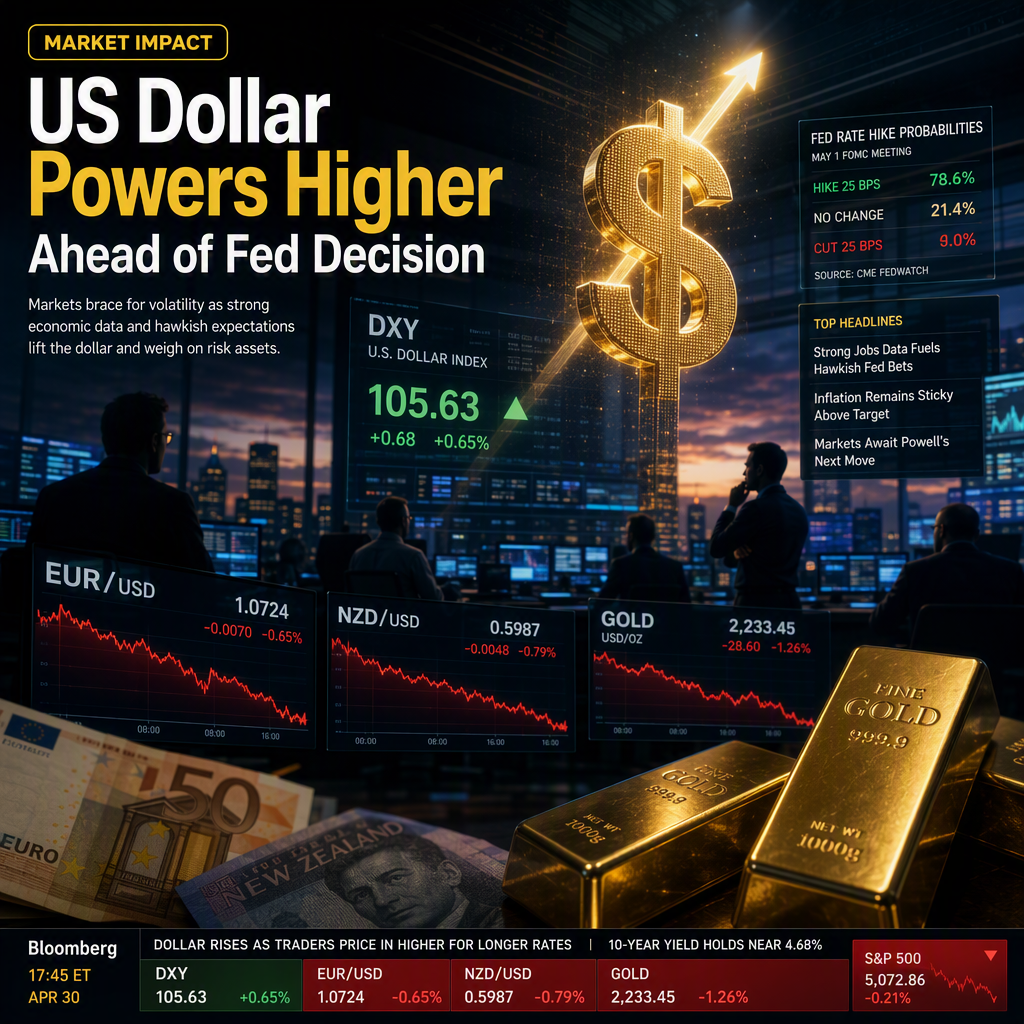
On Tuesday, the US Dollar Index (DXY) held firm near a two-week high, trading around 99.66 and up 0.17% on the day, as markets prepared for the Federal Reserve’s monetary policy decision scheduled for Wednesday [3][4]. The DXY’s strength was further confirmed by a 0.19% increase, with technical analysis showing the index reclaiming the 200-day SMA at 99.13 and facing resistance between 99.80 and the psychological 100.00 mark [3][4]. Market participants are nearly fully pricing in a 25-basis-point Fed rate hike, with the CME FedWatch Tool placing the probability at 92% [3] and Prime Terminal reporting odds of 95% for the hike to 3.75%-4% [4]. For the October and December meetings, the odds rise to 97% and 99%, respectively [4].
The Euro (EUR/USD) extended its losses against the US Dollar, sliding below the 100-day SMA at 1.1555 and trading at 1.1548, just above the 50-day SMA of 1.1530 [1]. The bearish momentum, as indicated by the RSI, suggests sellers are strengthening, with downside targets at 1.1500, 1.1450, and the July 28 swing low at 1.1353 [1]. The Euro was the strongest against the Japanese Yen but weakened against the US Dollar by 0.05% [1].
Similarly, the New Zealand Dollar (NZD/USD) tumbled for the second consecutive day, down 0.37% as risk appetite soured and high energy prices pushed expectations for further Fed tightening [2]. NZD/USD traded at 0.5757 after touching a two-month low of 0.5750, breaking below the 0.5800 level and the July 29 cycle low at 0.5761 [2]. The RSI indicated continued bearish momentum, with key support levels at 0.5750, 0.5700, and the July 7 low of 0.5672 [2]. The NZD was the strongest against the Japanese Yen but weakened against the US Dollar by 0.34% [2].
Gold (XAU/USD) prices were capped by resistance at the 100-day SMA at $4,328, trading at $4,295, down 0.06% [4]. Elevated US bond yields, with the 10-year Treasury yield surpassing 5% for the first time in nearly 19 years, and broad US Dollar strength weighed on the non-yielding metal [4]. The Houthis' attack on the Saudi Arabia East-West Oil pipeline pushed energy prices higher, contributing to inflation fears and further supporting expectations for Fed tightening [4]. Gold is poised to consolidate around $4,300, with the RSI bearish but not decisive, suggesting further sideways trading [4].
Analysts from Scotiabank and TD Securities noted that swaps are pricing in more than 90bps of Fed tightening by next summer, and that a 25bp rate hike is almost fully priced in [3]. TD Securities warned of potential knee-jerk weakness in the USD if the Fed’s guidance is dovish, while a rate hold would be a big surprise and could push the USD lower [3]. Conversely, hawkish projections or signals of additional hikes could extend the USD rally, with a sustained break above 100 on the DXY confirming stronger bullish momentum [3].
CONCLUSION
The US Dollar’s strength ahead of the Fed decision has pressured major currencies and commodities, with EUR/USD and NZD/USD breaking key support levels and Gold struggling beneath resistance. Markets are nearly fully pricing in a 25bp Fed rate hike, and further USD gains depend on hawkish guidance or economic projections. The overall sentiment is cautiously bullish for the USD, with high market impact expected from the upcoming Fed announcement.