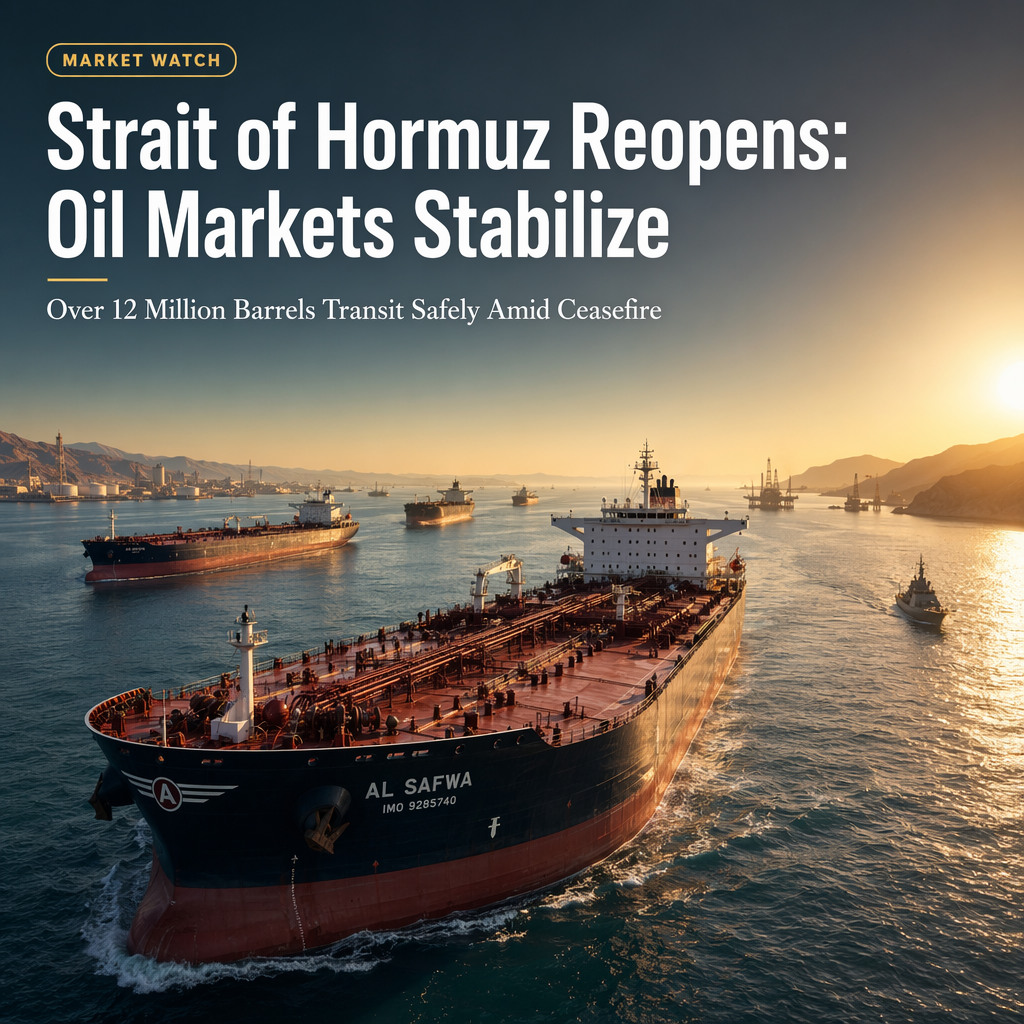
Oil prices stabilized following the reopening of the Strait of Hormuz, a critical shipping chokepoint, after US Vice President JD Vance confirmed that tankers carrying over 12 million barrels had successfully crossed overnight [1]. Brent crude futures, the international benchmark, closed at $79.85 per barrel, up 30 cents, while West Texas Intermediate (WTI) futures settled at $76.60 per barrel, down 19 cents [1]. The market's attention remains focused on the potential for renewed disruptions or escalation risks in the region, which could impact supply and price volatility [1].
The reopening of the Strait has eased immediate supply concerns, but UOB Global Economics & Markets Research notes that markets are likely to remain sensitive to any further developments or geopolitical tensions around the area [1]. Additionally, the US-Iran ceasefire deal has contributed to dialing back inflation concerns and exerted downward pressure on oil prices [1].
Other market factors include hawkish policy signals from the Federal Reserve and a stronger US dollar, which have pressured gold prices lower [1]. US financial markets are closed on June 19 in observance of the Juneteenth federal holiday, but oil market participants continue to monitor geopolitical developments, US dollar movements, and yields for near-term direction [1].
CONCLUSION
The safe passage of over 12 million barrels through the Strait of Hormuz has steadied oil prices, alleviating immediate supply concerns. However, markets remain vigilant for any renewed disruptions or escalation risks in the region, with geopolitical developments and US monetary policy continuing to influence near-term market direction.