
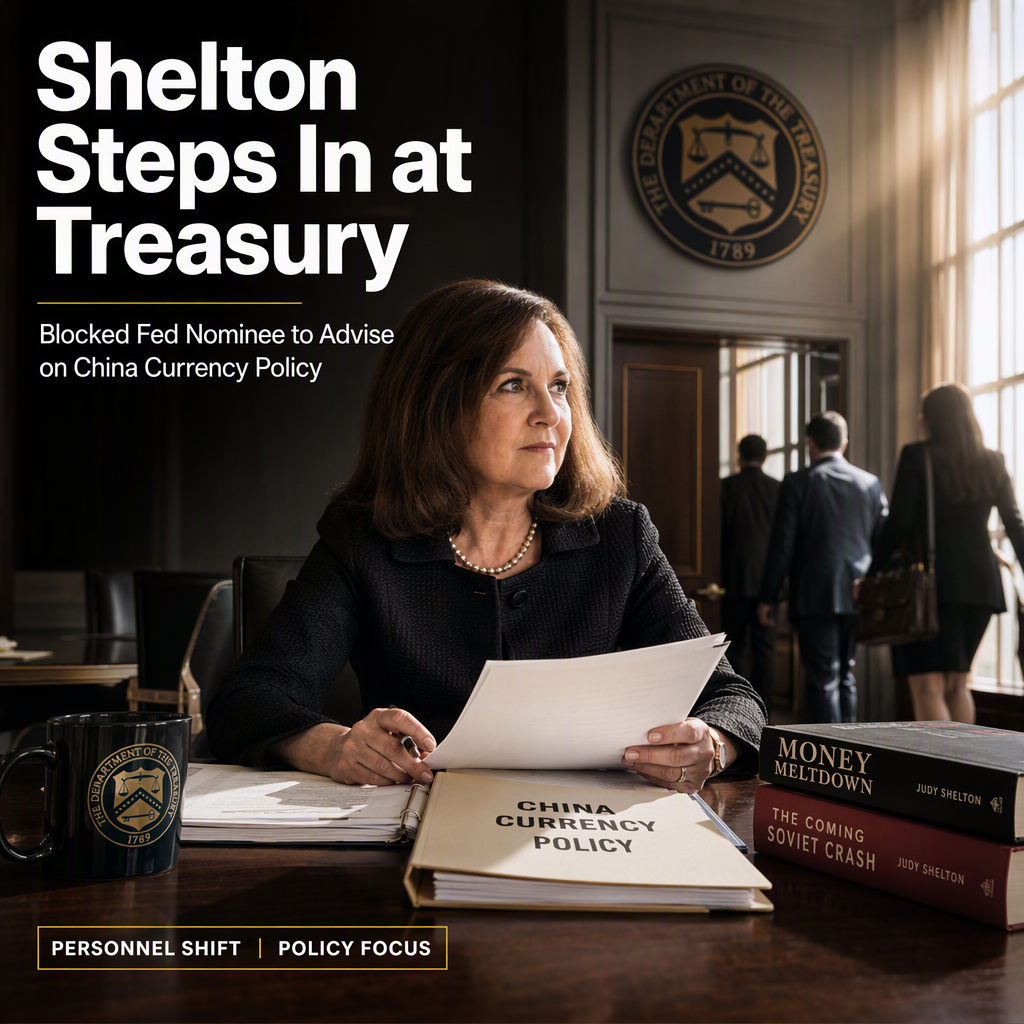
Judy Shelton, whose nomination to the Federal Reserve was previously blocked by the Senate, has been appointed as a counselor to Treasury Secretary Scott Bessent, according to a statement the Treasury is set to release later Friday [1]. Shelton will advise Bessent specifically on currency policy, with a particular focus on evaluating financial conditions in China [1]. The Treasury highlighted Shelton's expertise in analyzing internal monetary and financial conditions of nations and their impact on exchange rates, referencing her career and published works such as 'Money Meltdown' and 'The Coming Soviet Crash' [1].
Shelton's appointment comes amid apparent turmoil at the Treasury Department, as a recent Wall Street Journal story cataloged seven Senate-confirmed officials who have left the department through the end of August, with only one position filled to date [1]. The advisory role Shelton will occupy does not require Senate approval, similar to the recent appointment of David Zervos, former chief market strategist at Jeffries, who was also named counselor by Bessent [1].
Shelton's controversial economic views, including her support for a return to the gold standard and questioning the necessity of the U.S. central bank, were cited as reasons for bipartisan Senate opposition to her 2019 Fed nomination by President Donald Trump [1]. While Shelton is not recognized as a China expert, her appointment signals a focus on currency issues related to China at a time of personnel changes within the Treasury [1].
No explicit market reactions or analyst opinions were mentioned in the article. However, the appointment of Shelton, known for her unconventional monetary views, may attract attention from market participants given the ongoing changes at the Treasury and the focus on China-related financial conditions [1].
CONCLUSION
Judy Shelton's appointment as counselor to Treasury Secretary Bessent marks a notable personnel shift, especially given her previously blocked Fed nomination and controversial monetary views. While immediate market reactions were not discussed, her focus on currency policy and China, amid broader Treasury turnover, could have medium-term implications for financial policy direction.