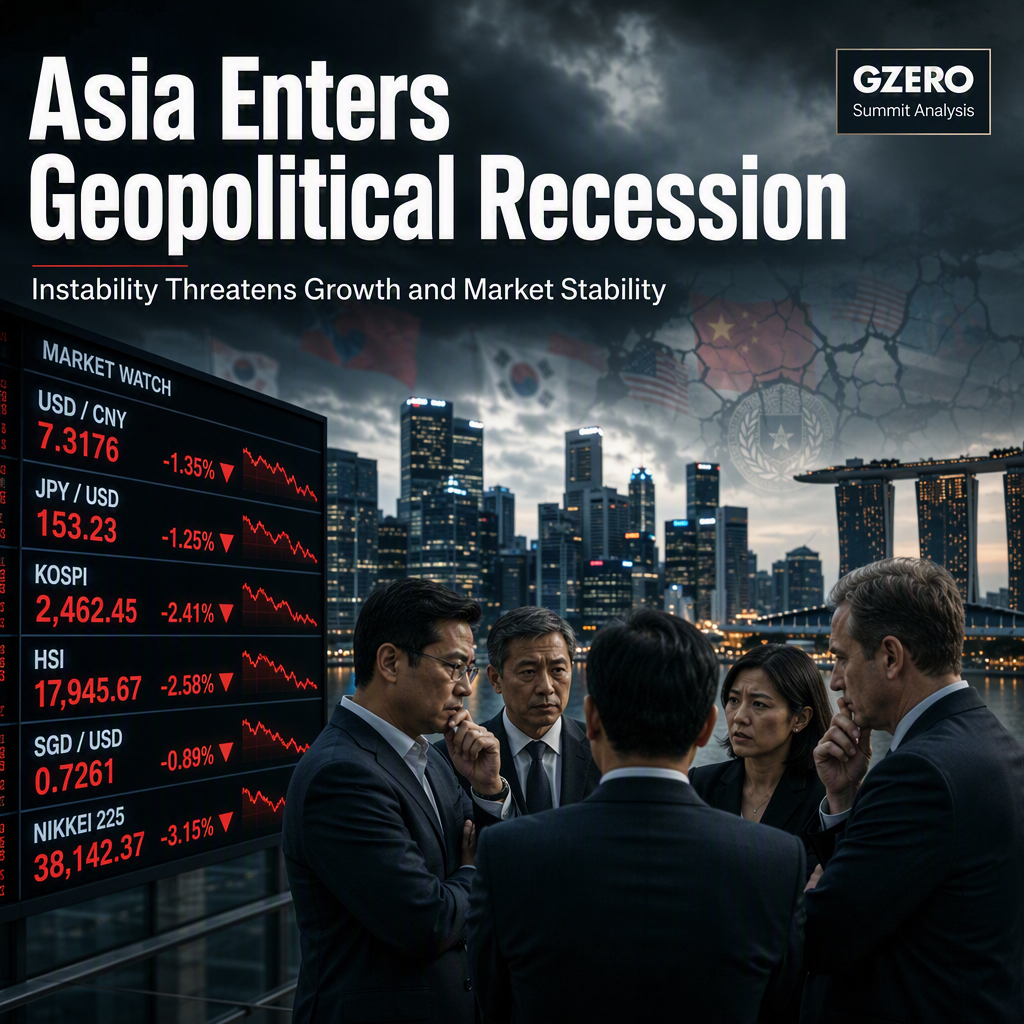
Eurasia Group CEO Maziar Minovi warned at the GZERO Summit Asia in Singapore that Asia is entering a 'geopolitical recession,' marked by long-term political and economic instability [1]. Minovi emphasized that the current global environment is defined by fragmented alliances and weakened multilateral institutions, which are elevating risks for investors and corporations operating in the region [1]. He stated, 'We are entering a geopolitical recession, where the world order is less stable, and the prospects for economic growth are threatened by political tensions' [1].
The analysis from Eurasia Group suggests that Asia's economies may experience slower growth rates and increased capital outflows as investors seek safer havens in response to escalating geopolitical risks [1]. The summit highlighted that shifting political alignments and trade disruptions could impact currency valuations, equity markets, and capital flows, leading to heightened volatility in Asia's financial markets [1]. There is potential for pressure on price levels and increased uncertainty regarding support and resistance zones in equity indices and currency pairs [1].
Singapore's Prime Minister called for the formation of 'new coalitions' to restore stability, acknowledging that traditional alliances may no longer be sufficient to address emerging challenges [1]. Market participants were advised to monitor developments closely and to prepare for possible downside risks by employing diversified strategies and considering hedging exposures in the face of geopolitical headwinds [1].
While no specific trading advice, detailed chart descriptions, or technical indicators were provided, the prevailing sentiment at the summit was one of caution, with an emphasis on robust risk management and flexible investment approaches to navigate the new era of instability [1].
CONCLUSION
Eurasia Group's warning signals a period of elevated risk and volatility for Asia's markets, with slower growth and capital outflows likely as geopolitical tensions rise. Investors are urged to adopt diversified and flexible strategies, as traditional alliances and market stability come under pressure. The market takeaway is one of caution and preparedness for ongoing uncertainty.