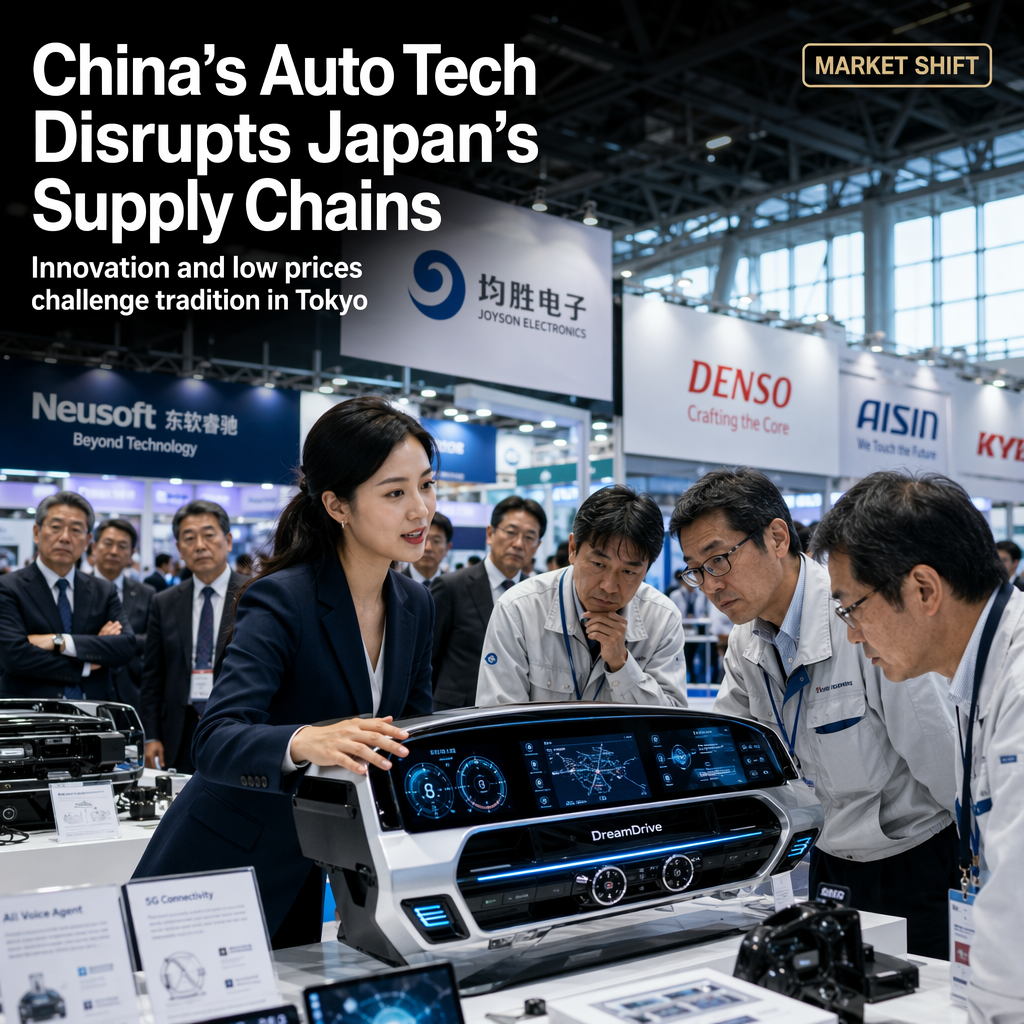
Chinese auto parts manufacturers are intensifying their efforts to enter the Japanese market, aiming to disrupt the country’s established, multi-tiered automotive supply chains with competitive pricing and rapid development cycles [1]. Companies such as Desay SV have showcased advanced technologies, including smart cockpits with enhanced displays and connectivity features, at Japanese trade shows in an effort to attract local automakers [1].
Industry observers note that the entry of Chinese suppliers poses a significant challenge to Japan’s traditional reliance on trusted, long-term partners and complex supply networks. The aggressive pricing strategies and technological advancements of these newcomers are seen as potential catalysts for lowering costs and increasing competition within the Japanese automotive sector [1].
Market sentiment among Japanese industry experts is described as cautious. While some acknowledge the benefits of reduced development timelines and cost competitiveness offered by Chinese parts makers, others emphasize the continued importance of quality and seamless integration with existing systems [1]. A Tokyo-based auto analyst commented, “Chinese suppliers are pushing the boundaries in both technology and cost, which could reshape how Japanese automakers source their components” [1].
Although no specific financial data, trading advice, or price levels are provided, analysts suggest that successful market entry by Chinese parts makers could exert downward pressure on prices and force Japanese suppliers to accelerate their own innovation efforts [1]. The article does not mention any explicit market reactions, charts, or technical analysis [1].
CONCLUSION
Chinese auto parts makers are poised to disrupt Japan’s automotive supply chains with their focus on innovation and cost efficiency. While the market response is cautious, the potential for increased competition and lower prices could drive significant changes in procurement strategies among Japanese automakers.