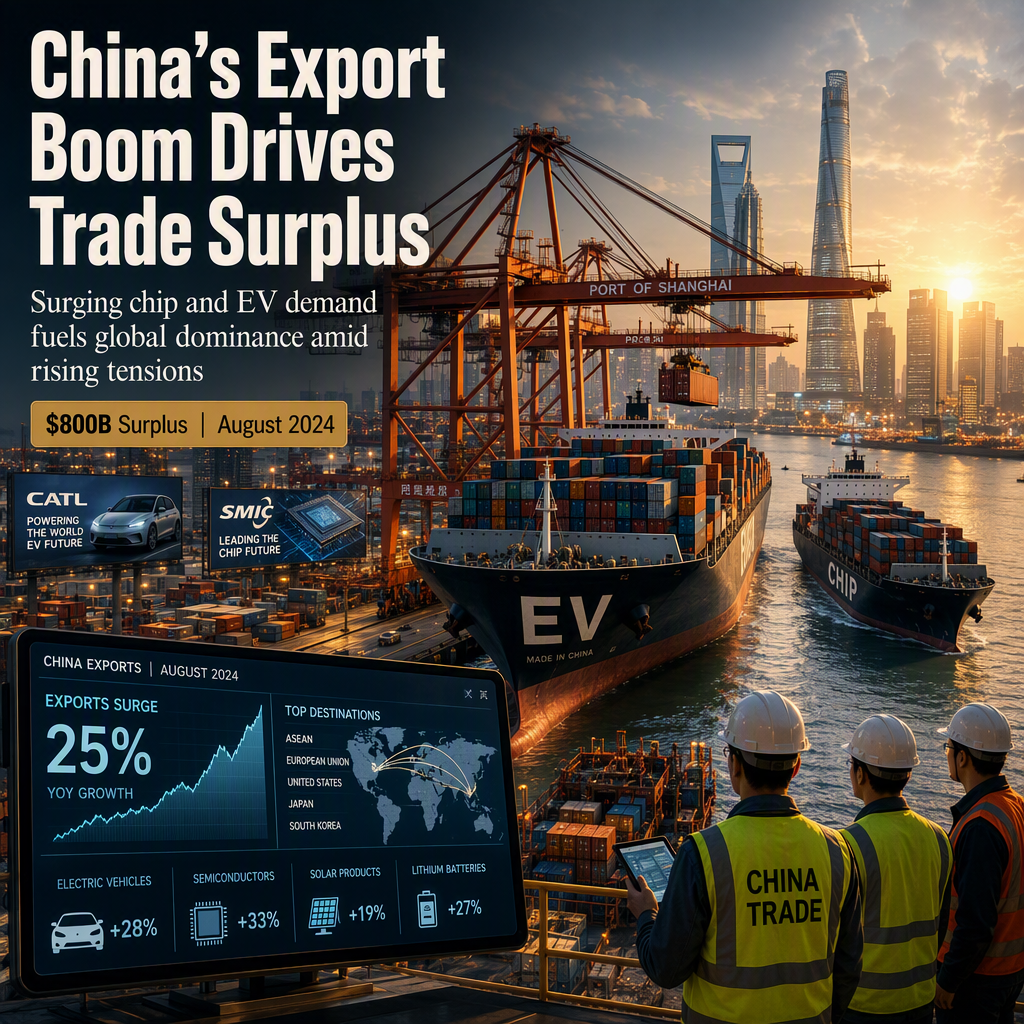
China's export sector experienced a significant boost in August, with exports rising 25% year-on-year, marking one of the strongest monthly performances in recent years [1]. This surge was primarily driven by robust global demand for semiconductors and electric vehicles, which are rapidly growing sectors both within China and internationally [1]. For the year to date, China's trade surplus has surpassed $800 billion, highlighting the country's continued dominance in global manufacturing and export markets [1]. Industry sources attribute these gains to expanding international orders, especially for next-generation automotive components and advanced chipsets [1].
Despite the impressive export figures, analysts caution that the rapid growth is contributing to heightened trade friction with major partners such as the US and EU [1]. Concerns have been raised in these regions about overcapacity and unfair competition, particularly in the chip and EV sectors, with Beijing actively disputing these claims [1]. Diplomatic efforts are ongoing to address issues related to technology transfers and market access, but trade tensions remain elevated [1].
Market observers note that while the momentum in exports remains strong, Chinese companies are facing increased scrutiny and the potential for regulatory challenges abroad [1]. The outlook for the remainder of the year is seen as dependent on both sustained global demand and the outcomes of ongoing trade negotiations [1]. Technical analysis of shipping volume charts indicates a continued upward trajectory in export traffic, with key support levels holding firm [1]. Analysts recommend that traders closely monitor announcements from both Chinese and Western governments, as policy changes could significantly impact market sentiment and the price levels of related stocks [1].
In summary, China's robust export performance in August underscores its resilience and competitiveness in the global market, but also brings challenges in the form of trade friction and potential market volatility [1]. Traders are advised to stay alert to shifts in global demand and regulatory developments that could influence the market landscape [1].
CONCLUSION
China's export surge in August highlights the country's strong position in global trade, driven by demand for chips and electric vehicles. However, the impressive growth is also intensifying trade tensions with major partners, creating potential risks for market volatility. The outlook will depend on global demand and the results of ongoing trade negotiations.