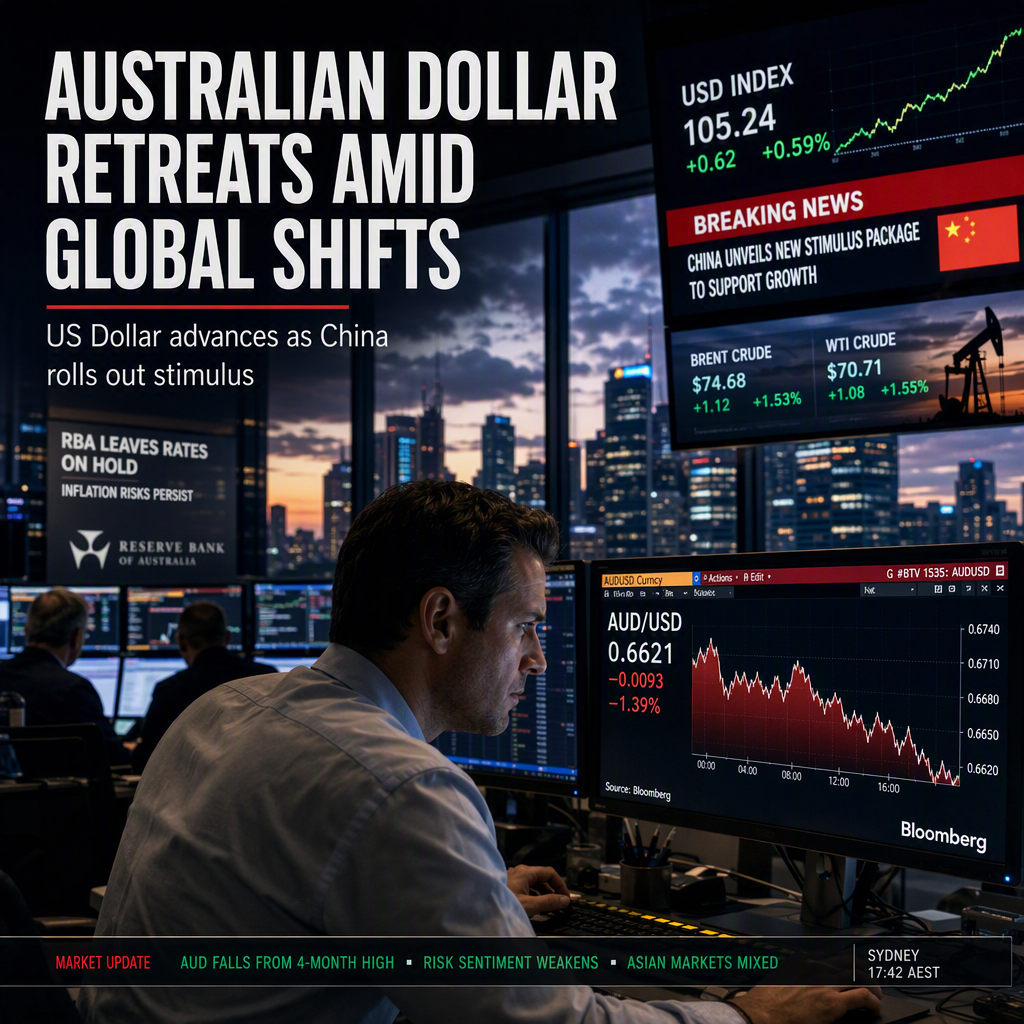
The Australian Dollar (AUD) eased against the US Dollar (USD) on Thursday, slipping below the 0.7200 mark after reaching its highest level since mid-May earlier in the week. The AUD/USD pair currently trades in the 0.7160 area, lower on the day, as a firmer US Dollar pulls the pair away from its recent peak around 0.7220 [1].
A significant factor influencing the AUD was news that Beijing is reportedly preparing a $54 billion stimulus package aimed at supporting its banking and broader financial sector. This development initially boosted the Australian Dollar, given Australia's strong trade ties with China. From the June trough, AUD/USD had climbed sharply before this week's pullback [1].
Support for the AUD also came from the Reserve Bank of Australia (RBA), with hawkish comments from officials and oil prices holding near $100 a barrel. These factors have led traders to price in a potential rate rise later this month, with short-dated yields firming as expectations shift. Higher Australian rates relative to other major central banks typically support the currency [1].
However, the US Dollar has strengthened as investors increasingly expect the Federal Reserve to raise rates in September, following a Producer Price Index (PPI) increase of 5.4% year-on-year in August. The escalation of the Middle East conflict and soaring oil prices have kept inflation sticky, further supporting the Greenback and dampening the AUD's advance [1]. Technical analysis shows AUD/USD trading at 0.7167, maintaining a bearish near-term tone with the Relative Strength Index (RSI) near 29, indicating oversold conditions and persistent downside pressure. Immediate support is at 0.7157, with resistance levels at 0.7174, 0.7193, 0.7213, and 0.7215 [1].
CONCLUSION
The Australian Dollar's recent rally has lost momentum due to renewed US Dollar strength and persistent inflation concerns. While Chinese stimulus and RBA hawkishness initially supported the AUD, market sentiment has turned bearish in the short term, with technical indicators pointing to further downside risk. Traders are now watching key support and resistance levels as the corrective phase continues.