
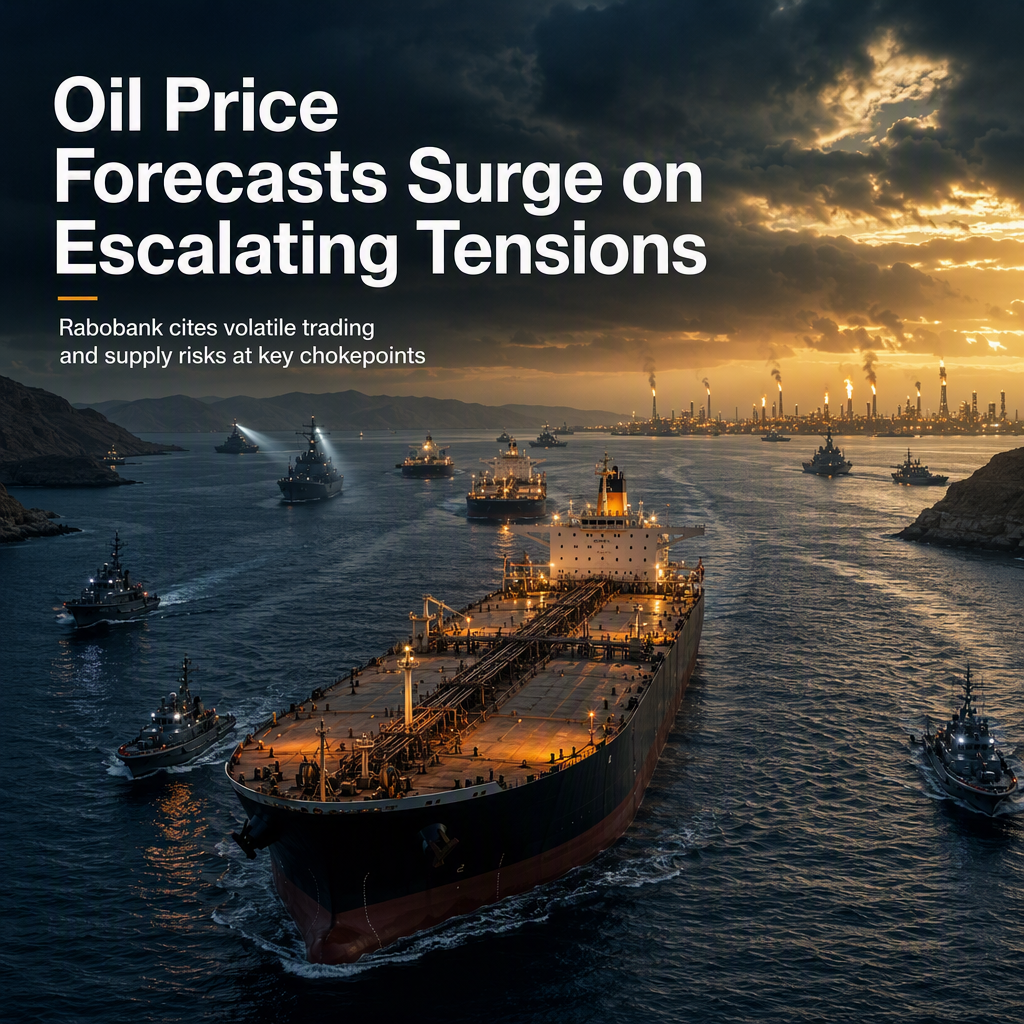
Rabobank’s Joe DeLaura highlights that renewed tensions between the United States and Iran, along with disruptions at the Strait of Hormuz, have led to a sharp rally followed by a correction in Brent and West Texas Intermediate (WTI) crude prices. As of the report's publication, Brent is trading near $81 per barrel and WTI at $76.30 per barrel. Rabobank expects Brent to oscillate within a volatile range, with support at $70-75 and resistance at $95-100, driven primarily by geopolitical developments around the Strait of Hormuz and Bab al-Mandab. Increased shipping transits and peace deal rumors could push prices lower, while escalations and attacks on shipping could drive prices to the upper end of the range [1].
Rabobank notes that a short-term deal to open the Strait of Hormuz for commercial shipping is unlikely to provide a permanent solution, as both sides have little common ground. The current arrangement allows for a 60-day window of free transits while negotiations continue. However, the bank warns that frustration with negotiations could quickly reignite tensions, forcing markets to price in renewed geopolitical risk [1].
The report also points out that global oil inventories are being drawn down by about 2-5 million barrels per day, with an additional 5-6 million barrels per day of refined products being consumed. Rabobank cautions that these inventory 'savings accounts' are not sustainable in the long term. The bank projects that flows through the Strait of Hormuz could only recover to 50-60% of prewar levels by 2027, with Middle East refinery exports returning to normal by mid-2028, highlighting a significant gap between crude and product flows [1].
Reflecting these dynamics, Rabobank has raised its price forecasts: Brent is now expected to average $84 per barrel in Q3 2026, $80 in Q4 2026, and $76.50 in 2027. WTI forecasts have also been increased to $80.50 in Q3 2026, $76 in Q4 2026, and $72.25 in 2027 [1].
CONCLUSION
Rabobank sees ongoing geopolitical risks and supply disruptions as key drivers of oil price volatility, prompting upward revisions to its Brent and WTI forecasts through 2027. The market is expected to remain sensitive to developments in the Strait of Hormuz and Bab al-Mandab, with inventory drawdowns adding to the bullish outlook.