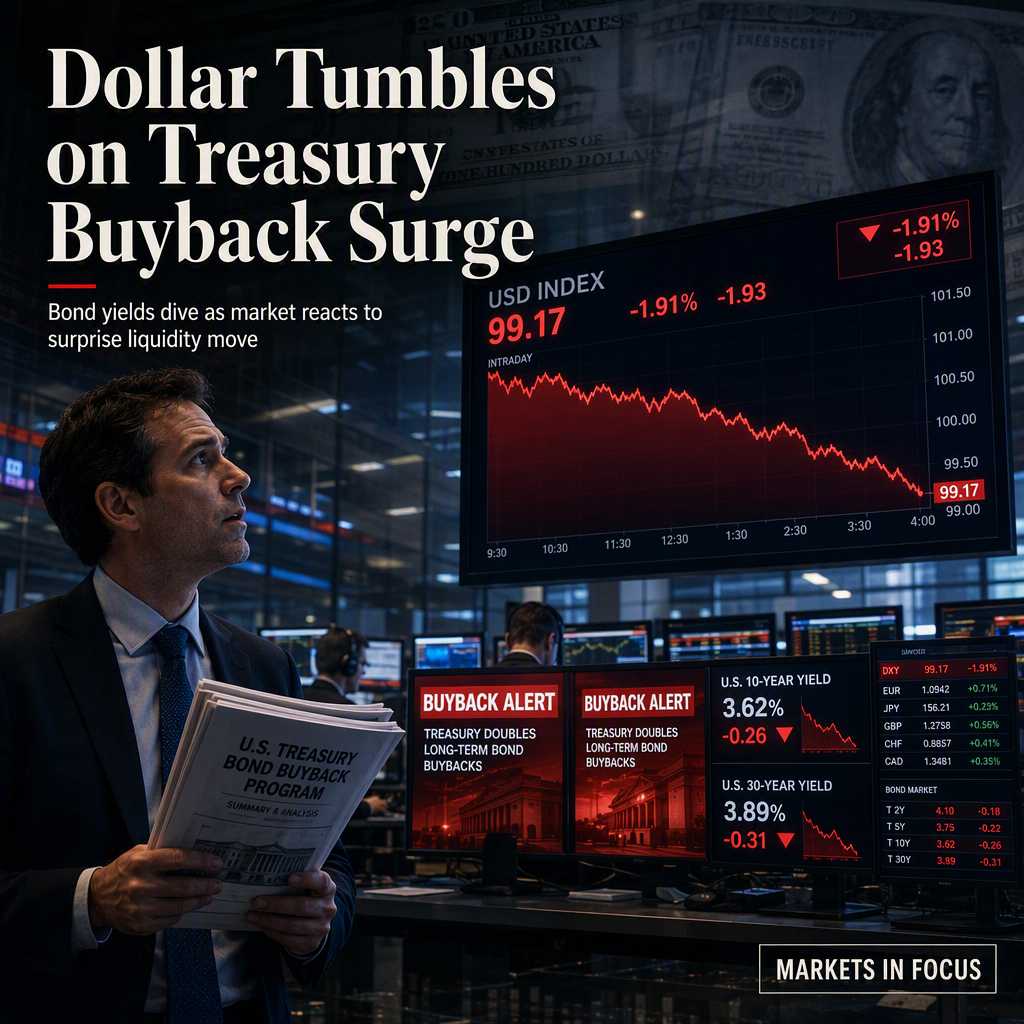
The US Dollar (USD) experienced significant selling pressure on Wednesday after the US Treasury Department unexpectedly announced it would double the size of some long-dated debt buyback operations to support market liquidity [1]. This move led to a sharp decline in US Treasury yields, with the 30-year bond yield, which had reached a 19-year high on Tuesday, falling nearly 2% on Wednesday. The 10-year reference yield also declined by 1.4% [1]. As a result, the USD Index dropped 0.9%, touching its lowest level in nearly three months below 99.00, before stabilizing around 98.80 in the European morning on Thursday [1].
Currency performance data for the week shows the US Dollar was the weakest against the Swiss Franc, declining 1.61%, and also posted losses against other major currencies such as the Euro (-1.02%), British Pound (-0.65%), and Japanese Yen (-0.52%) [1]. The market is now awaiting mid-tier US macroeconomic data releases, including weekly Initial Jobless Claims and the Philadelphia Fed Manufacturing Survey for August, which could further influence USD movements [1].
The minutes from the Federal Reserve's July policy meeting, released late Wednesday, indicated that many participants believe higher rates would likely be necessary if inflation does not decline. However, a few members preferred an immediate rate hike, arguing it could prevent the need for further increases later [1].
Deutsche Bank’s George Saravelos described the Treasury's buyback initiative as a 'soft-form financial repression policy aimed at containing the long-end of the US yield curve,' warning that this could have negative implications for the USD [1].
CONCLUSION
The US Treasury's decision to double long-term bond buybacks triggered a sharp drop in yields and a notable decline in the US Dollar, which reached its lowest level in nearly three months. Market participants are closely watching upcoming US economic data and Fed policy signals for further direction.