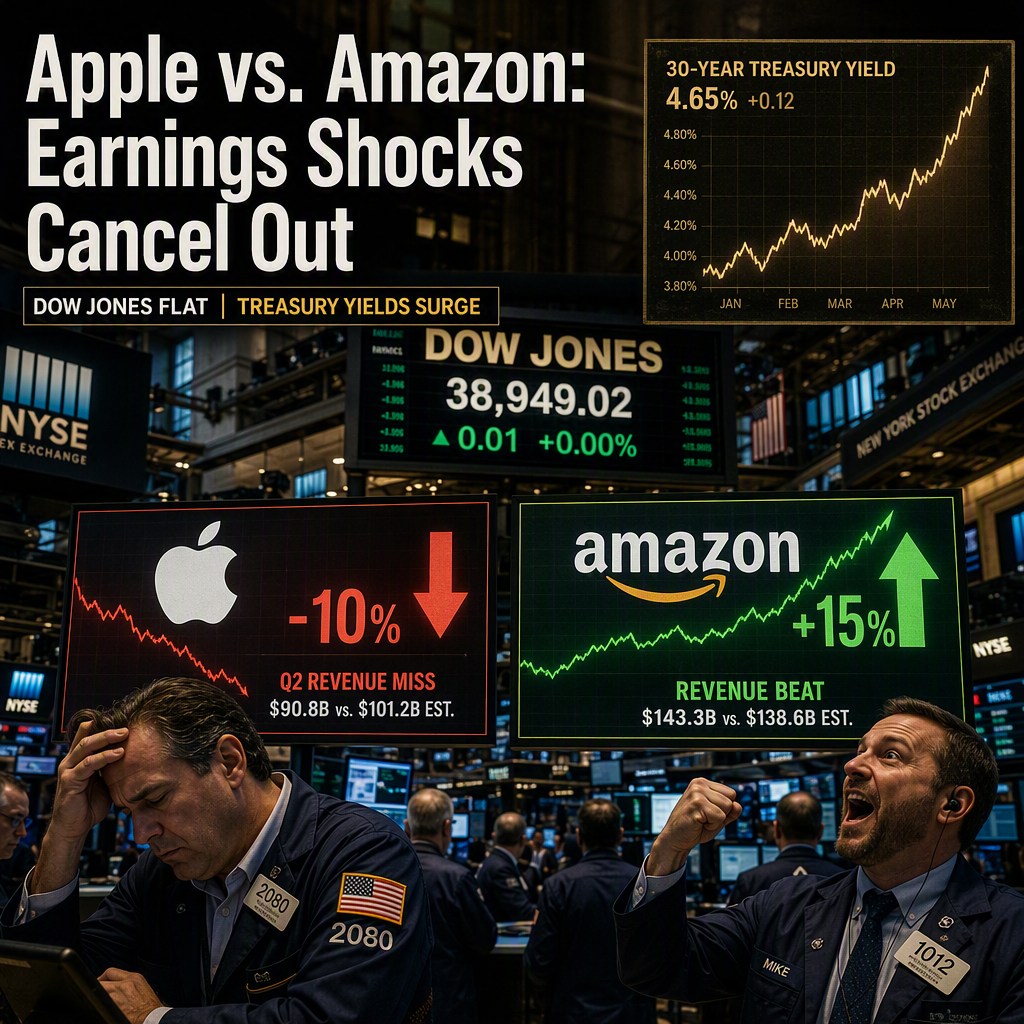
The Dow Jones Industrial Average traded just beneath 52,500 on Friday, up around 230 points and approximately 1.6% below its record set earlier in July. The session was marked by significant volatility, with the index swinging nearly 600 points from a high in the 52,600 area to a low just below 52,000, before recovering more than 450 points within two hours. Despite this volatility, there was no new information released during the session to explain the swings [1].
The primary drivers of the session were earnings shocks from two major Dow components: Apple (AAPL) and Amazon (AMZN). Apple shares traded around 10% lower after its fiscal third quarter, where revenue beat expectations on a 22% jump in iPhone sales, but a shortfall in services revenue led to the decline. In contrast, Amazon shares surged over 15% higher following a second-quarter revenue beat, driven by strong performance in its cloud business, which was interpreted as confirmation that the capital-spending cycle supporting the technology sector remains intact. Both companies are similarly weighted in the price-weighted Dow index, and their opposing moves effectively canceled each other out, resulting in a net index gain of less than half a percent. This represents the largest single-name earnings dispersion of the quarter, yet it had minimal net impact on the index [1].
The structure of the Dow, often criticized for lagging the broader technology trade, was the same mechanism that neutralized the week's biggest earnings shocks. Of the seven largest technology names, five are now included in the Dow, with Meta Platforms (META) and Tesla (TSLA) as the notable absentees. The difference between major benchmarks is now attributed more to weighting methods and breadth than to index membership [1].
In the bond market, the 30-year Treasury yield remained near its highest level since 2007, extending its rise through Friday, while the 10-year yield stayed above 4.7%, its highest since January 2025. These moves occurred even as equities remained bid. The Federal Reserve's recent decision to hold rates steady for the fifth consecutive time, with three regional presidents dissenting in favor of a quarter-point increase, signaled a committee unwilling to move ahead of incoming data. This stance left inflation risk with bondholders, prompting a repricing of long-term yields. The Fed chair acknowledged that there is no immediate solution for five years of above-target inflation, and long-dated investors responded accordingly. The divergence between a near-record equity index and a yield curve pricing in further tightening reflects differing views on the economy, with persistent geopolitical tensions keeping crude oil prices elevated and influencing the bond market [1].
CONCLUSION
Earnings shocks from Apple and Amazon effectively offset each other in the Dow Jones, resulting in minimal net movement for the index despite significant individual stock volatility. Meanwhile, rising long-term Treasury yields and a cautious Federal Reserve stance highlight ongoing inflation concerns and market uncertainty. The market remains caught between strong equity performance and tightening bond market conditions.