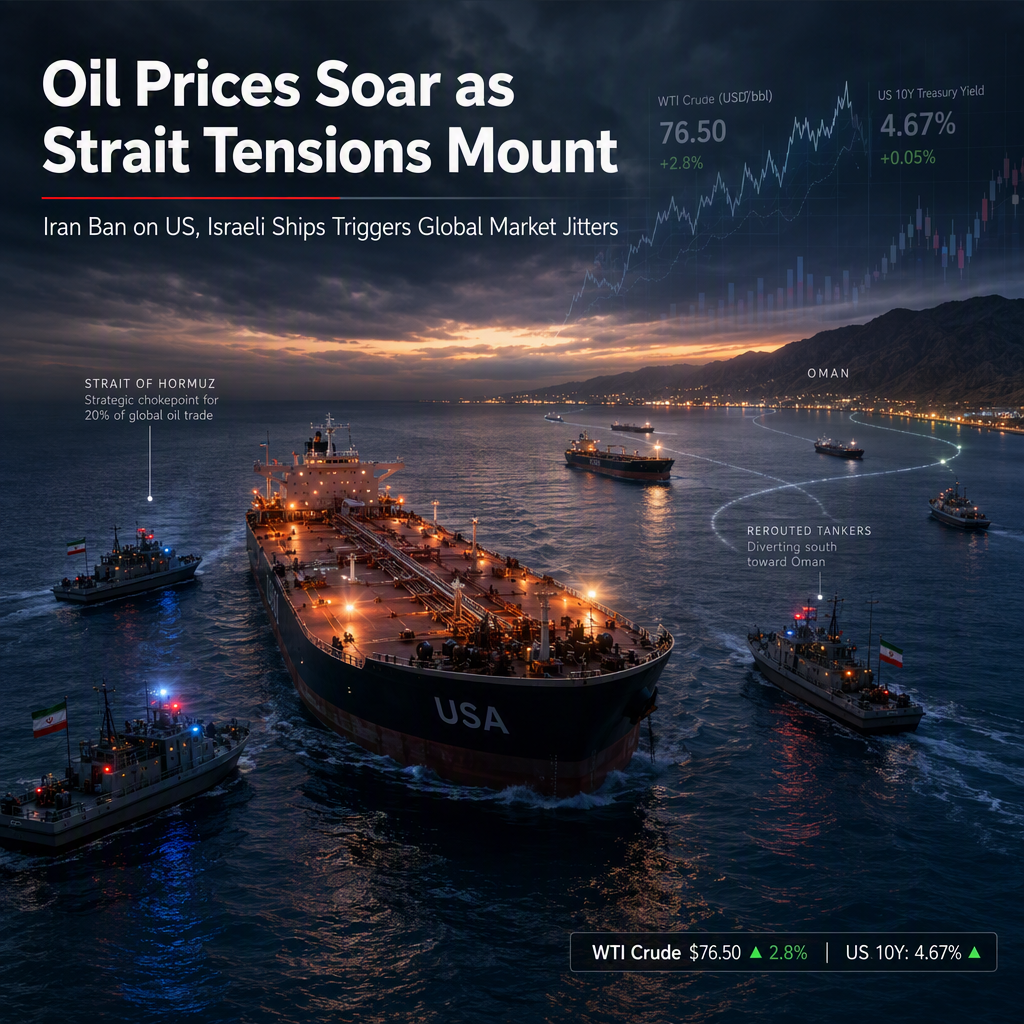
West Texas Intermediate (WTI) Oil rebounded sharply on Thursday, trading around $76.50 per barrel and rising nearly 2.80% according to fxstreet, as traders responded to new details of the Iran-Oman agreement concerning the Strait of Hormuz [1]. Source 2 also reports WTI climbing by over 2.85%, trading at approximately $76.45 per barrel, following media reports that Iran is blocking US and Israeli vessels from entering the Strait, which triggered a jump in Oil prices [2]. The proposed Iranian parliamentary bill would ban US, Israeli, and other hostile vessels from passing through the Strait, with fines of up to 20% of a vessel’s cargo value for violations. Iran further stated that countries and individuals accused of causing damage to the country would not be granted passage until compensation is paid [1][2]. The Iran-Oman framework would direct ships entering the Strait through a northern route near Iran, while outgoing vessels would use a southern route near Oman, highlighting Iran’s push for greater control over the waterway [1]. Tehran has repeatedly asserted that the Strait will not operate as it did before the war, while Washington insists on toll-free passage and maintains that Hormuz is an international waterway [1].
The heightened geopolitical risk has spilled over into US financial markets. US Treasury yields climbed along the curve, with the 10-year note yielding 4.672%, up nearly six basis points, as market participants began to price in a possible jump in inflation, which could warrant a Federal Reserve rate hike [2]. Money markets speculated that the Fed would raise rates at the September meeting, with odds near 58% for a 25 basis points hike and a 42% chance for keeping rates at the current 3.50%–3.75% range, according to Prime Terminal [2]. Meanwhile, Fed officials offered mixed signals: San Francisco Fed President Mary Daly favored keeping monetary policy unchanged and gathering more data, while Fed Governor Lisa Cook supported holding rates but indicated readiness to act if disinflation stalls [2].
Additional market unease was fueled by reports of attacks on Saudi tankers in the Red Sea, as Houthis continued to launch strikes against Saudi Arabia [2]. On the economic front, US Initial Jobless Claims for the week ending August 1 came in at 199K, below the 202K forecast, and Challenger job cuts dropped to a two-year low in July, indicating a stable labor market [2]. Traders are now focused on the upcoming Nonfarm Payrolls, expected at 80K, nearly double June’s print, with the Unemployment Rate projected to remain steady at 4.2% [2].
CONCLUSION
The Iran-Oman agreement and proposed shipping bans have reignited geopolitical tensions, driving WTI Oil prices higher and prompting a jump in US Treasury yields as inflation concerns mount. Market participants are increasingly pricing in the risk of a Federal Reserve rate hike, while traders await key US employment data for further direction. The event has had a significant impact across both energy and financial markets, underscoring the sensitivity of global markets to geopolitical developments.