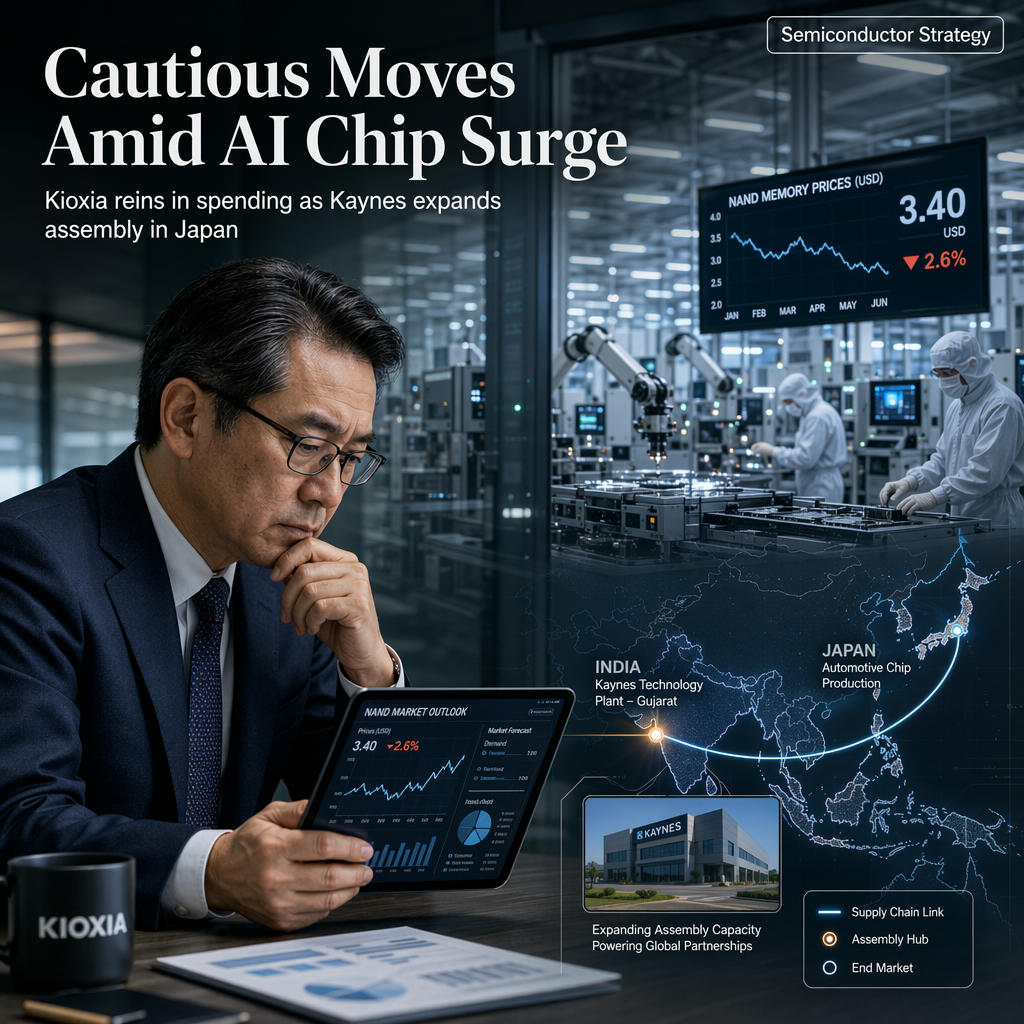
Japanese memory chip maker Kioxia Holdings is taking a restrained approach to capital expenditures despite a surge in AI-driven demand for advanced memory chips, particularly NAND products such as solid-state drives [1]. While competitors are aggressively expanding production to capitalize on the AI memory boom, Kioxia is prioritizing stable, sustainable growth and is wary of triggering a supply glut that could lead to falling prices [1]. A Kioxia executive stated, "We're focused on balancing the need for growth with the risk of overcapacity," emphasizing that prudent capital expenditure is key to long-term profitability [1].
Financial analysts cited in the article suggest that Kioxia's cautious strategy could help insulate the company from volatile swings in memory prices, which have historically been subject to boom-and-bust cycles due to industry-wide investment surges [1]. The company has forecasted a 48-fold quarterly profit jump on AI demand, underscoring the current market rewards for memory suppliers, but management remains committed to adjusting capex based on real-time market signals and inventory levels rather than speculative future demand [1]. Industry experts are closely monitoring Kioxia's approach, noting that its restraint could influence broader market sentiment and supply dynamics in the memory chip sector [1].
In a related development within the Japanese semiconductor industry, India's Kaynes Technology is entering the Japanese chip assembly market through partnerships with local companies [2]. Kaynes aims to handle back-end processing at its new plant in Gujarat, focusing on the automotive chip segment, which is a strategic growth area for both India and Japan [2]. This move is seen as a way for Japanese manufacturers to diversify geopolitical risks, as back-end processing has traditionally been concentrated in Taiwan, China, and Southeast Asia [2].
The market sentiment around Kaynes' entry is positive, with Japanese manufacturers welcoming the diversification of their supply chain and the increased resilience against geopolitical uncertainties [2]. Industry analysis suggests that India's emergence as a new base for chip assembly is expected to strengthen supply chain security for Japanese chipmakers, particularly in the automotive sector, and provide alternative sourcing options amid rising global demand for automotive chips [2].
CONCLUSION
Kioxia's cautious capital expenditure strategy amid the AI memory boom reflects a focus on long-term stability over rapid expansion, potentially shielding the company from market volatility. Meanwhile, Kaynes Technology's entry into Japan's chip assembly market is viewed positively, enhancing supply chain resilience for Japanese manufacturers. Both developments highlight strategic shifts in the semiconductor industry aimed at balancing growth opportunities with risk management.