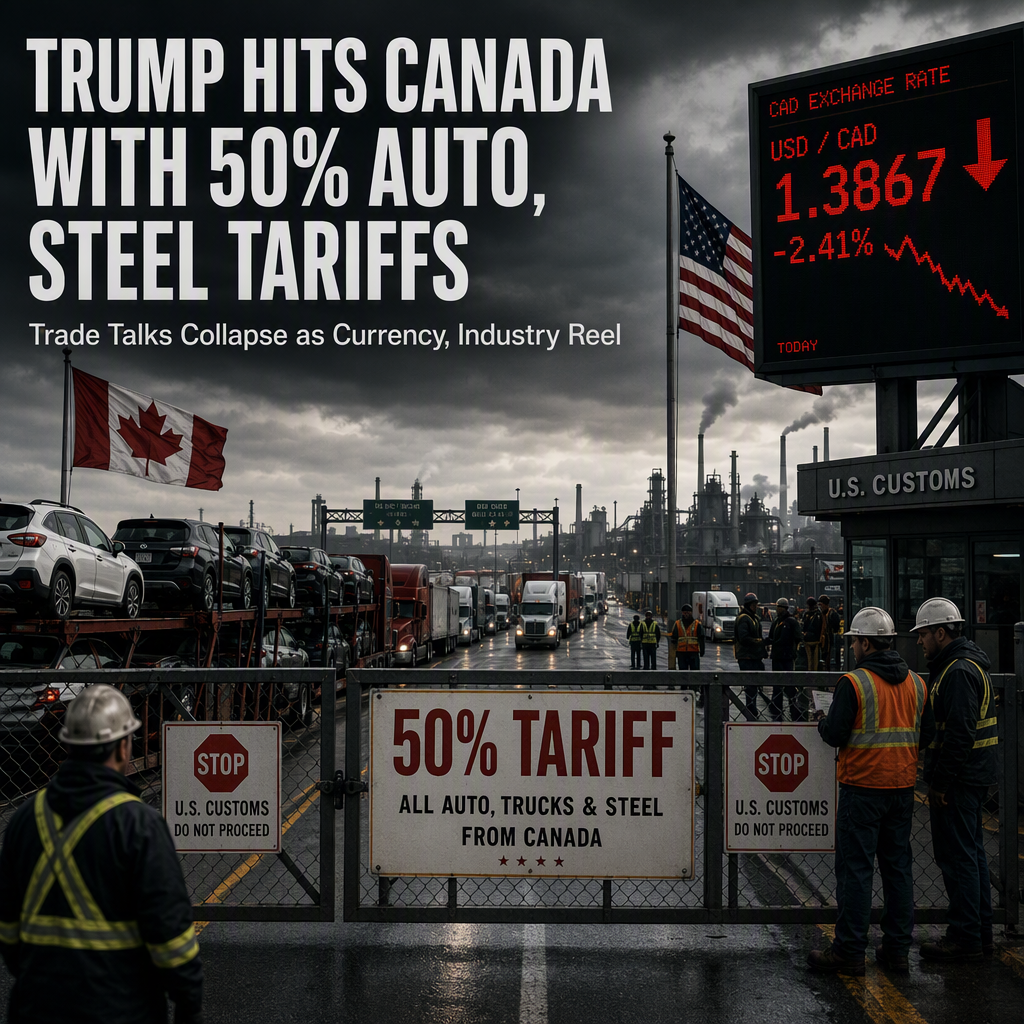
U.S. President Donald Trump has announced a significant escalation in trade tensions with Canada, declaring that starting January 1, 2027, the United States will impose 50% tariffs on all cars, trucks, automotive parts, and steel imported from Canada [1][2][3]. This move comes after the collapse of trade negotiations between Washington and Ottawa, with both sides blaming each other for the breakdown. Trump stated that the increased duties would not apply to companies manufacturing within the United States, emphasizing, 'Build in the US, and there are ZERO TARIFFS' [1][2].
Trump justified the tariffs by accusing Canada of years of unfair trade practices, particularly citing high Canadian tariffs on American farmers and farm products, which he claims have contributed to a $60 billion trade deficit between the two countries [1][2][3]. He further asserted that Canada conducts 95% of its trade with the U.S., while the reverse is not true, and declared, 'WE DON'T NEED CANADA, THEY NEED US!' [1][2][3].
The announcement follows the imposition of a separate round of 50% U.S. tariffs on approximately $20 billion worth of Canadian imports, including wine, cement, hockey sticks, and other products, which took effect early Saturday [2][3]. These duties were enacted in retaliation for alleged Canadian trade discrimination against U.S. cars, alcohol, and dairy [3]. Canadian Prime Minister Mark Carney responded by suspending trade negotiations and ordering his trade team back to Ottawa, accusing the U.S. of making a last-minute 'power play' and introducing new demands related to Canada's other trading relationships, its auto sector, and protections for Canadian culture and the French language [2]. Carney has vowed to retaliate 'dollar for dollar,' with Canadian tariffs targeting multiple sectors such as steel, dairy, appliances, agricultural equipment, pulp and paper, and electronics, set to take effect the Tuesday after Labor Day, September 8 [2][3].
Market reaction was immediate, with the U.S. dollar strengthening against the Canadian dollar by 0.47% on the day of the announcement, making the USD the strongest currency against the CAD among major currencies [1]. The Canadian auto market is notably smaller than the U.S., with fewer than 2 million new vehicles sold in Canada in 2025 compared to over 16 million in the U.S. Only 5.4% (about 861,000) of vehicles produced in Canada were sold in the U.S. last year [3]. Japanese automakers Toyota and Honda accounted for 76.5% of Canada's vehicle production in 2025, outpacing Detroit automakers in Canadian output [3].
According to U.S. Trade Representative Jamieson Greer, the trade talks failed because 'the Canadians just — you know, they wanted more' [3]. Both sides have accused each other of making unreasonable last-minute changes to the agreement [2][3]. Trump's unpredictable tariff policies have been cited as a major source of uncertainty for the automotive industry [3].
CONCLUSION
President Trump's announcement of 50% tariffs on Canadian autos, trucks, and steel marks a sharp escalation in U.S.-Canada trade tensions, following the collapse of trade negotiations and the imposition of new tariffs on both sides. The move has already impacted currency markets, with the U.S. dollar strengthening against the Canadian dollar. With both countries vowing retaliatory measures, the trade dispute is set to have significant repercussions for multiple sectors and cross-border commerce.