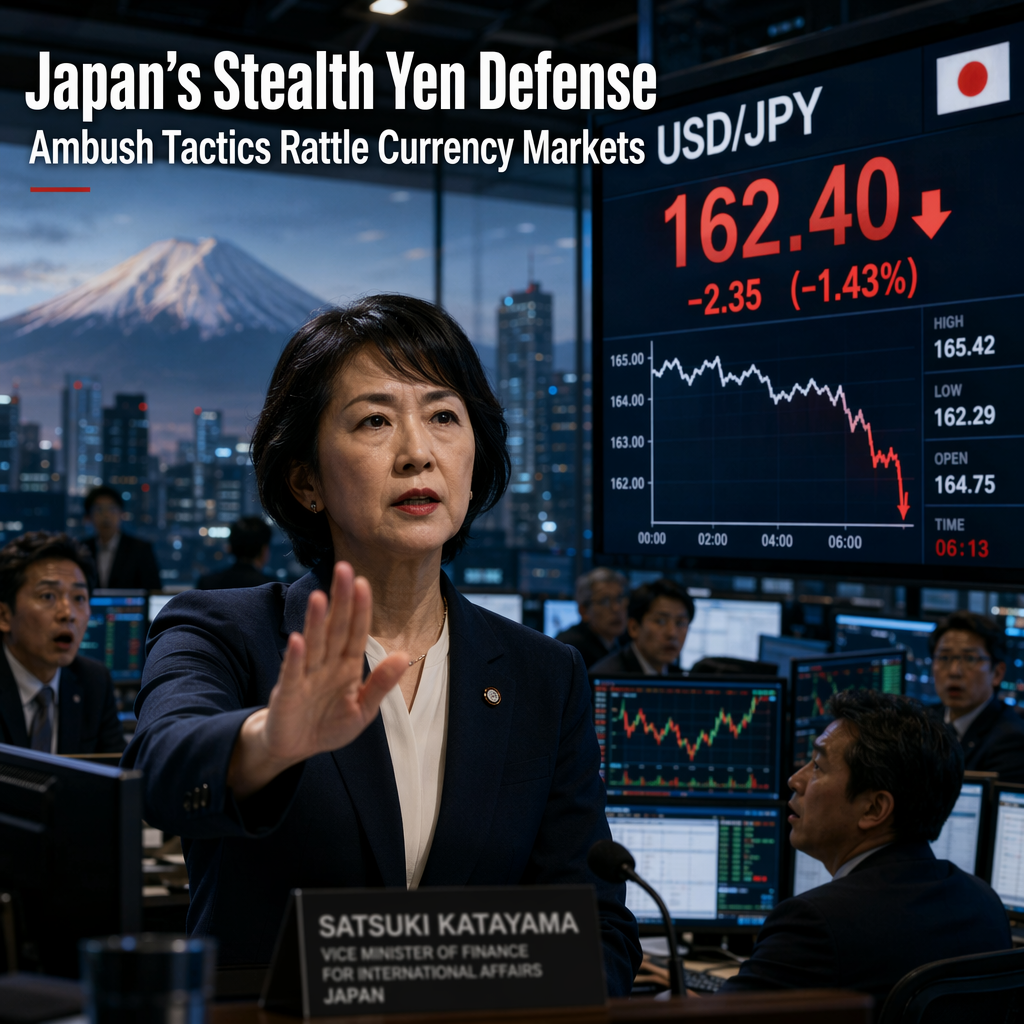
Japanese authorities have shifted their approach to currency intervention, moving away from openly signaling intervention risks and instead adopting a more targeted, 'ambush' strategy aimed at squeezing speculators and increasing the cost of betting against the Japanese Yen (JPY) [1][2]. According to Reuters sources cited in both articles, the Ministry of Finance (MOF) is now avoiding any public declaration of a specific exchange rate level that would trigger intervention, opting instead for abrupt market actions to clear out speculative short positions [1][2]. This policy shift is designed to keep traders uncertain and to prevent excessive declines in the Yen without providing a clear 'line in the sand' [1][2].
Finance Minister Satsuki Katayama reiterated that authorities remain fully prepared to respond appropriately to currency market developments at any time, underscoring the government's readiness for intervention if necessary [1]. As a result of these developments, the USD/JPY pair has retreated from recent 40-year highs, trading around 162.40 during Asian hours on Thursday, with a reported 0.10% decline to approximately 162.42 at press time [1][2].
The Yen's recent support is also attributed to a weaker US Dollar, following a less hawkish tone from Federal Reserve Chairman Kevin Warsh at the ECB Forum on Central Banking. Warsh did not provide explicit guidance on the Fed's upcoming July policy decision, and softer US economic data—including June's ADP Employment Change report (98K vs. 113K forecast) and a lower ISM Manufacturing PMI (53.3 vs. 54.0 consensus)—further cooled expectations for aggressive Fed action [1]. Market participants are now focused on the upcoming US Nonfarm Payrolls report for further insight into the labor market and the Fed's policy trajectory [1].
Both articles highlight that the Japanese Yen's value is influenced by factors such as Bank of Japan policy, the differential between Japanese and US bond yields, and broader risk sentiment. The recent shift in intervention tactics by Japanese authorities represents a more aggressive and unpredictable approach, aiming to deter speculative attacks on the currency [1][2].
CONCLUSION
Japan's move to stealth intervention tactics has provided support for the Yen and pressured the USD/JPY pair lower. The market is now on alert for potential surprise interventions, with traders closely watching both Japanese policy signals and upcoming US economic data for further direction.