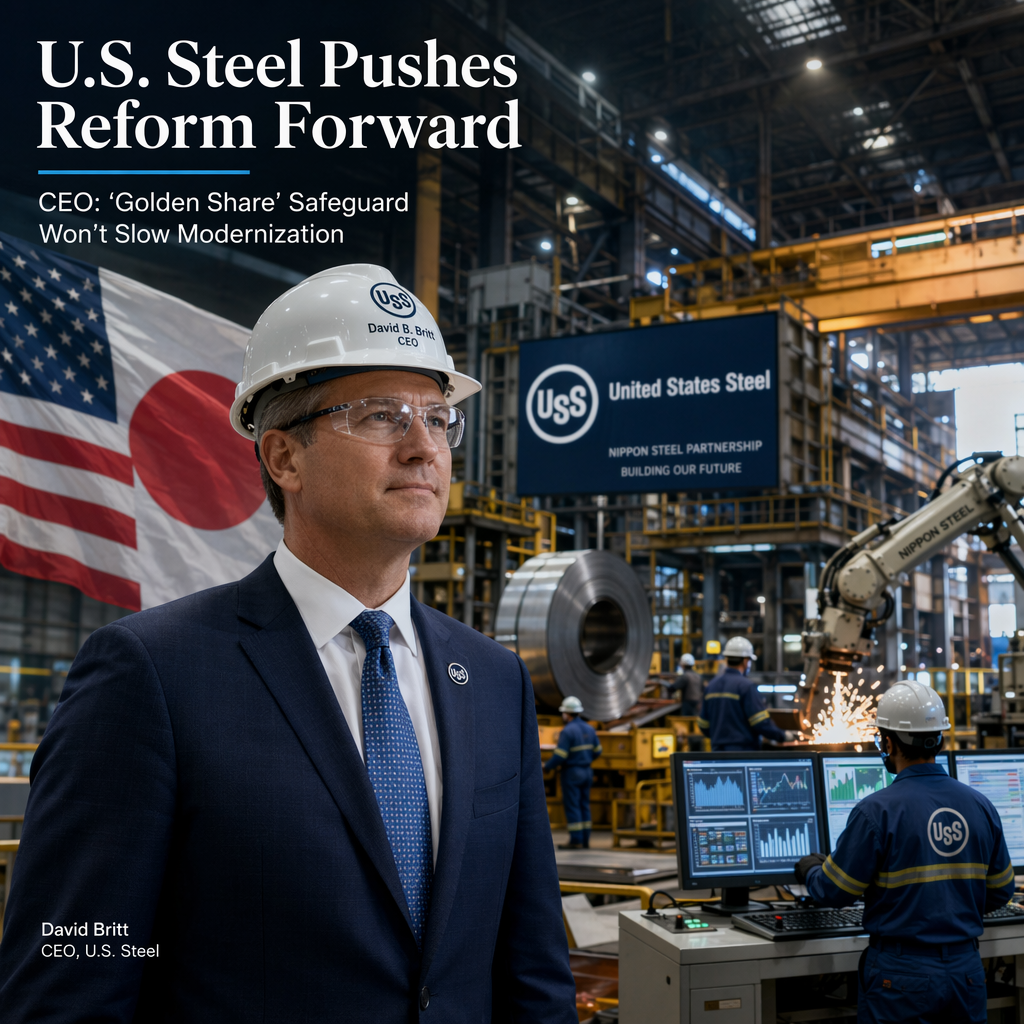
U.S. Steel CEO David Britt stated in an interview that the 'golden share' mechanism, which grants the U.S. government veto power over certain key decisions following Nippon Steel's acquisition of U.S. Steel, will not impede the company's ongoing reform strategy. Britt emphasized that the company remains committed to aggressive cost and operational improvements, which have already begun to yield positive results. He described the golden share as a safeguard that does not affect U.S. Steel's day-to-day or long-term business plans [1].
Since being acquired by Nippon Steel, U.S. Steel has implemented a series of cost-cutting and modernization initiatives. According to Britt, these efforts have led to measurable improvements in profitability, with the company's operations now contributing positively to Nippon Steel's profits. While specific financial figures were not disclosed, Britt highlighted the benefits of new capital investment and enhanced operational discipline [1].
Britt also noted that local support and worker engagement have been crucial to the company's turnaround, stating that the workforce recognizes and is actively participating in the transformation. The integration with Nippon Steel has provided U.S. Steel with access to additional technology and management expertise, further supporting ongoing reforms. Nippon Steel has signaled its commitment to continued reforms by investing in equipment upgrades and operational improvements [1].
Market analysts cited in the article suggest that the swift profit gains following the acquisition could pave the way for more ambitious restructuring efforts in the future. Britt concluded that U.S. Steel's mission is to remain competitive, deliver value to stakeholders, and modernize, expressing confidence in the company's trajectory under the current governance structure [1].
CONCLUSION
U.S. Steel's leadership asserts that the 'golden share' arrangement will not hinder its reform agenda, with early post-acquisition results already contributing to Nippon Steel's profits. Continued modernization and local support are seen as key drivers for future growth, and analysts view the rapid turnaround as a foundation for further restructuring.