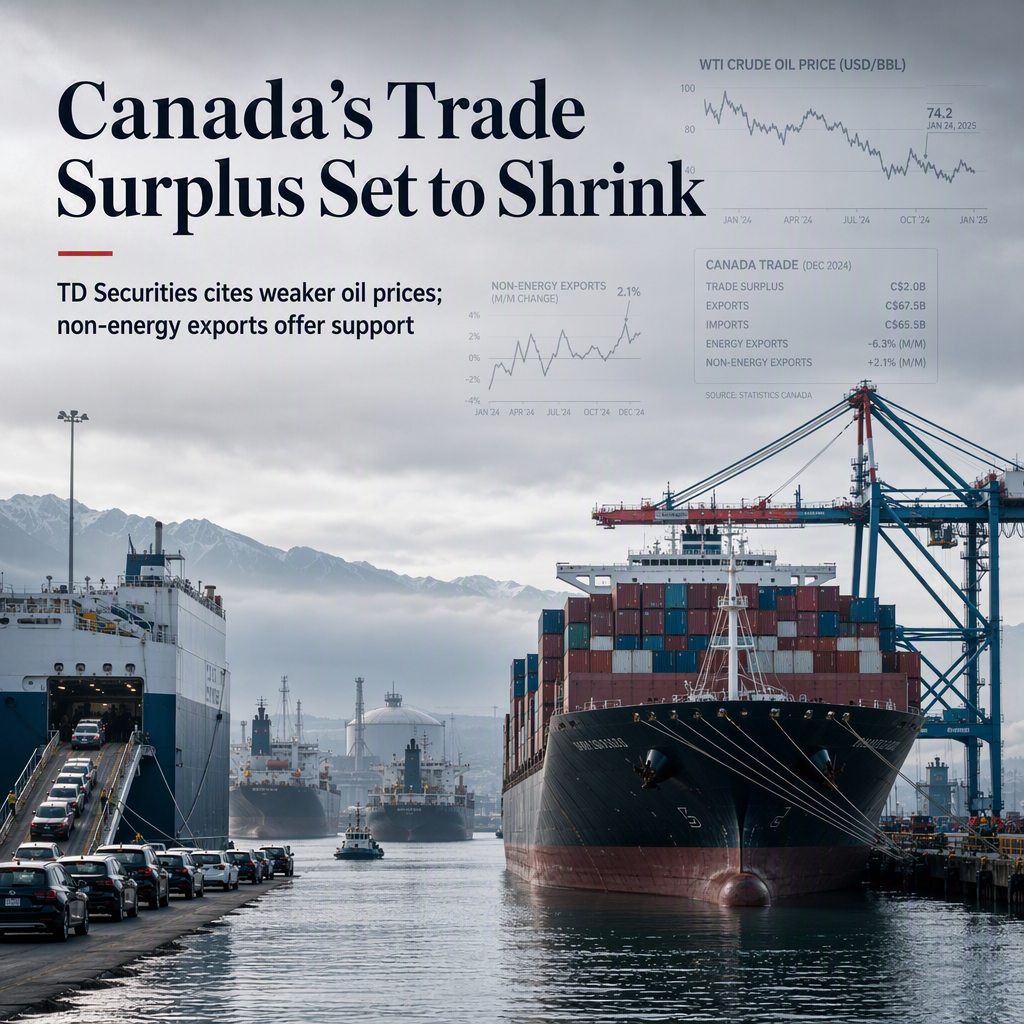
TD Securities strategists anticipate that Canada's International Merchandise Trade surplus will narrow in June, primarily due to weaker oil prices impacting energy exports. The firm forecasts a surplus of $2.5 billion, which is below both the market consensus of $3.0 billion and May's reported surplus of $4.2 billion [1]. According to TD Securities, crude oil prices declined by approximately 15% in June, exerting significant pressure on energy exports. However, early data from US imports suggests only a modest decline, indicating a potential rebound in real energy exports after a 4% drop in May [1].
Non-energy exports, particularly in the automotive and manufacturing sectors, are expected to partially offset the negative impact from energy. Flash estimates point to a 2.2% increase in non-energy manufacturing sales for June, reflecting ongoing strength in these areas [1]. Additionally, stronger imports are projected to contribute to the narrowing surplus, with the real trade balance expected to see a smaller decline in the absence of further commodity price drops [1].
TD Securities' outlook suggests that while the energy sector faces headwinds, resilience in non-energy exports and increased imports will shape the overall trade balance for June. The firm's forecast is more conservative than the broader market expectation, highlighting the sensitivity of Canada's trade position to fluctuations in commodity prices, particularly crude oil [1].
CONCLUSION
TD Securities expects Canada's trade surplus to shrink in June due to weaker oil prices, forecasting a $2.5 billion surplus compared to the market's $3.0 billion estimate. Strength in non-energy exports and higher imports may help cushion the impact, but the overall outlook remains cautious amid commodity price volatility.