
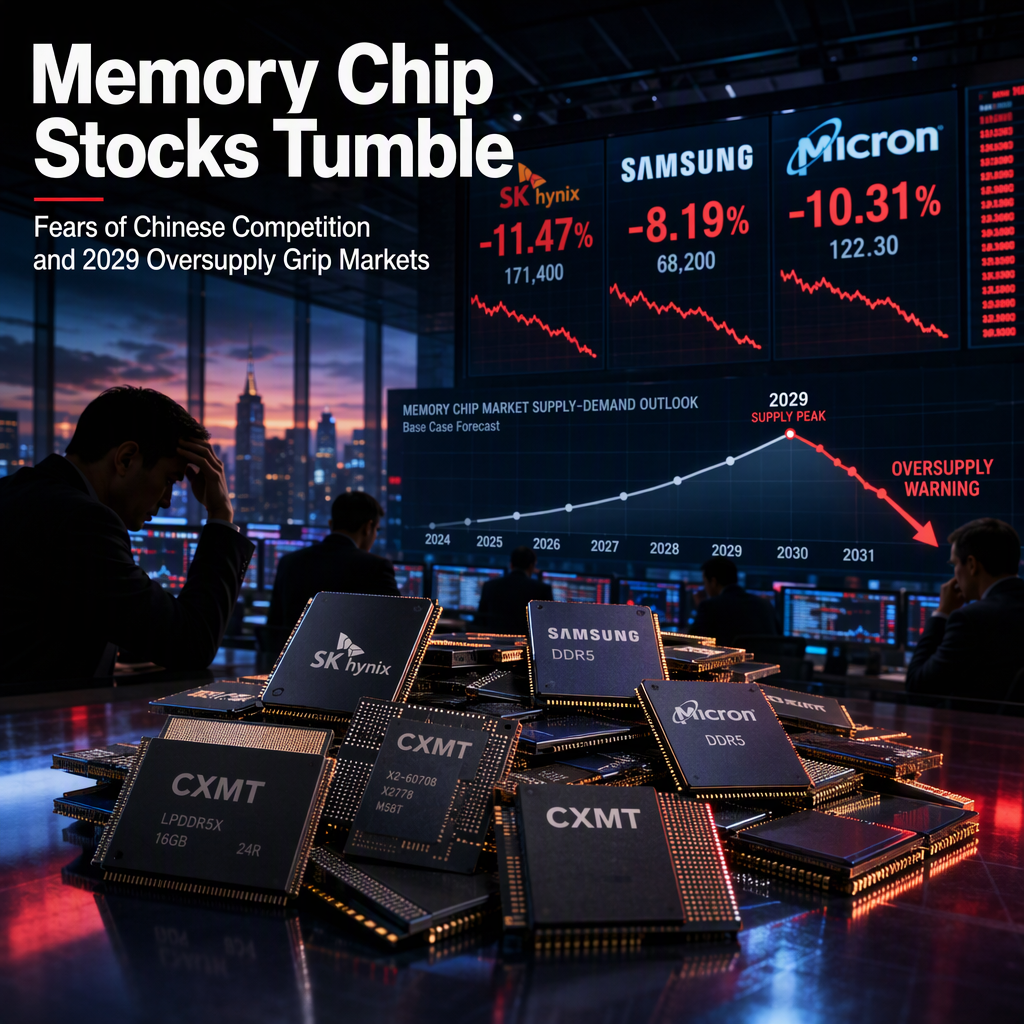
Memory chip stocks, including SK Hynix, Samsung, and Micron, have experienced significant declines this week, driven by investor concerns over increased competition from China's ChangXin Memory Technologies (CXMT) and speculation about a potential oversupply of memory chips by 2029 [1]. Over the past five days, SK Hynix shares have dropped 26%, Samsung has fallen 22%, and Micron has declined around 11% [1].
The initial market jitters were triggered by CXMT's announcement of a new server memory product based on advanced architecture, which could allow for higher storage density. This development raised fears that CXMT might capture global market share from established players such as Samsung, SK Hynix, and Micron [1]. However, analysts like Ben Barringer of Quilter Cheviot and Kevin Cassidy of Rosenblatt Securities expressed skepticism about CXMT's ability to scale production efficiently, with Barringer noting concerns about manufacturing yields and Cassidy stating that the development is unlikely to significantly alter the supply-demand balance in the market [1].
Further pressure on memory stocks came from an opinion column in South Korea's Maeil Business Newspaper, which cited Professor Hwang of Seoul National University and Ahn Ki-hyun of the Korea Semiconductor Industry Association. They warned of a possible 'flood of new supply' in 2029 that could turn the memory market into a 'red ocean,' potentially ending the current supercycle and leading to an industry downturn by 2030 [1]. Elon Musk also commented on the situation, predicting that China will be producing a significant amount of RAM by 2028 [1].
The combination of immediate concerns about Chinese competition and longer-term fears of oversupply has created a challenging environment for memory chip stocks, leading to sharp declines and heightened market uncertainty [1].
CONCLUSION
Memory chip stocks have suffered steep losses due to fears of increased Chinese competition and warnings of a potential market oversupply by 2029. While some analysts downplay the immediate impact of CXMT's advancements, the prospect of a future supply glut has unsettled investors. The sector faces significant headwinds as it navigates both near-term and long-term challenges.