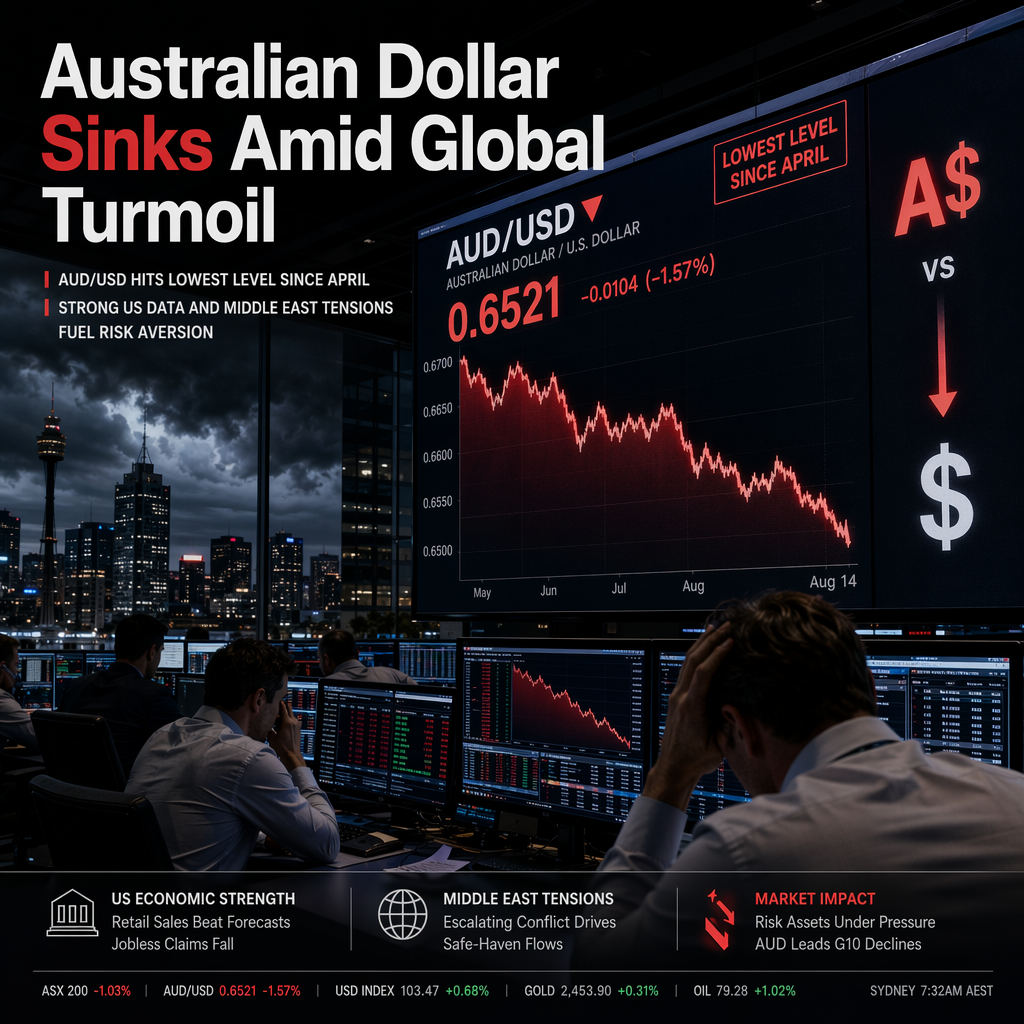
The Australian Dollar (AUD) fell to its lowest level against the US Dollar (USD) since early April during the Asian session on Friday, following a fresh wave of selling pressure after modest gains the previous day [1]. The AUD/USD pair traded just below the 0.6900 mark, down over 0.25% for the day, although it recovered a few pips in the last hour [1]. This decline was driven by a combination of strong US economic data and a global risk-off sentiment.
The US Bureau of Economic Analysis reported that the US economy grew at an annualized rate of 2.1% in the first quarter of 2026, surpassing the previous estimate of 1.6% [1]. Additionally, the US Personal Consumption Expenditures (PCE) Price Index indicated persistent inflationary pressures, which kept the possibility of a US Federal Reserve interest rate hike this year firmly on the table [1]. These factors supported the US Dollar, which had recently reached its highest level since May 2025 [1].
Geopolitical tensions also contributed to the risk-averse mood, as reports indicated that Iran’s Islamic Revolutionary Guard Corps (IRGC) attacked a Singapore-flagged cargo ship in the Strait of Hormuz, raising concerns about the sustainability of a preliminary US-Iran peace deal [1]. Furthermore, a tech-driven selloff in equity markets intensified global risk aversion, further boosting the safe-haven appeal of the US Dollar and weighing on the risk-sensitive Australian Dollar [1].
Despite these pressures, expectations that the Reserve Bank of Australia (RBA) will maintain a hawkish stance limited aggressive bearish bets on the AUD/USD pair [1]. Looking ahead, traders are awaiting the revived University of Michigan US Consumer Sentiment Index and upcoming comments from Federal Reserve officials, which could influence USD dynamics [1]. Additionally, a speech by RBA Governor Michele Bullock on Sunday is anticipated to provide further direction for the AUD/USD pair at the start of the new week [1]. The pair remains on track for heavy weekly losses, marking the second consecutive week of declines [1].
CONCLUSION
The Australian Dollar has come under significant pressure due to strong US economic data, persistent inflation, and heightened global risk aversion, while geopolitical tensions have further supported the US Dollar. Although expectations of a hawkish RBA stance have provided some support, the AUD/USD pair is set for notable weekly losses. Upcoming US economic indicators and RBA commentary will be key for the pair's direction in the near term.