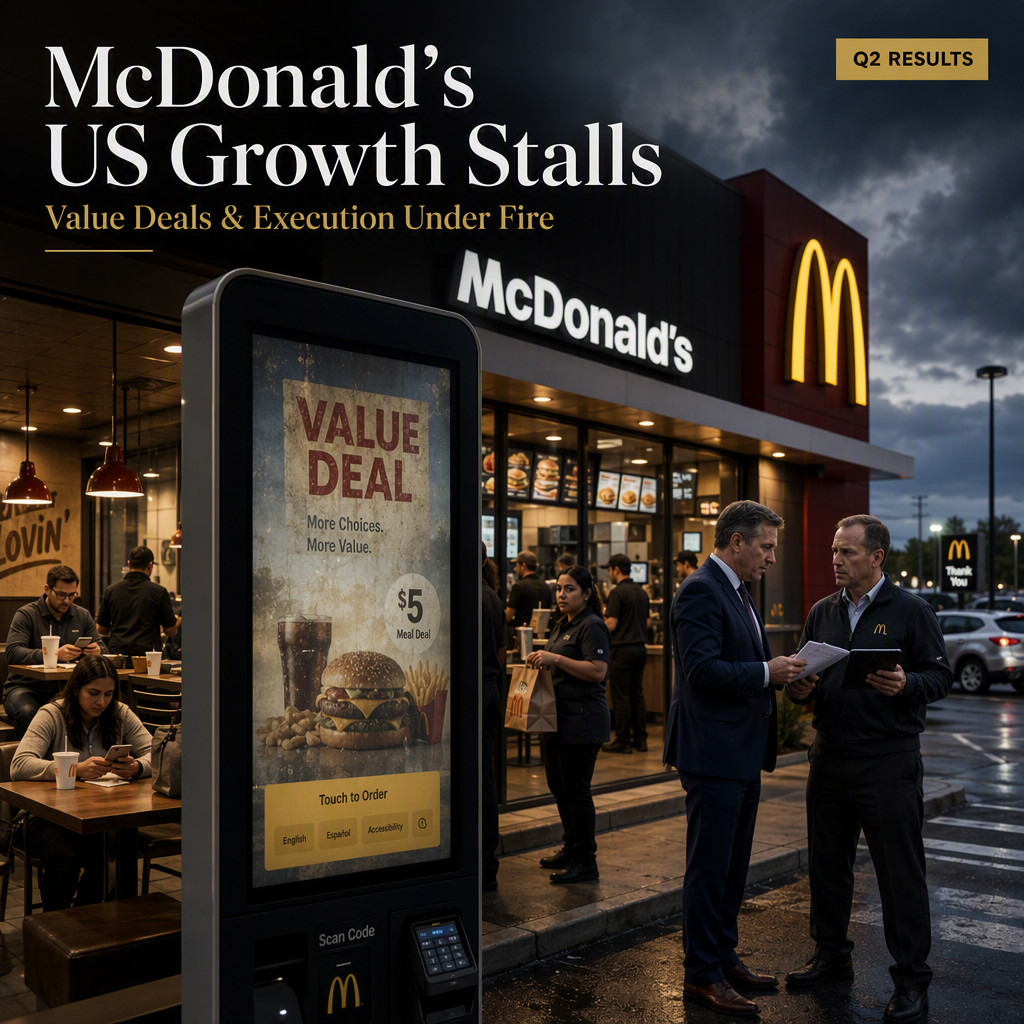
McDonald's reported slower-than-expected sales growth in its largest market, the United States, for the second quarter, attributing the shortfall to execution lapses in its value deal promotions aimed at lower-income consumers [1]. CEO Chris Kempczinski stated that weak promotion of value deals and a reduction in digital deals, such as buy-one-add-one offers, led to a decline in visits from loyal customers, which accounted for about two-thirds of the drop in customer traffic for the quarter [1].
Comparable sales in the U.S. grew by 0.8%, falling short of analysts' estimates of a 1.06% increase, according to LSEG data. This growth rate is notably lower than the 2.5% pace recorded last year [1]. Kempczinski emphasized that the issue was not with the company's strategy, but rather with inconsistent execution, particularly among franchisees who struggled to implement low-price menu offerings effectively [1]. He noted that about one-third of McDonald's U.S. restaurants did not follow guidance for the everyday affordable price menu, and the company plans to educate franchisees on the importance of compliance, which will be considered in future business reviews [1].
Operational challenges also impacted efficiency and customer service times, as restaurant teams were overwhelmed by the number of initiatives deployed during the quarter. Marketing programs failed to meet expectations, further contributing to the sales slowdown [1]. CFO Ian Borden announced that McDonald's will launch more national digital flash offers starting next week to reenergize high-frequency customers and will target loyal customers with more personalized digital offerings [1]. The company is also simplifying restaurant operations by eliminating several non-customer-facing activities over the remainder of the year [1].
To support its turnaround strategy, McDonald's appointed Skye Anderson to lead its U.S. business. Anderson, who has 26 years of experience with the company and previously served as U.S. chief operating officer, will oversee approximately 14,000 restaurants and guide the new growth initiatives [1].
CONCLUSION
McDonald's second quarter U.S. sales growth lagged expectations due to inconsistent execution of value deals and operational challenges. The company is responding with new digital offers, operational simplification, and leadership changes to reinvigorate growth. Market sentiment is cautious as investors await the impact of these turnaround efforts.