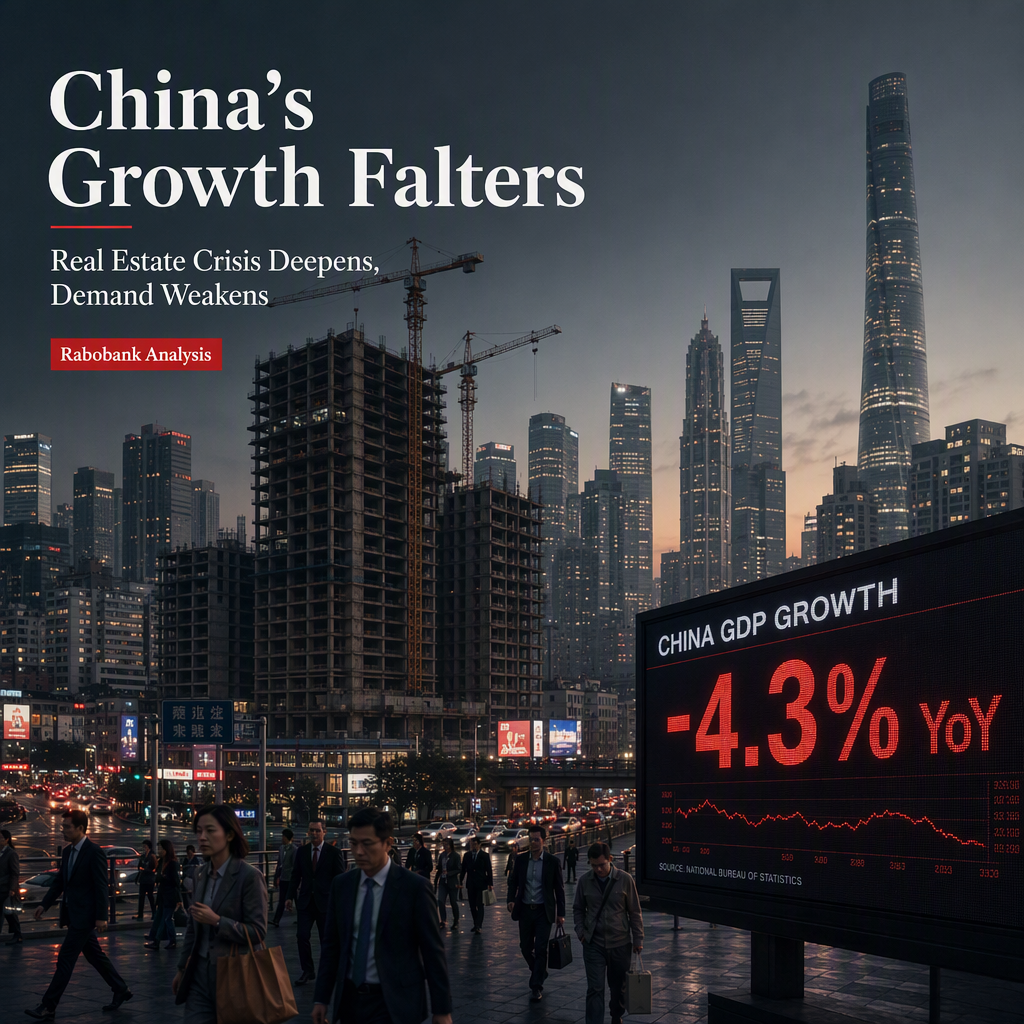
Rabobank’s Teeuwe Mevissen reports that China’s Gross Domestic Product (GDP) growth in the second quarter fell short of expectations, primarily due to persistent challenges from weak domestic demand and a worsening real estate crisis [1]. According to the data released in July, China’s GDP grew by 4.7% year-to-date (YTD), translating to 4.3% year-on-year (YoY), while economists had predicted 4.8% YTD and 4.5% YoY, respectively [1].
Despite retail sales and imports exceeding expectations, Rabobank cautions that these figures do not yet indicate a sustainable recovery in domestic demand, citing ongoing price declines in the real estate sector as a major factor suppressing consumer sentiment and retail sales [1]. The report suggests that Beijing is likely to respond with renewed consumption subsidies and minor People's Bank of China (PBoC) rate cuts, specifically forecasting two additional 10 basis point cuts for the remainder of the year [1].
Looking ahead, Rabobank expects China’s trading partners, including those in the Global South, to become increasingly dissatisfied with the current trade relationship, which may pressure China to implement significant reforms. The bank argues that a shift towards a consumption-driven economic model will result in structurally lower GDP growth in the coming years, likely falling below China’s official growth target of 4.5% to 5% [1]. Rabobank forecasts GDP growth of 4.5% for this year and a further slowdown to 4.2% in the following year [1].
CONCLUSION
China’s economy is facing significant headwinds from weak domestic demand and a deepening real estate crisis, leading to slower-than-expected GDP growth. Rabobank anticipates further policy easing and a structural shift towards lower growth rates as China transitions to a consumption-driven model. Market participants should prepare for continued economic moderation and potential policy responses from Beijing.