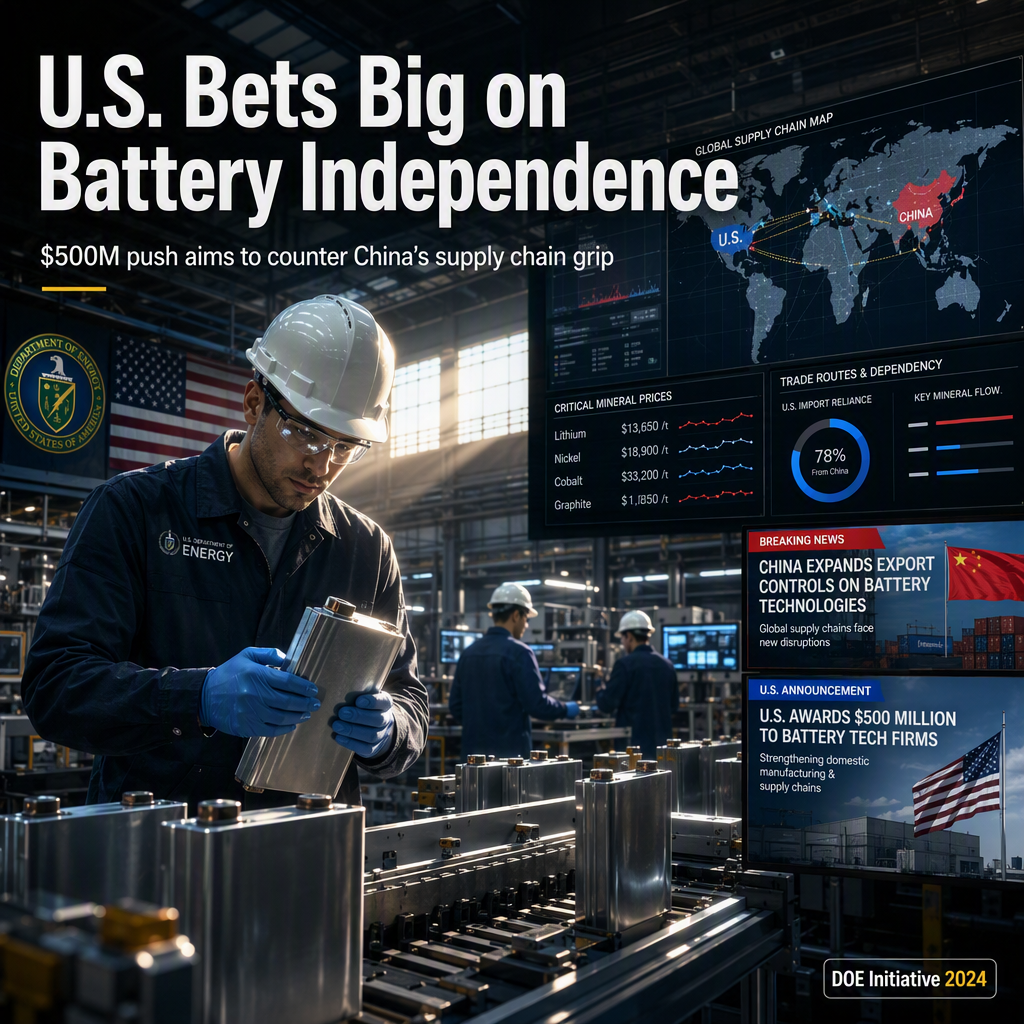
The Trump administration has initiated a significant push to reduce U.S. reliance on China for battery technology by awarding $500 million in August to seven companies involved in battery minerals, materials, manufacturing, or recycling [1]. This funding is part of two $3 billion Department of Energy (DOE) battery technology and materials programs established under the Biden-era Infrastructure Investment and Jobs Act [1]. The administration's efforts follow the cancellation of many Biden-era policies that supported battery manufacturing and funding for electric vehicles, which represent the largest global market for battery technology [1].
China maintains a majority share across several points of the battery supply chain, including raw minerals, chemicals, finished products like electric vehicles, and energy storage systems [1]. Its dominance is particularly pronounced in mineral refining, which has grown since 2020 according to the International Energy Agency [1]. In 2025, China leveraged its position by imposing strict export controls on rare earths and other minerals and processing equipment [1].
Among the companies receiving DOE funds, Coreshell Technologies was awarded $50 million to produce battery anodes from domestically sourced silicon, aiming to reduce dependence on Chinese-sourced graphite [1]. Lilac Solutions received $100 million, targeting areas where China has a strong presence in the supply chain [1]. Despite these efforts, analysts and executives interviewed by CNBC noted that the funding allocated is small compared to what would be required to significantly loosen China's grip on the industry [1]. Tu Le, founder and managing director of Sino Auto Insights, emphasized that achieving comprehensive scale across the supply chain would require decades and tens, if not hundreds, of billions of dollars, but the U.S. only has five to seven years to become competitive [1].
Richard Wang, CEO of Voya Energy, highlighted that boosting the U.S. battery supply chain had been a high priority for the Biden administration, but many of those policies have reversed or shifted under the Trump administration [1].
CONCLUSION
The U.S. is making a concerted effort to strengthen its battery supply chain and reduce reliance on China, but current funding levels are seen as insufficient to challenge China's entrenched dominance. Analysts warn that substantial investment and rapid progress are needed if the U.S. hopes to become competitive within the next decade. The market impact is medium, as these developments signal a shift in policy but do not immediately alter the global battery landscape.