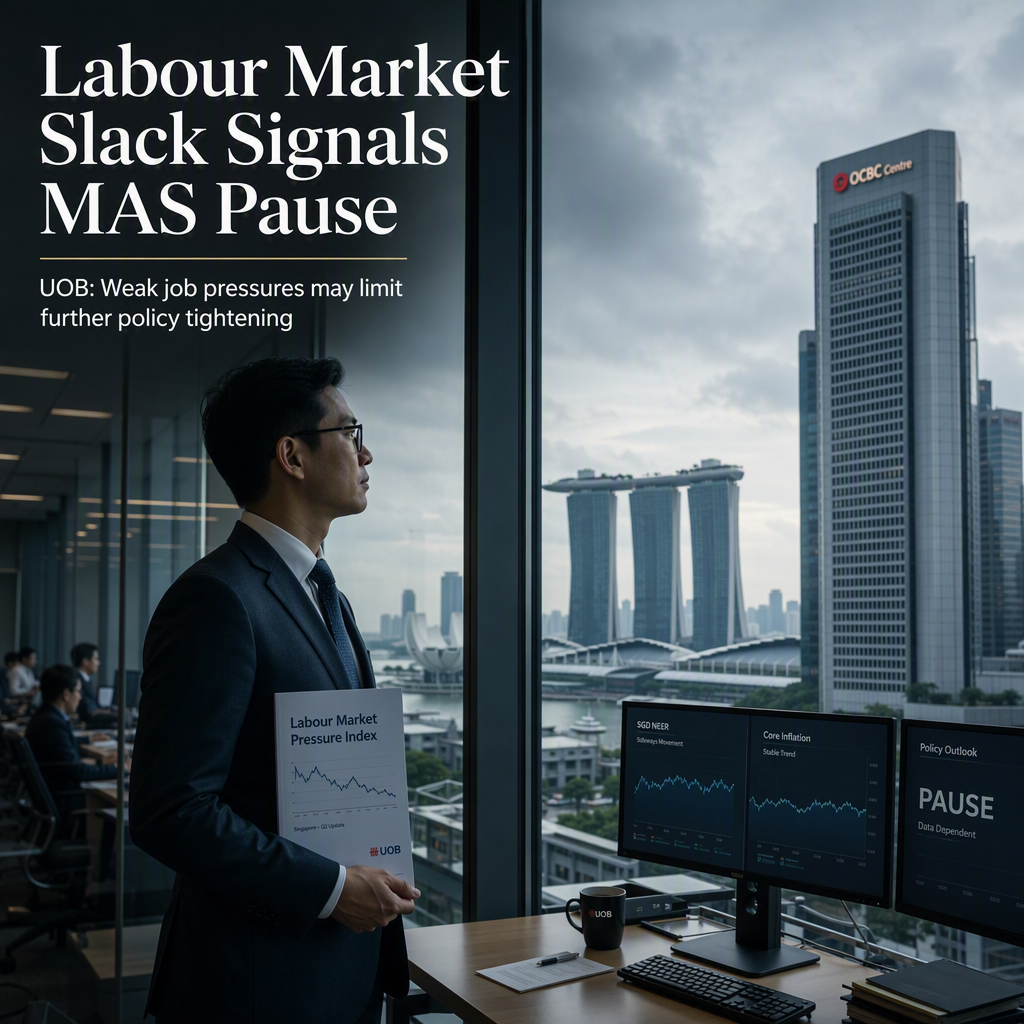
UOB’s Jester Koh has analyzed Singapore’s labour market conditions and their implications for the Monetary Authority of Singapore’s (MAS) monetary policy. According to UOB, the Labour Market Pressure Index (LMPI) indicates rising slack in the labour market, which is associated with a weaker passthrough of supply-side shocks, such as energy and food price increases, into core inflation. This trend has led to repeated downside surprises in core inflation readings [1].
UOB expects MAS to maintain its current Singapore Dollar Nominal Effective Exchange Rate (S$NEER) policy settings, with the slope estimated at 1.25% per annum, following two tightening moves in April and July of this year [1]. The report flags only a limited risk of further tightening, specifically a 'very slight' slope steepening of 25 basis points, which could occur in either the October 2026 or January 2027 Monetary Policy Statements (MPS) to address imported inflation risks. These risks are linked to the recent reacceleration in energy prices and strengthening food inflation momentum, with adverse weather events such as a looming Super El Niño posing additional upside risks [1].
UOB notes that the current labour market slack may temper the extent of passthrough from supply-side shocks into consumer prices, reducing the need for the aggressive MAS tightening seen in 2021-2022, when policy was tightened five times, including three upward re-centring moves [1].
CONCLUSION
UOB’s analysis suggests that Singapore’s soft labour market is likely to limit the need for further aggressive MAS policy tightening, despite ongoing risks from energy and food inflation. The base case is for MAS to keep its current policy stance, with only a limited chance of a minor adjustment in the coming years.