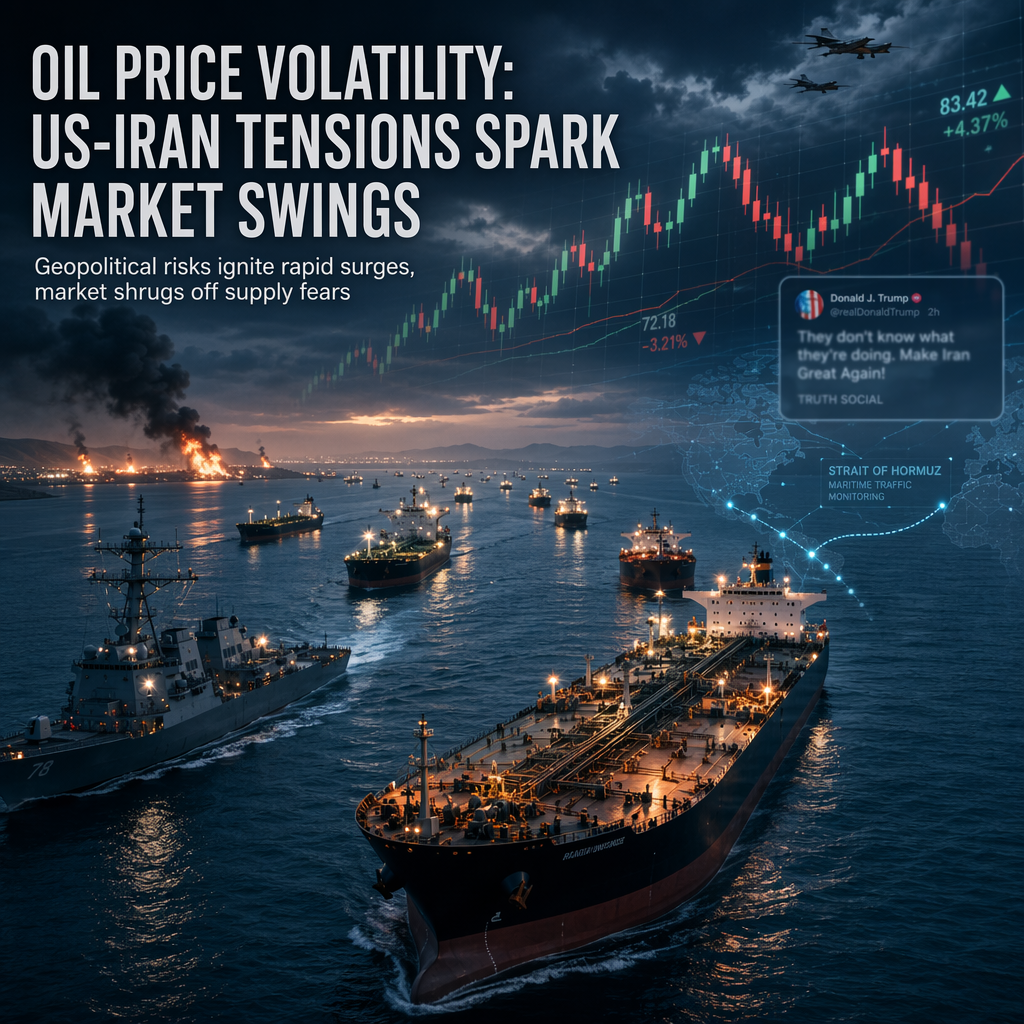
Crude oil markets experienced significant volatility on Monday, with prices initially declining from just above $84.00 to nearly $79.50 before rebounding sharply following geopolitical developments involving the US and Iran [1]. The morning sell-off occurred despite ongoing US strikes against Iranian capabilities targeting Strait of Hormuz shipping and recent attacks by the Islamic Revolutionary Guard Corps on tankers near Oman [1]. Market participants appeared to interpret diplomatic signals, such as the US Secretary of State's insistence that diplomatic channels remain open and the shelving of a proposed 20% transit fee on Hormuz cargo, as signs of potential de-escalation, prompting profit-taking after a 3% price increase on Sunday [1].
The reversal in oil prices was triggered by a Truth Social post from President Trump, in which he vowed revenge on Iran after Iranian strikes killed two US soldiers in Jordan, stating that Tehran would 'repay every American death several times over' and confirming that directives had already been issued to US commanders [1]. This announcement led to an immediate bid in crude oil, with prices surging through $82.00 and testing the $83.00 handle, recouping nearly $2.00 of the earlier losses within two hours [1]. The market's asymmetric reaction was notable, as it took hours of negative news to drive prices lower, but only a single statement to recover much of the decline [1].
Societe Generale analysts Michael Haigh and Jeremy Sellem reported that the front month Brent contract rose 12% during the week, with most of the rebound occurring on Monday and Tuesday following the resumption of strikes by both the US and Iran [2]. Additional support for oil prices came from Trump's reiterated intention to launch record strikes against military targets and a brief proposal for US fees to ensure safe passage for commercial vessels [2]. The Houthi group's announcement of a maritime blockade on Saudi Arabia in response to the situation in Yemen added further risk, causing oil prices to rally toward $91/bbl before retreating, which analysts interpret as a sign of market complacency regarding threats to regional energy flows [2].
Crack spreads, which measure the profitability of refining crude oil into products, have strengthened significantly, rising 22% in Asia and 12% in the US, reflecting heightened concerns in Asia about potential disruptions to flows through the Strait of Hormuz and the risk of product shortages [2]. Inventory data indicated a build of 21 million barrels in June, primarily in crude oil rather than refined products [2]. Crude oil now accounts for nearly 80% of Hormuz transit volumes, about five percentage points higher than before the conflict began [2].
CONCLUSION
Crude oil markets remain highly sensitive to geopolitical developments, with US-Iran tensions and regional threats driving sharp price swings. While risk premia surged on renewed conflict and political rhetoric, the market's subsequent retreat suggests a degree of complacency about supply disruptions. Strengthening crack spreads and shifting transit volumes highlight ongoing concerns about refined product availability, particularly in Asia.