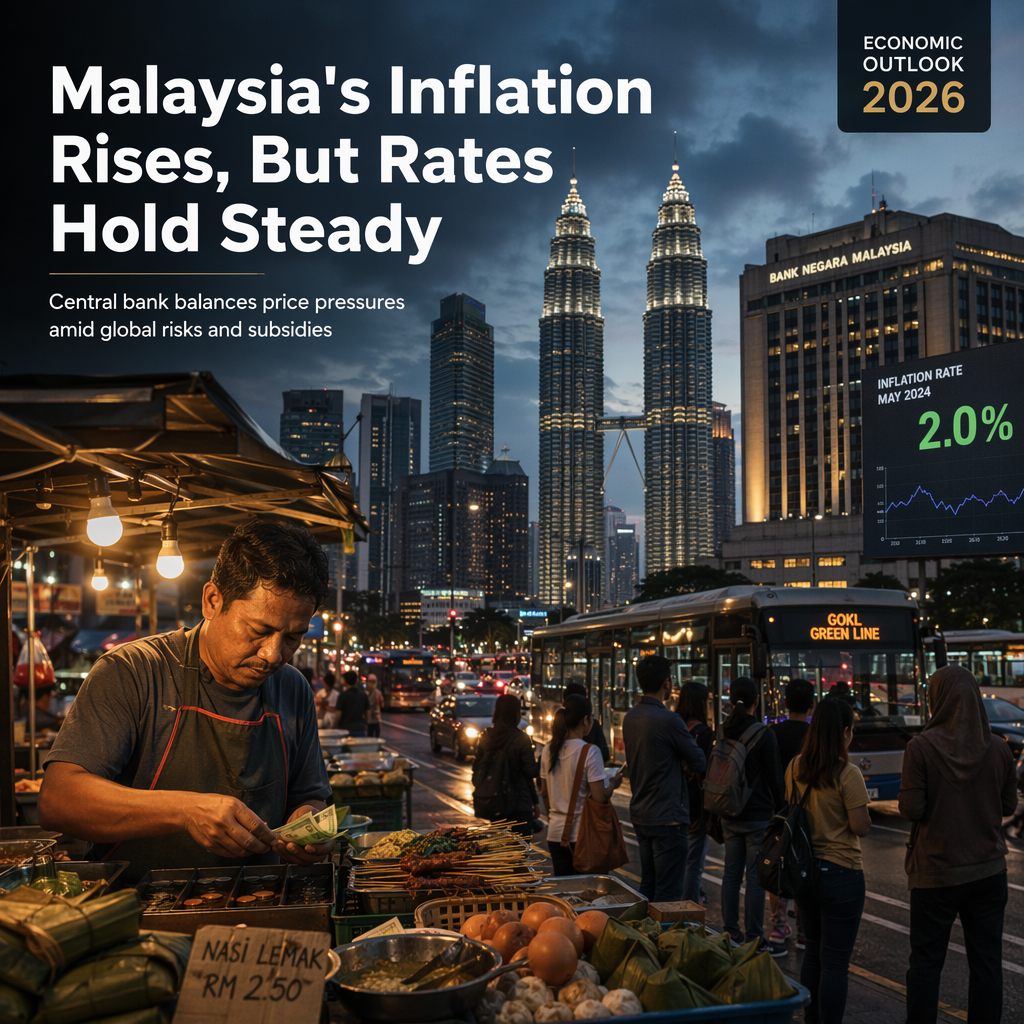
Malaysia's headline inflation rate rose to 2.0% year-on-year in May, marking the highest level since July 2024, according to UOB economists Julia Goh and Loke Siew Ting. The increase was primarily driven by higher costs in Food, Housing, Utilities, and Transport sectors [1]. Year-to-date inflation from January to May 2026 stands at 1.7%, which supports UOB's full-year inflation forecast of 2.0%. Bank Negara Malaysia's (BNM) official estimate for full-year inflation ranges between 1.5% and 2.5%, with 2025 inflation recorded at 1.4% [1].
The economists highlighted ongoing supply-side shocks, including the Middle East conflict and the anticipated onset of El Niño from June 2026 to mid-2027, which are expected to push crop prices higher and pose upside risks to inflation. However, they noted that the preliminary US–Iran peace memorandum of understanding (MOU) could help ease tensions in the Middle East, potentially alleviating some cost pressures. Despite these risks, continued fuel subsidies are expected to help contain inflation, provided oil prices remain below USD200 per barrel [1].
Core inflation continues to ease, indicating softer domestic demand. This, combined with manageable headline inflation due to ongoing subsidies and lower global energy prices, leads UOB to expect that Bank Negara Malaysia will maintain the Overnight Policy Rate (OPR) at 2.75% through 2026. The central bank is expected to remain vigilant regarding external risks and adjust policy settings as necessary [1].
Overall, prevailing price pressures in Malaysia are largely attributed to supply-side factors, while the moderation in core inflation points to weakening domestic demand conditions. UOB maintains its view that the OPR will be held steady at 2.75% for the foreseeable future [1].
CONCLUSION
Malaysia's inflation has reached its highest point since July 2024, but UOB expects the central bank to keep interest rates unchanged at 2.75% due to manageable inflation and easing core pressures. While supply-side risks persist, ongoing subsidies and lower energy prices are expected to help contain further inflationary pressures.