
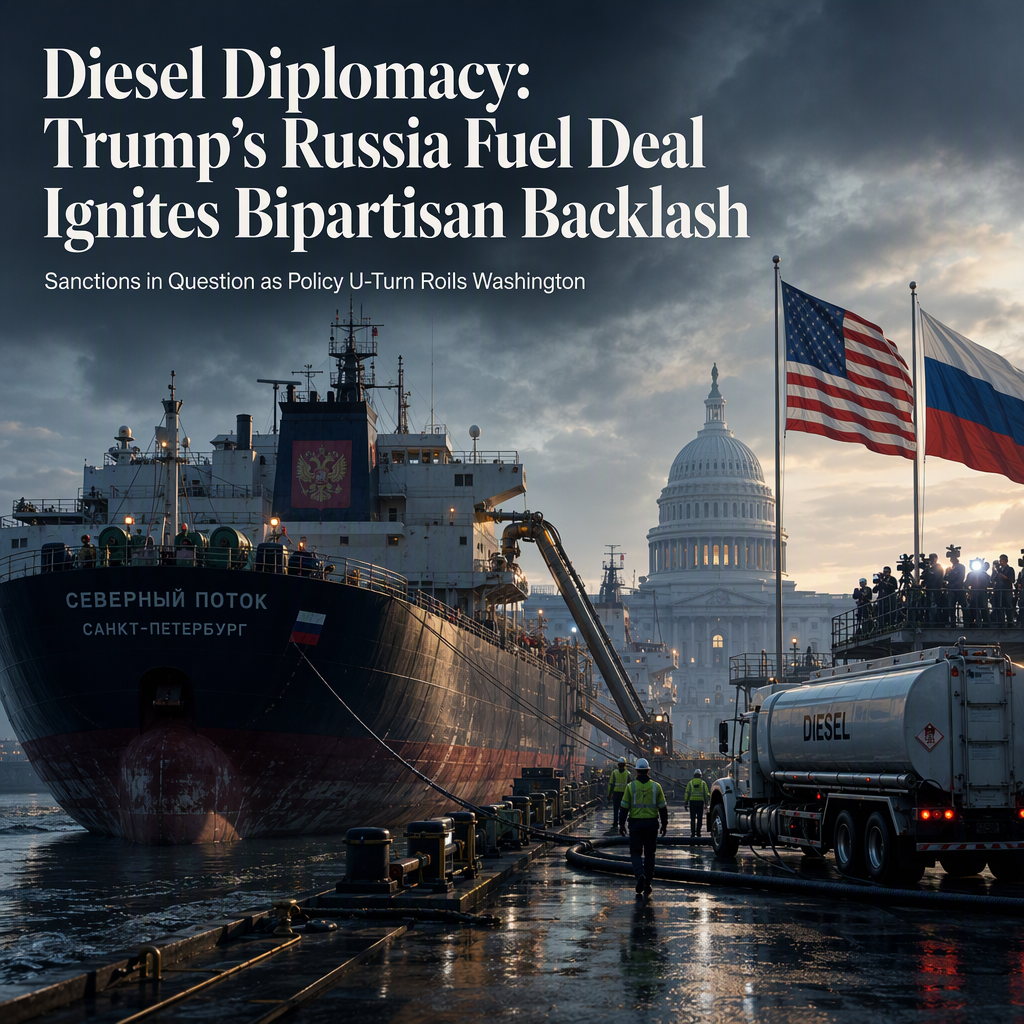
President Donald Trump announced that Russia will supply diesel fuel to the global market, a move intended to swiftly reduce record-high diesel prices ahead of the upcoming midterm election focused on affordability [1]. This announcement marks a significant shift from recent U.S. efforts to pressure Moscow by targeting Russian energy exports, specifically in response to the ongoing war in Ukraine [1].
The decision has drawn immediate criticism for contradicting the Lindsey O. Graham Sanctioning Russia and Iran Act of 2026, which Trump signed into law just three weeks prior. This legislation empowers the president to impose tariffs up to 100% on top purchasers of Russian crude oil or gas, among other restrictions [1]. Scott Lincicome, vice president of the Cato Institute, questioned the logic of the move, asking, "Congress just passed a law giving Trump the power to impose new tariffs on major buyers of Russian oil & gas. Can America tariff America?" [1]. Senator Richard Blumenthal, D-Conn., accused Trump's action of being "directly contrary to Congress's intent in our bipartisan sanctions bill" [1]. Peter Harrell of Georgetown University Law Center commented that the relaxation of Russian diesel restrictions "pretty much proves the point that the Graham Russia Bill was not going to force the Trump Administration to increase economic pressure on Moscow" [1].
Criticism has crossed party lines, with Representative Michael McCaul, R-Texas, expressing concern that lifting sanctions on Russian oil could "only fund the Kremlin's war machine—emboldening more violence and destruction, as we have seen in recent days" [1]. The White House has not responded to questions regarding the diesel agreement with Russia [1].
Less than a year earlier, the Trump administration imposed sanctions on multiple Russian oil companies due to "Russia's lack of serious commitment to a peace process to end the war in Ukraine" [1]. Trump had previously criticized NATO allies for purchasing Russian oil, stating in a September 2025 Truth Social post that such purchases "greatly weaken your negotiating position, and bargaining power, over Russia" [1]. At the United Nations General Assembly later that month, Trump reiterated his criticism, saying, "They're funding the war against themselves. Who the hell ever heard of that one? They can't be doing what they're doing" [1].
CONCLUSION
Trump's announcement of a diesel supply agreement with Russia has triggered bipartisan criticism for contradicting recent sanctions legislation and potentially undermining efforts to pressure Moscow over the Ukraine war. While the move aims to lower diesel prices ahead of the midterm election, lawmakers and analysts warn it may inadvertently strengthen Russia's position. The market impact is likely significant given the policy reversal and its implications for global energy dynamics.