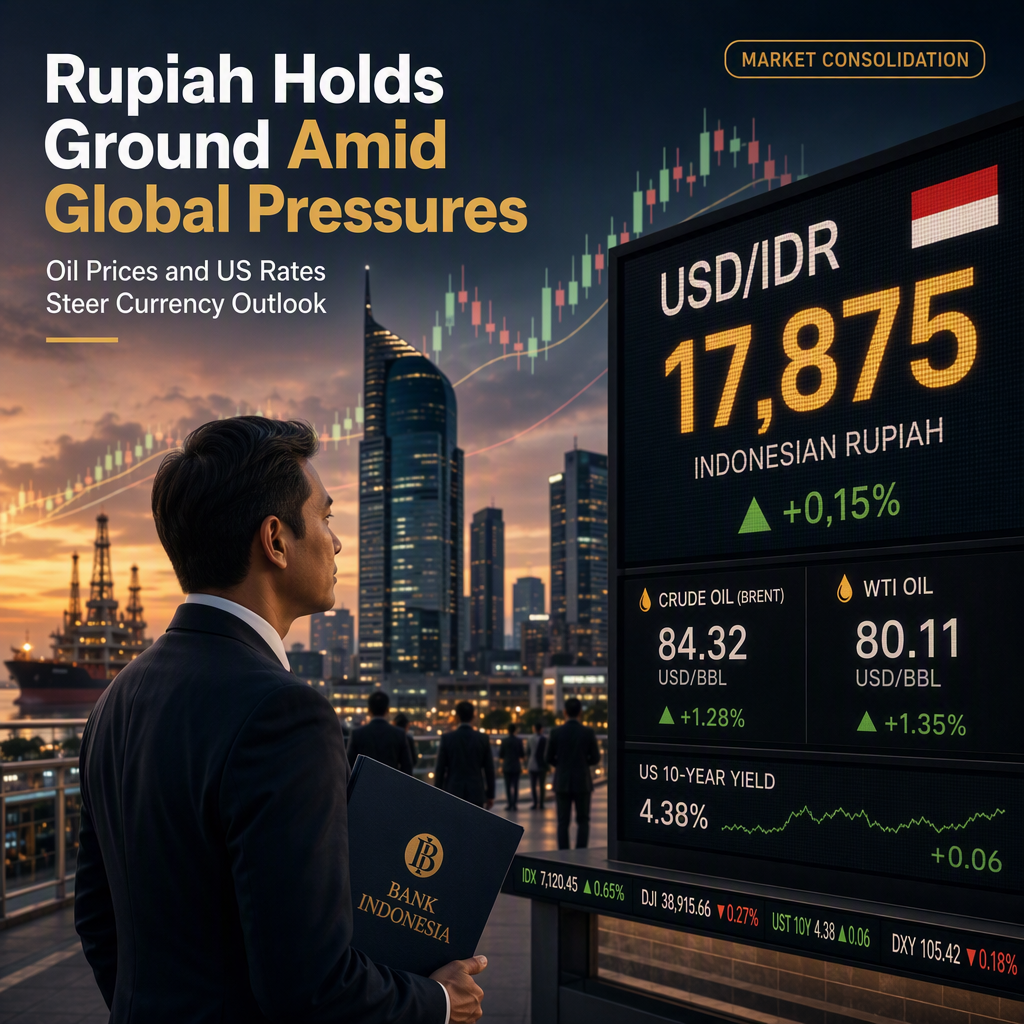
According to OCBC analysts Sim Moh Siong and Christopher Wong, the Indonesian Rupiah (IDR) has experienced a rebound against the US Dollar (USD) following a near 2% month-to-date pullback, with the USD/IDR pair last observed at 17,875 levels [1]. The analysts highlight that external factors, particularly elevated oil prices and US interest rates, continue to be the main drivers influencing the currency pair. Elevated oil prices are noted as a headwind for Indonesia’s terms of trade, even as the broader USD backdrop has eased somewhat [1].
Policy continuity at Bank Indonesia (BI) and its ongoing focus on IDR stability are seen as supportive for investor confidence and as factors that could help mitigate volatility in the Rupiah [1]. Despite these supportive elements, the analysts remain slightly cautious on the IDR in the near term, citing oil prices, US rates, and the broader direction of the USD as likely to remain key influences [1].
From a technical perspective, the article identifies resistance levels for USD/IDR at 17,950 (aligned with the 21- and 50-day moving averages) and 18,100, while support is noted at 17,800 and 17,600 (the 100-day moving average) [1]. The daily chart shows mild bearish momentum for the pair, but a rising RSI suggests that two-way trades are likely in the current environment [1].
No specific market reactions or analyst forecasts regarding future price targets are provided beyond the technical levels and the expectation of continued consolidation [1].
CONCLUSION
The Indonesian Rupiah is expected to consolidate against the US Dollar, with defined resistance and support levels guiding near-term trading. External factors such as oil prices and US rates remain key drivers, while policy continuity at Bank Indonesia supports investor confidence. Analysts maintain a slightly cautious outlook, anticipating two-way trading in the current environment.