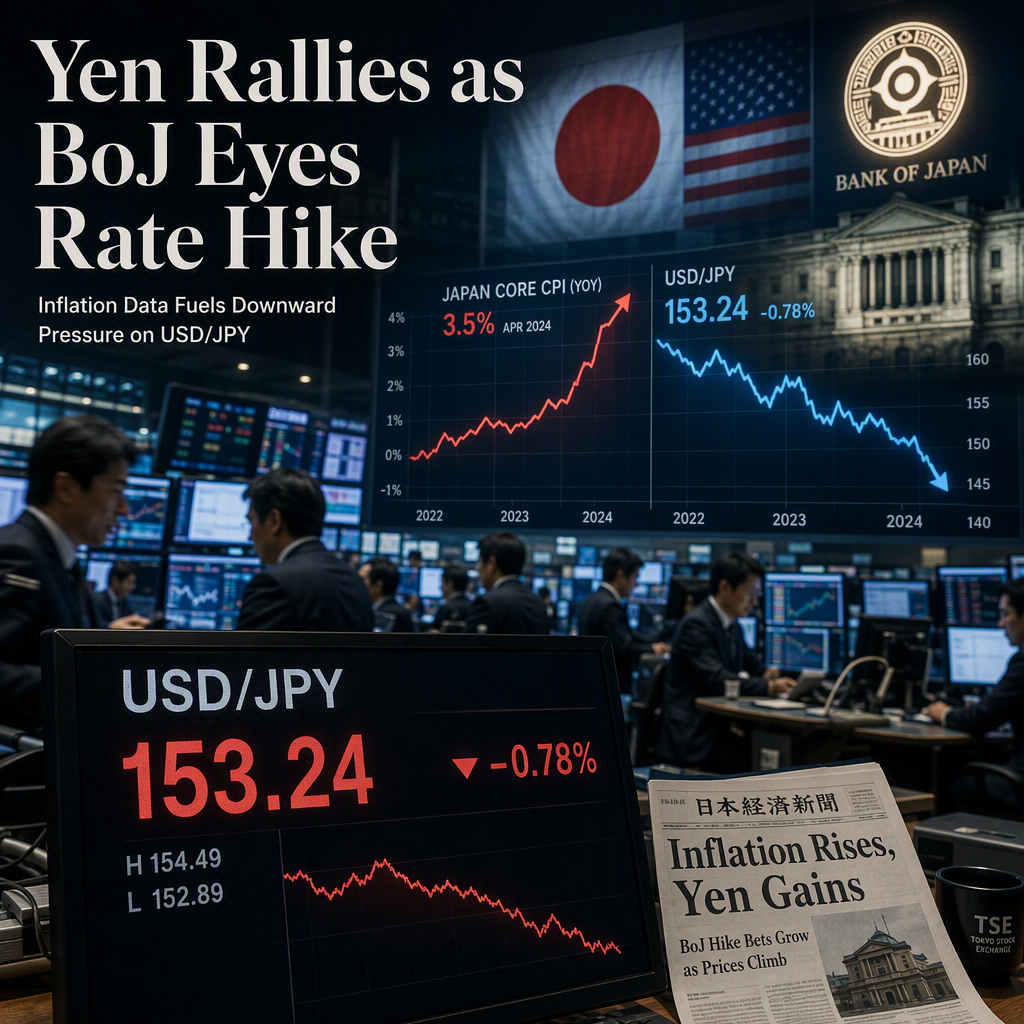
The Japanese Yen (JPY) maintained its gains against the US Dollar (USD) amid growing expectations of a hawkish stance from the Bank of Japan (BoJ), following the release of domestic data showing an acceleration in core consumer inflation during July. Specifically, Japan's core Consumer Price Index (CPI), excluding fresh food, rose 1.8% year-over-year in July, up from 1.6% in the previous month and marking the fastest pace since January. Additionally, an index excluding both fresh food and fuel prices, closely watched by the BoJ, increased 1.9% year-over-year after a 1.7% gain in June, further supporting the case for a potential BoJ rate hike [1].
The USD/JPY pair struggled to build on its previous day's recovery from the 158.00 level, meeting fresh supply and trading around 158.60 during the first half of the European session. This left the pair on track to end in the red for the first time in three weeks. The Japanese Yen was the strongest against the US Dollar among major currencies this week, with the USD/JPY pair showing a -0.44% change [1].
On the US side, the US Dollar Index (DXY) hovered near its lowest level since May 14 as traders reduced bets on an immediate interest rate hike by the Federal Reserve. However, markets still assigned a 68% probability that the Fed would raise borrowing costs by the end of the year, citing inflation risks from higher oil prices. Minutes from the July 28-29 FOMC meeting indicated officials saw the need to raise rates soon unless inflation showed more progress in declining [1].
According to United Overseas Bank (UOB) analyst Quek Ser Leang, the USD/JPY pair rebounded sharply from 158.00 to close at 159.05 (+0.56%), but the rebound appears overdone. UOB expects the pair to trade in a range between 158.50 and 159.35 intraday, with a slightly negative outlook for the next 1–3 weeks, projecting the pair to edge lower within a 156.60–159.60 range. However, longer-term charts still allow for a potential advance above the 21-day EMA [2].
Despite the JPY's recent strength, the wide US-Japan interest rate gap and concerns about Japan's fiscal condition may limit further aggressive JPY gains. Traders are now looking to upcoming US flash PMIs and developments in the Middle East for additional market direction [1].
CONCLUSION
The Japanese Yen's recent gains are underpinned by accelerating domestic inflation and rising expectations of a BoJ rate hike, while the US Dollar remains pressured by shifting Fed expectations. Analysts anticipate the USD/JPY pair to remain range-bound with a mild downside bias in the near term. Market participants are closely monitoring upcoming economic data and geopolitical developments for further cues.