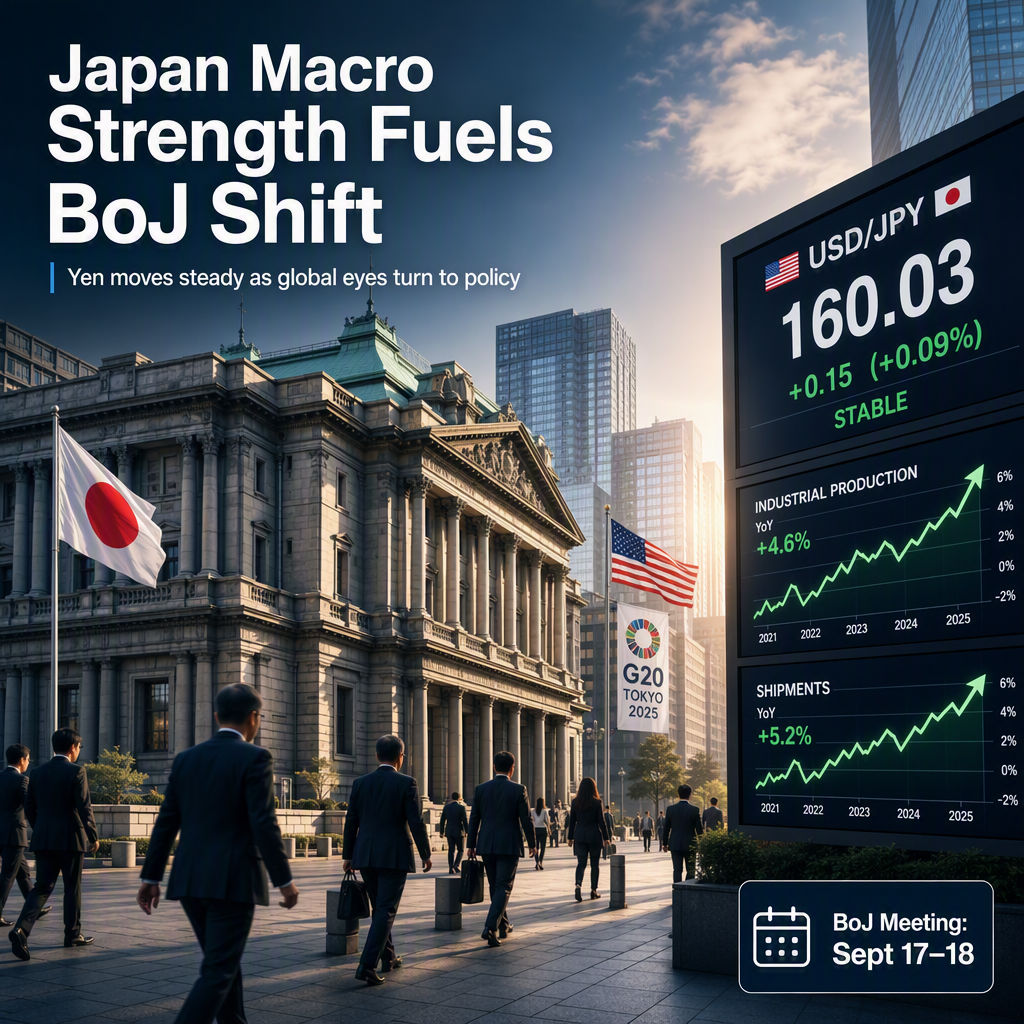
Recent Japanese macroeconomic data has reinforced expectations that the Bank of Japan (BoJ) may continue its policy normalization process. According to Wee Khoon Chong at BNY, Japan's industrial production was flat month-on-month in July, registering a +0.1% m/m increase on a seasonally adjusted basis. Shipments rose by 2.2% m/m, inventories increased by 0.5% m/m, and the inventory ratio fell by 1.7% m/m, all of which support the narrative that Japan has exited deflation and that BoJ normalization remains in play [1].
U.S. Treasury Secretary Scott Bessent commented that recent Japanese Yen (JPY) moves have been 'pretty well-contained' and not disorderly, which has reduced immediate expectations of another joint U.S.-Japanese intervention. Bessent acknowledged that the yen's slide below 160 per dollar has drawn market attention but characterized the situation as manageable [1].
Bessent further stated that he expects BoJ Governor Kazuo Ueda to 'do the right thing' regarding policy decisions, while refraining from advising Japan on interest rates. He suggested that Japan has already overcome deflation and that the era of Abenomics is ending, with the country shifting toward 'Takaichi-nomics.' These remarks come ahead of the BoJ's September 17-18 meeting, which markets are closely watching for a possible rate hike. Bessent also plans to meet Ueda at the upcoming G20 gathering in Asheville [1].
CONCLUSION
Strong macroeconomic data and comments from U.S. Treasury Secretary Bessent have reinforced expectations of BoJ policy normalization, while immediate intervention in the yen appears unlikely. Market participants are now focused on the upcoming BoJ meeting for potential policy changes.