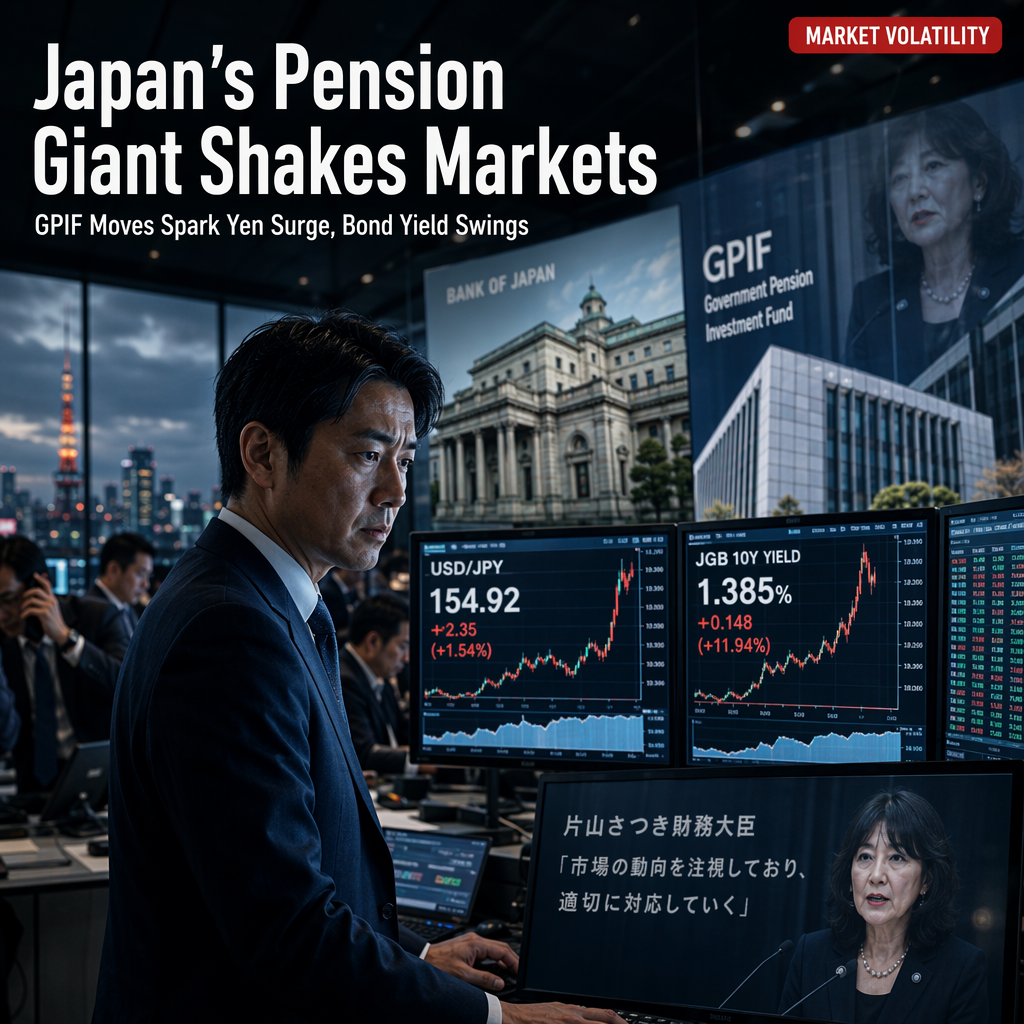
Japan's financial markets experienced significant volatility following remarks by Finance Minister Satsuki Katayama, which led to a sharp drop in long-term Japanese government bond (JGB) yields and a rise in the yen's value [1]. Market participants speculate that the Government Pension Investment Fund (GPIF), Japan's largest pension fund, may have been actively buying JGBs, exerting a substantial influence on both yields and the currency [1]. Despite the short-term decline in yields, underlying fiscal concerns remain unresolved, and the conditions that initially drove yields higher have not changed [1].
The yen strengthened and JGB yields fell immediately after the finance minister's comments, but ongoing fiscal fears have pushed Japanese bond yields toward 3%, highlighting persistent worries about the sustainability of government spending and debt levels [1]. The yen's weakness continues, with the currency reaching a 39-year low of 162 per dollar, as markets perceive the Bank of Japan (BOJ) as lagging behind in policy responses [1]. Japanese banks are reportedly hesitant to buy JGBs as the BOJ reduces its intervention, further contributing to market uncertainty [1].
Technical indicators reveal that price levels in both the JGB and yen markets are highly sensitive to fiscal policy signals, with support and resistance zones shifting rapidly in response to government actions and sentiment [1]. Traders are advised to closely monitor official statements and pension fund activity for signs of further volatility [1]. The recent developments highlight the complex interplay between fiscal policy, central bank independence, and market stability in Japan, with major institutional players like the GPIF having an outsized impact on market movements [1].
CONCLUSION
Speculation about GPIF's JGB purchases and remarks from Finance Minister Katayama have triggered notable volatility in Japan's bond and currency markets. Persistent fiscal concerns and perceived BOJ inaction continue to weigh on sentiment, with traders closely watching for further official signals. The market remains highly sensitive to policy developments, underscoring the importance of institutional actions and government statements.