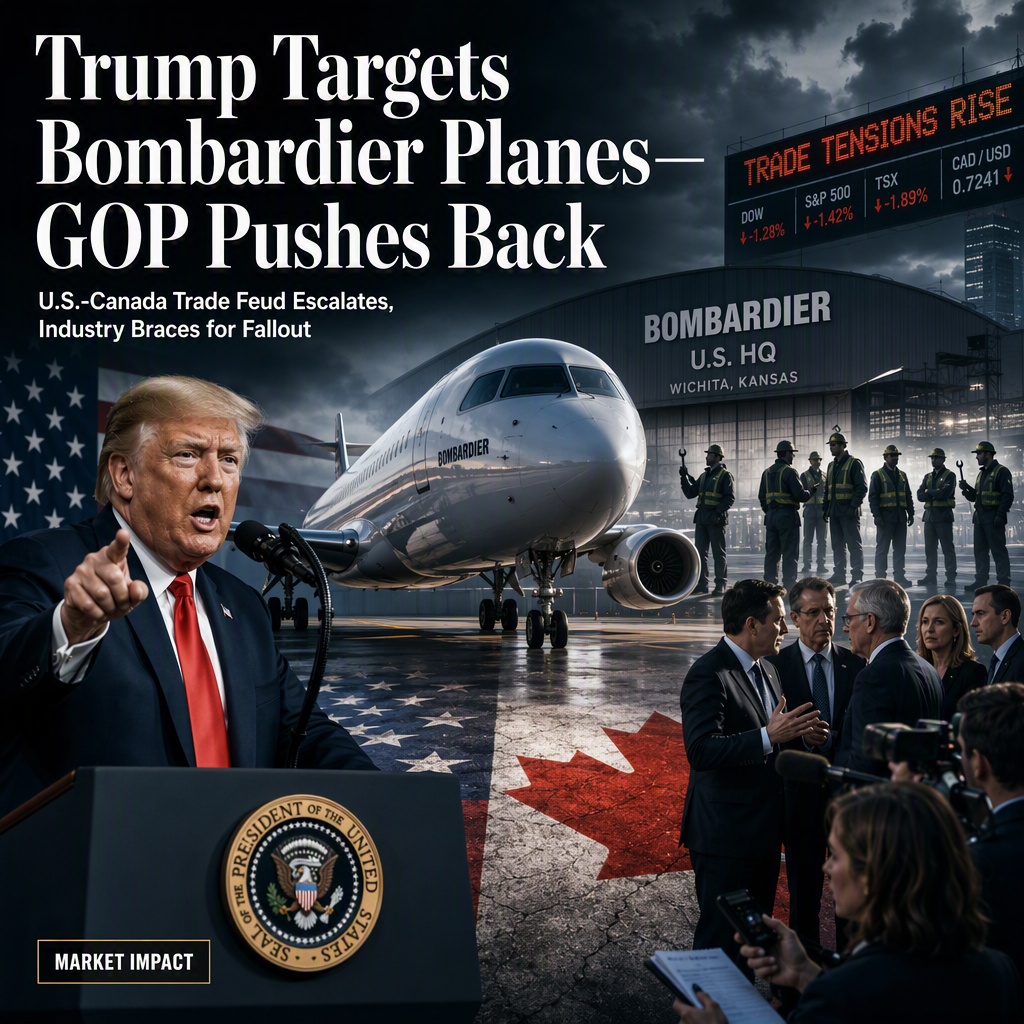
President Donald Trump announced on Monday that the Canadian aerospace company Bombardier should no longer be allowed to sell its planes in the United States, escalating his ongoing trade dispute with Canada [1]. Trump made the declaration via Truth Social, stating, 'NO MORE SELLING BOMBARDIER IN THE UNITED STATES!' and criticizing the quality of Bombardier's products. He further accused the company of relying heavily on American buyers, companies, airports, and services, while alleging that Canada restricts American banks and companies from operating freely in the U.S. [1].
Trump demanded that Bombardier must build its products in the U.S. if it wants access to the American market, and stop treating America like a 'piggybank' [1]. The announcement drew immediate responses from both Bombardier and Senator Jerry Moran (R-Kan.), whose state hosts Bombardier’s U.S. headquarters. Moran emphasized Bombardier's significant role in Wichita, Kansas, supporting a local workforce of more than a thousand employees and contributing to national defense and aerospace capabilities [1]. He stated that he had contacted the Trump administration to highlight Bombardier's importance to Kansas workers and the broader supply chain [1].
Bombardier defended its position, describing itself as a 'strong contributor' to the American aerospace industry, responsible for creating tens of thousands of jobs across the United States [1]. The company detailed its employment presence in more than 20 states, including Kansas, Texas, Arizona, Florida, Connecticut, Illinois, Delaware, California, Washington D.C., and New Jersey. Bombardier also highlighted its robust U.S. supply chain and the use of American-made components, noting that the wings for its fastest business jet are manufactured in Red Oak, Texas, and crucial flight control components are produced in Los Angeles, California [1]. Additionally, Bombardier announced plans to expand its defense activities and service network, with a new facility set to open in Fort Wayne, Indiana later this year [1].
The clash between Trump and Bombardier occurs against the backdrop of a broader trade war, with the president imposing new tariffs on Canadian products and Republican senators increasingly pushing back against his Canada trade policy as midterm elections approach [1].
CONCLUSION
Trump's call for a Bombardier plane ban has heightened U.S.-Canada trade tensions and sparked immediate opposition from both Bombardier and Senator Moran, who underscored the company's significant U.S. presence and job creation. The event signals potential disruption in the aerospace sector and broader supply chains, with high market impact as stakeholders await further developments.