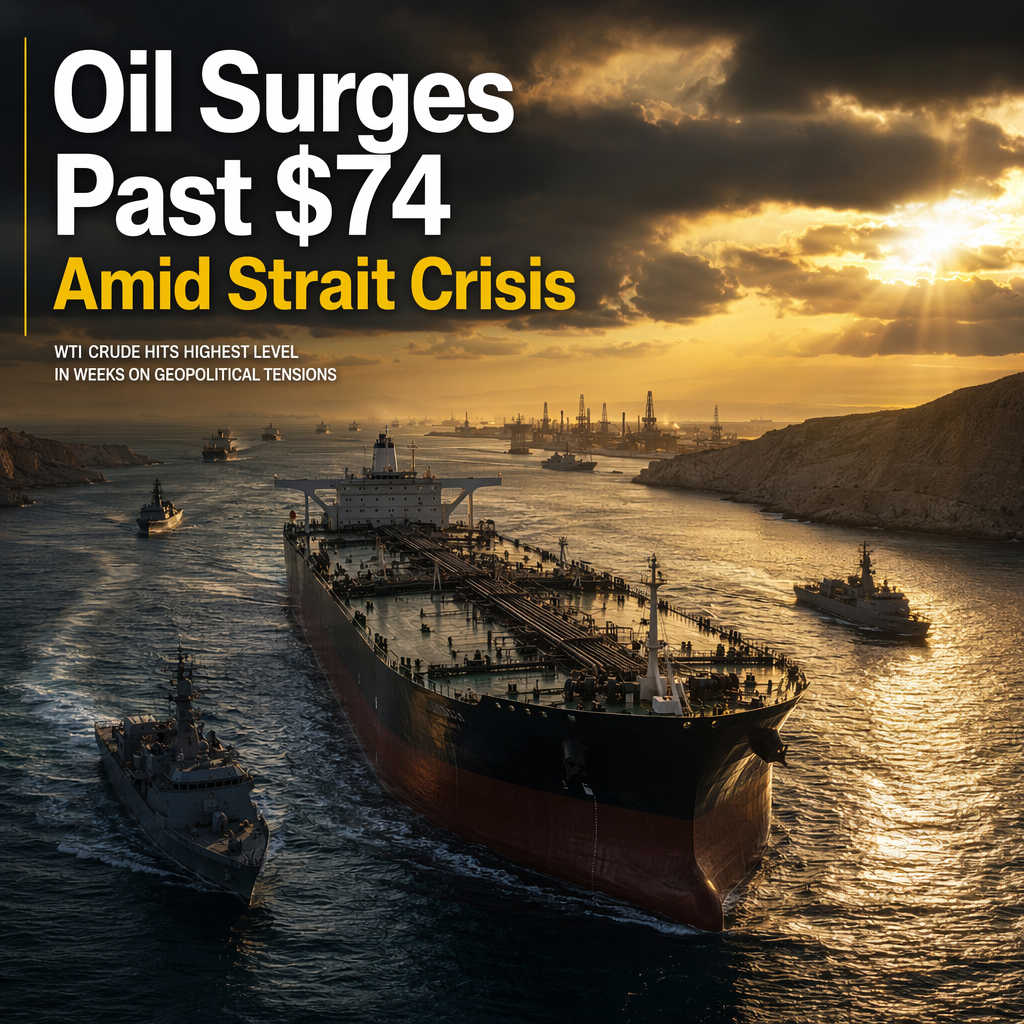
West Texas Intermediate (WTI), the benchmark US crude oil price, climbed above the $74.00 mark during the Asian session on Monday, following a modest bullish gap opening. This upward movement was driven by escalating tensions between the US and Iran, as well as the closure of the Strait of Hormuz, which has injected uncertainty into the energy market and provided support for oil prices [1].
From a technical perspective, WTI retains a bearish near-term bias as it remains below the 200-day Exponential Moving Average (EMA) and the 23.6% Fibonacci retracement level of the April-July decline. The Moving Average Convergence Divergence (MACD) indicator has turned positive, suggesting some rebuilding upside momentum, but the Relative Strength Index (RSI) at around 47 indicates that rebounds are still occurring within a broader capped structure rather than signaling a confirmed trend reversal [1].
Resistance levels are noted at the 23.6% Fibonacci retracement near $76.58 and the 200-day EMA at $77.19, which form the first critical supply band bulls would need to reclaim to ease downside pressure. Additional resistance is seen at the 38.2% retracement around $82.45, the 50% level near $87.20, and the 61.8% retracement close to $91.95, with higher barriers at $98.71. On the downside, structural support sits at the prior swing low around $67.08, and a break below this level could reopen the broader bearish leg [1].
No forward-looking statements or analyst opinions are explicitly provided in the article. The market reaction is characterized by a modest bullish move, but technical indicators suggest caution as the bearish bias remains intact below key resistance levels [1].
CONCLUSION
WTI crude oil prices have risen above $74.00 due to geopolitical tensions and supply disruptions, but technical analysis indicates that the bearish bias persists unless key resistance levels are reclaimed. The market remains cautious, with upside momentum building but not yet signaling a confirmed trend reversal.