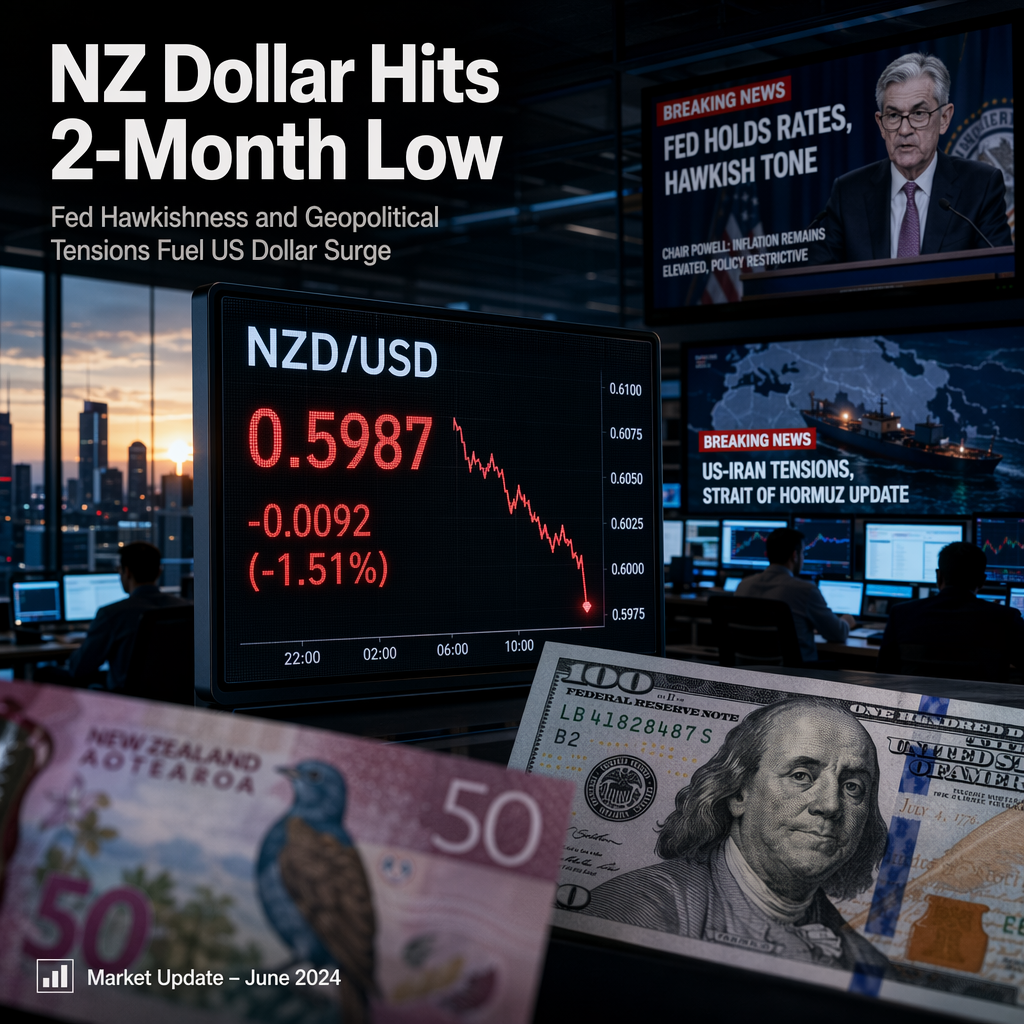
The New Zealand Dollar (NZD) continued its decline against the US Dollar (USD) on Monday, with NZD/USD trading around 0.5730 and marking its lowest level since April 8. This marks the fourth consecutive day of losses for the pair, driven by broad US Dollar strength and ongoing uncertainty surrounding the US-Iran peace process [1].
The People's Bank of China (PBOC) announced that it would keep its Loan Prime Rates (LPRs) unchanged, with the one-year rate at 3% and the five-year rate at 3.5%. This decision was in line with market expectations and provided no additional support to the New Zealand Dollar, which is closely linked to Chinese economic conditions [1].
The US Dollar Index (DXY) rebounded after a recent pullback, reflecting renewed demand for the Greenback. This was attributed to a hawkish stance from the Federal Reserve (Fed) and heightened geopolitical tensions. At its first meeting under new chairman Kevin Warsh, the Fed kept its benchmark interest rate steady between 3.5% and 3.75%. Warsh emphasized that "price stability" would remain the Fed's guiding principle. Futures markets are now pricing in at least a 25-basis-point rate hike at the September meeting, with some traders anticipating a possible move as early as July [1].
Geopolitical developments also influenced market sentiment. US Vice President JD Vance confirmed that mechanisms have been established to keep the Strait of Hormuz open and halt hostilities in Lebanon, with technical talks on the US-Iran peace deal set to continue. Iran has agreed to allow International Atomic Energy Agency (IAEA) inspectors back, with inspections potentially starting this week. Qatar and Pakistan announced that Washington and Tehran have agreed on a roadmap aimed at a final peace agreement within 60 days. Iranian Foreign Minister Abbas Araqchi confirmed breakthroughs, including waivers for oil and petrochemical exports, the release of some frozen Iranian assets, and the start of an economic reconstruction program. These diplomatic advances contributed to lower oil prices and eased concerns about energy-driven inflation [1].
Despite these positive diplomatic signals, risk appetite remains subdued due to the fragile nature of the truce. Iran previously accused the US and Israel of ceasefire violations and temporarily closed the Strait of Hormuz, while US President Donald Trump threatened military action if Tehran-backed groups continued attacks on Israel. These incidents highlight ongoing risks in the region [1].
CONCLUSION
The New Zealand Dollar's decline reflects a combination of hawkish Fed policy expectations and persistent geopolitical uncertainty, which have strengthened the US Dollar. While diplomatic progress between the US and Iran has eased some inflation concerns, market sentiment remains cautious due to the fragile nature of the truce and ongoing regional risks.