
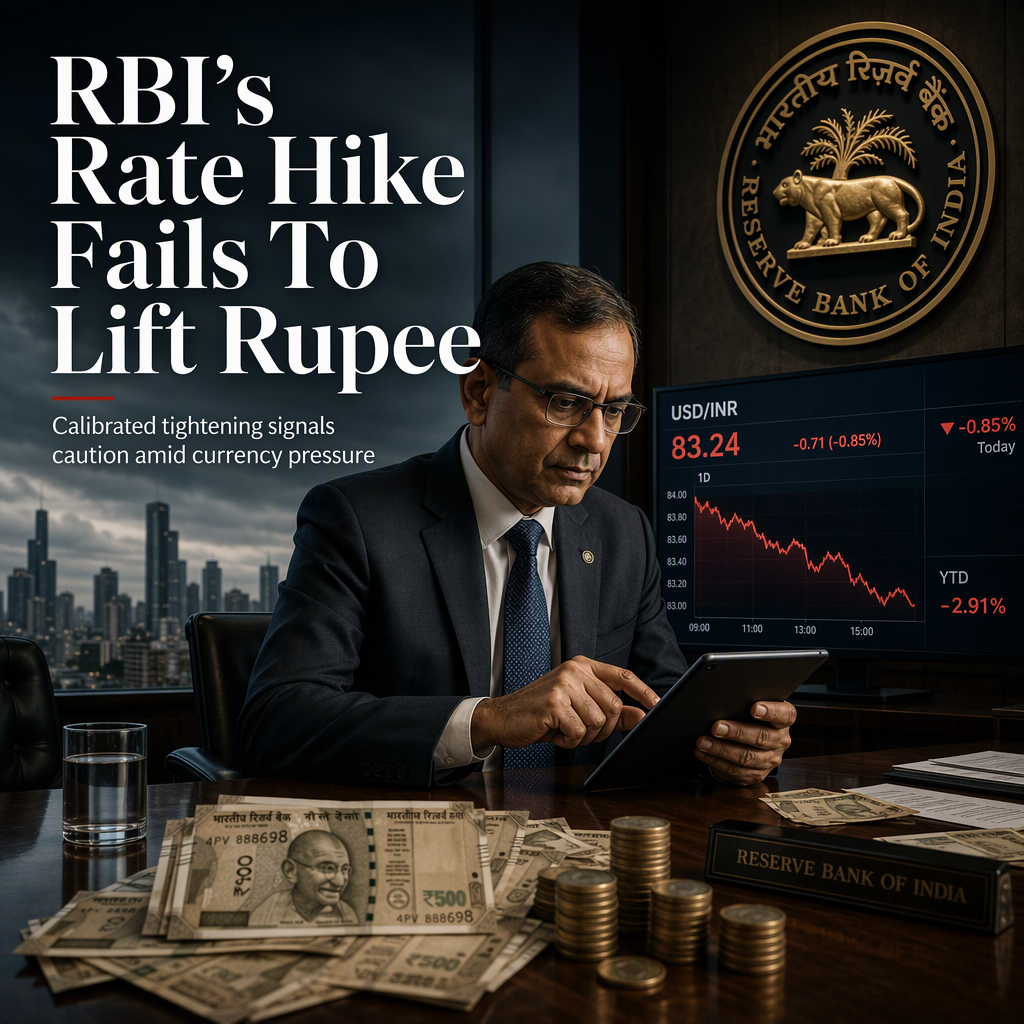
The Reserve Bank of India (RBI) raised its policy rate by 25 basis points to 5.50%, marking a shift from a neutral to a 'calibrated tightening' stance after holding rates at 5.25% for the previous four meetings [1]. Despite this move, the Indian Rupee continued to weaken, as the rate hike and policy guidance indicated a limited appetite for sustained aggressive tightening [1]. The decision was unanimous for the rate hike, but the policy stance saw a 4-2 split, with two members (Kumar and Singh) preferring to retain a neutral stance, highlighting a lack of strong consensus for further tightening measures [1].
Elias Haddad of Brown Brothers Harriman (BBH) noted that while the RBI's actions were expected, the 'calibrated tightening' stance leaves room for either additional hikes or pauses, which diluted the hawkish signal the market might have anticipated [1]. The RBI's strategy is being tested as the Rupee trades at record-high USD/INR levels, and the central bank's FX interventions, along with positive real rates, are expected to help contain any overshoots in the currency pair [1].
Market implications suggest that the RBI's measured approach may not be sufficient to provide immediate support for the Rupee, especially given the lack of consensus for aggressive tightening and the ongoing pressure on the currency [1]. Forward-looking, the RBI's willingness to intervene in FX markets and maintain positive real rates could help stabilize the Rupee, but the central bank's cautious stance may limit the effectiveness of these measures in the short term [1].
CONCLUSION
The RBI's 25bps rate hike and shift to a 'calibrated tightening' stance failed to support the Indian Rupee, reflecting market skepticism about further aggressive tightening. While FX intervention and positive real rates may help contain volatility, the lack of consensus within the RBI signals a cautious approach going forward.