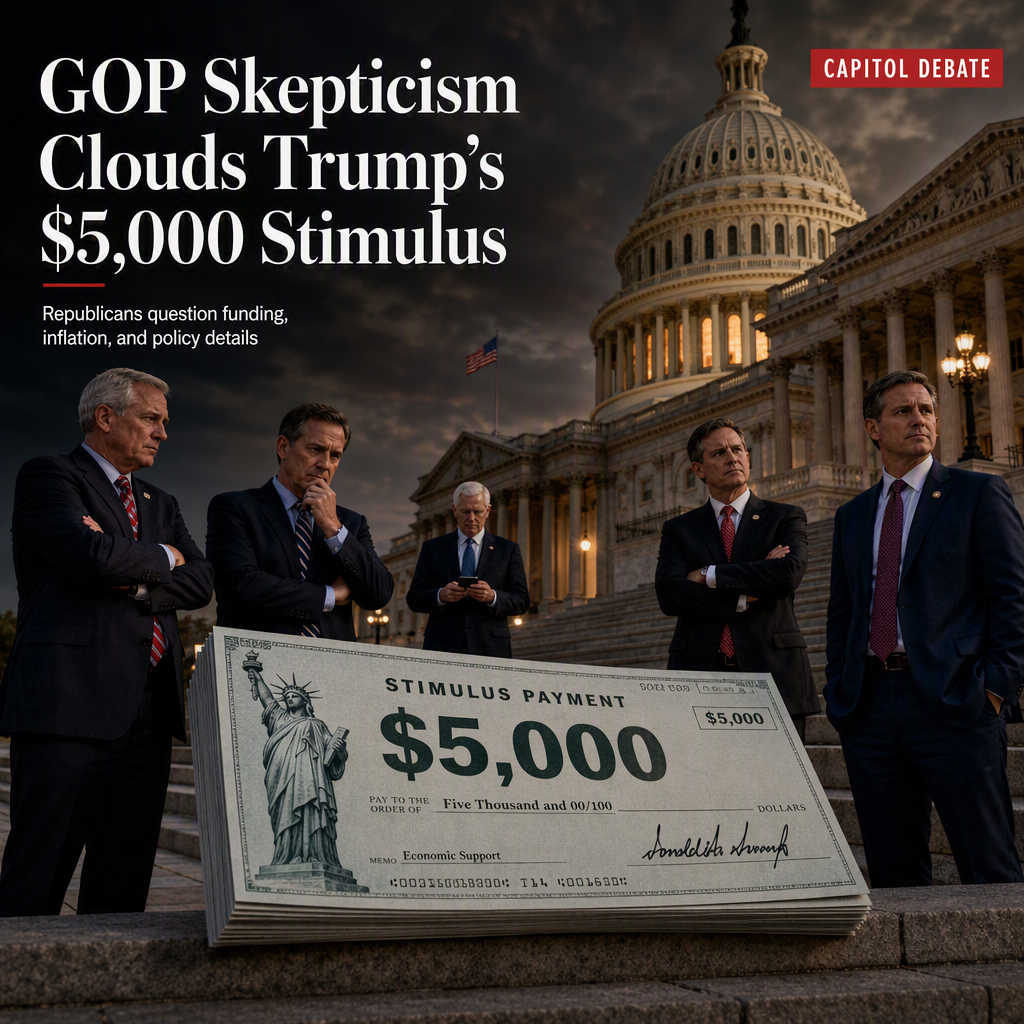
President Donald Trump has proposed a $5,000 payout to Americans if Republicans win the midterms, but the plan is facing significant skepticism among GOP lawmakers on Capitol Hill [1]. Several Republicans have outright opposed the idea, with Rep. Ralph Norman, R-S.C., criticizing the proposal as 'pay-to-play' and questioning the source of funding, noting, 'I think we're in debt $40 trillion' [1].
House Appropriations Committee Chairman Tom Cole, R-Okla., expressed doubt about the feasibility of the plan, stating he was 'skeptical' it could be achieved and suggesting that available funds would be better used to bolster defense or save Social Security. Cole emphasized that there is currently no bill, only an idea to return money to the American people, which he supports in principle [1].
Other lawmakers, such as Rep. John Rutherford, R-Fla., indicated conditional support, emphasizing that any cash injection should not fuel inflation and should be limited to working taxpayers. Rep. Beth Van Duyne, R-Texas, highlighted the need for more details and preferred focusing on job opportunities instead. Rep. Brad Knott, R-N.C., suggested that structured tax incentives or rebates would be better policy than direct checks [1].
Some support for the proposal was voiced by House Freedom Caucus Chairman Andy Harris, R-Md., who stated that hardworking Americans deserve a tax rebate, though he suggested the $5,000 figure should be negotiable and that the measure should go through Congress, possibly via reconciliation. Republican Study Committee Chairman August Pfluger, R-Texas, also commented on potential funding sources, but the article does not provide his full remarks [1].
Overall, the proposal has sparked debate within the GOP, with concerns about fiscal responsibility, inflation, and policy structure dominating the discussion. No concrete legislative path or funding mechanism has been established, and the idea remains in the conceptual stage [1].
CONCLUSION
Trump's $5,000 stimulus check proposal has met with mixed reactions among Republican lawmakers, with many expressing concerns about funding, inflation, and policy details. While some support the idea in principle, significant hurdles remain before any legislation could be advanced. The market is likely to view the proposal as uncertain and politically contentious at this stage.