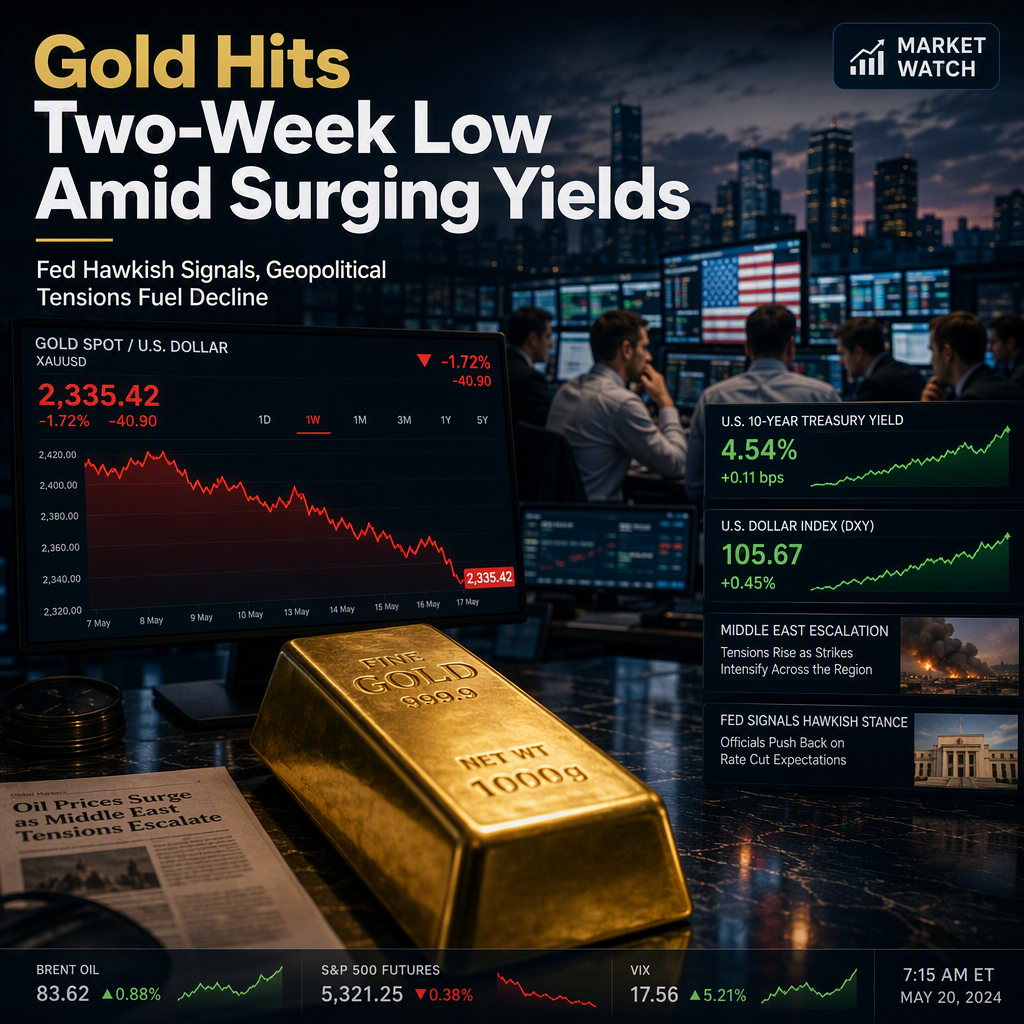
Gold (XAU/USD) fell sharply to near a two-week low around $4,330 during the early Asian session on Wednesday, pressured by rising US Treasury yields and a stronger US Dollar [1]. US Treasury yields reached their highest levels since January 2025 in the previous session, driven by escalating tensions in the Middle East, which have fueled inflation concerns and triggered a global bond selloff [1]. Bloomberg reported that the US and Iran exchanged attacks on Tuesday, with American forces targeting Iranian positions around the Strait of Hormuz and Tehran launching retaliatory operations against US interests in the region [1].
Market analyst Jim Wyckoff from American Gold Exchange attributed the gold market's weakness to technical selling pressure and the surge in global bond yields, which are at multi-year highs [1]. Higher interest rates and Treasury yields typically weigh on gold, as they increase the opportunity cost of holding the non-yielding asset [1].
Additionally, hawkish comments from Federal Reserve Chair Kevin Warsh at the Jackson Hole symposium have contributed to the downside in gold prices. Warsh warned that policymakers may need to tighten policy further if inflation does not convincingly move toward the 2% target, prompting traders to increase bets on a September rate hike [1]. TD Securities analysts noted that, despite Warsh's more hawkish tone, gold positioning has remained resilient, with investors seemingly looking past the renewed focus on inflation and potential future policy tightening [1].
Technical analysis shows that XAU/USD remains bearish, trading below the 100-day simple moving average (SMA) and the Bollinger Bands’ 20-day middle band, indicating that rallies are being capped by these resistance levels. The Relative Strength Index (RSI) at 46.28 suggests waning downside momentum but does not yet signal a convincing recovery. Key resistance levels are at the 100-day SMA ($4,365) and the Bollinger middle band ($4,445), while the lower Bollinger band at $4,192 provides notable support [1].
Looking ahead, market participants are focused on the upcoming US jobs data for August, set to be released on Friday. This report could influence expectations for a September Fed rate hike, with any signs of labor market weakness potentially weighing on the US Dollar and supporting gold prices in the near term [1].
CONCLUSION
Gold prices have come under significant pressure due to rising US yields, a stronger dollar, and hawkish signals from the Federal Reserve. While technicals remain bearish, investor positioning in gold has shown resilience. The upcoming US jobs data will be closely watched for further direction on both the Fed's policy path and gold's near-term outlook.