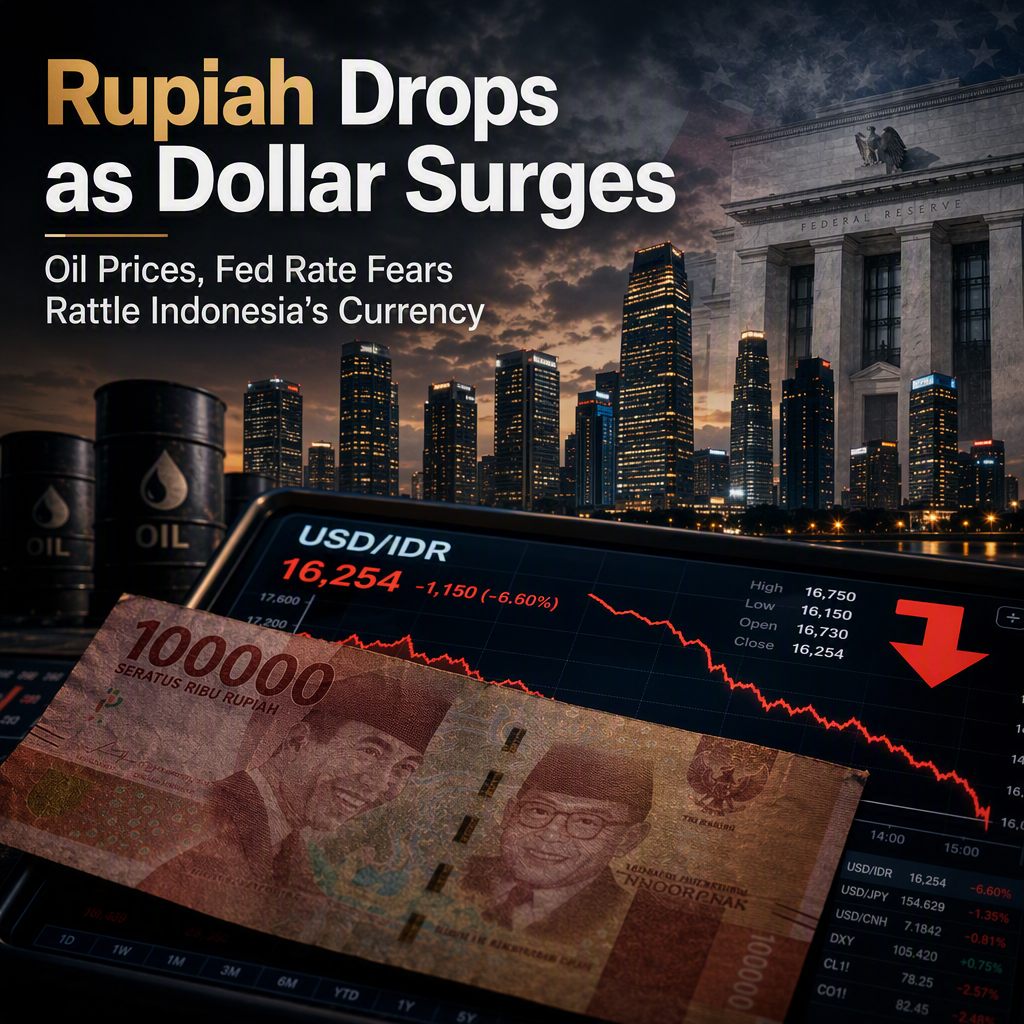
The Indonesian rupiah (IDR) weakened against the US dollar (USD) as rising oil prices heightened inflation fears and threatened Indonesia's fiscal position as a net oil importer [1]. The USD/IDR currency pair extended its gains for the fourth consecutive day, trading around 17,730 during Asian hours on Tuesday [1]. This move was driven by increased expectations for a US Federal Reserve interest rate hike this week, with money markets on Monday reflecting over a 92% chance of a rate hike, up sharply from roughly 60% a week earlier, according to CME FedWatch tool data [1].
Strategists at Scotiabank noted that the USD is entering FOMC week 'on a firm note,' as markets react to shifting expectations around the policy decision following recent US inflation data [1]. Swaps now reflect 21 basis points (or 85%) of tightening risk for Wednesday, while a Bloomberg survey shows only a very narrow majority of respondents favoring a hold, highlighting the finely balanced expectations ahead of the meeting [1].
US economic data released on Friday showed the Consumer Price Index (CPI) rose in August, with core inflation recording its largest gain in four months [1]. The US 10-year Treasury yield surged toward 5% due to broader inflation and fiscal concerns [1]. In Indonesia, headline inflation accelerated to 3.19% in August, undermining government efforts to curb El Niño-driven food price volatility [1].
Technical analysis indicates that USD/IDR is trading in a neutral near-term stance, sitting above the short-term nine-period Exponential Moving Average (EMA) but capped below the medium-term 50-period EMA, suggesting consolidation rather than a clear trend [1]. The 14-day Relative Strength Index (RSI) is around 47, indicating subdued upside momentum even as selling pressure has eased [1]. Key resistance is at the 50-period EMA near 17,797, while immediate support is at the nine-period EMA around 17,685 [1].
CONCLUSION
The Indonesian rupiah's weakness is driven by rising oil prices and heightened expectations for a US Federal Reserve rate hike, which have strengthened the US dollar. Market sentiment remains cautious, with technical indicators suggesting consolidation in the USD/IDR pair. Inflationary pressures and fiscal concerns continue to weigh on Indonesia's currency outlook.