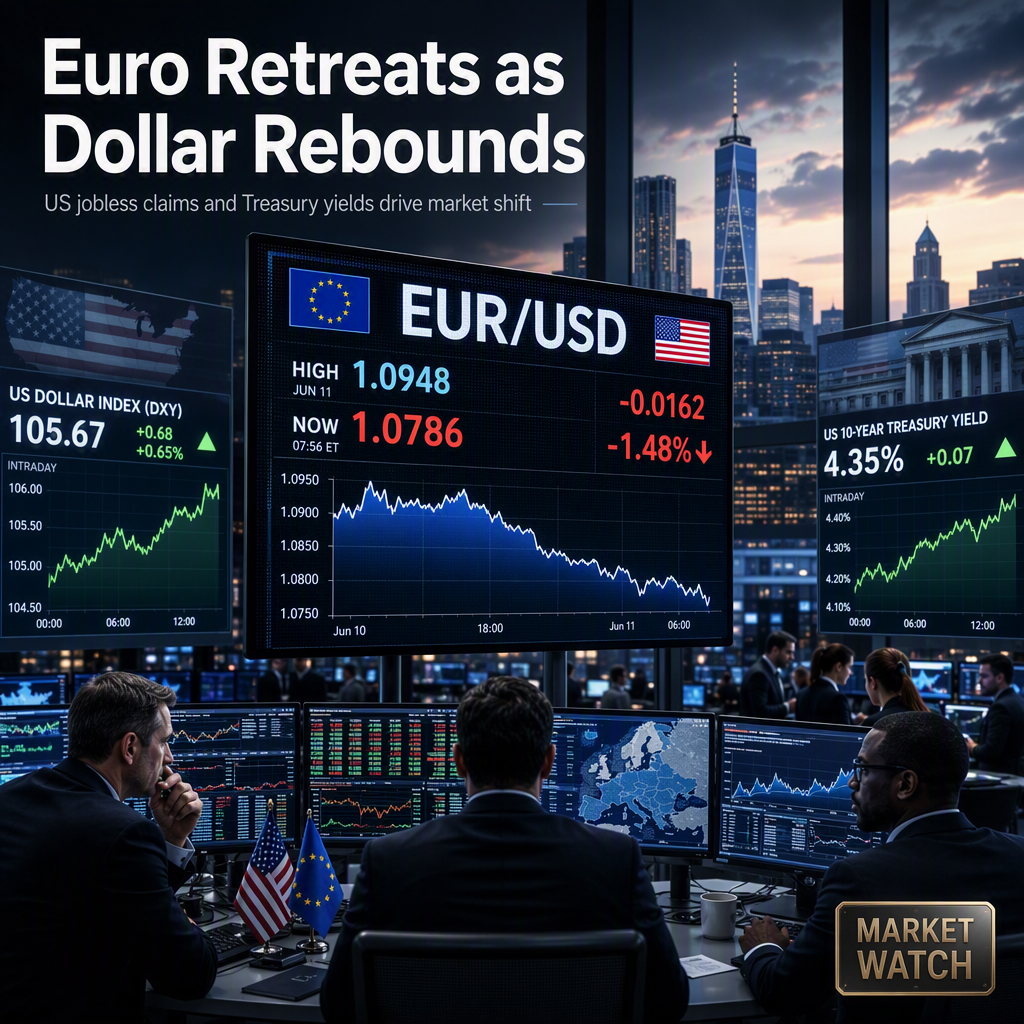
The Euro (EUR) eased from a three-month high against the US Dollar (USD) on Thursday, as the Greenback stabilized following a sharp selloff the previous day. The EUR/USD pair traded around 1.1686 after reaching an intraday high of 1.1710, its highest level since May 14 [1]. The US Dollar found support as Treasury yields rebounded, reversing some of Wednesday’s steep pullback that was triggered by the US Treasury Department’s announcement of larger liquidity-support buybacks for longer-dated government securities [1].
Strategist Chang Wei Liang from DBS Group Research noted the recent Dollar weakness but cautioned against expecting further downside, stating that the additional buybacks are small and there is no change in monetary policy. He suggested the USD is more likely to consolidate rather than continue its decline [1]. The US Dollar Index (DXY), which tracks the Greenback against a basket of six major currencies, traded around 98.76, recovering from an intraday low of 98.56 [1].
The latest US labor market data provided additional support for the Dollar. Initial Jobless Claims fell to 206,000 for the week ending August 15, beating market expectations of 210,000 and the previous upwardly revised reading of 212,000 [1]. On the monetary policy front, the Federal Reserve is widely expected to keep interest rates unchanged at its next meeting, while the European Central Bank is seen raising rates for the second time this year [1].
San Francisco Fed President Mary Daly commented that rising bond yields do not signal a change in policy and that the Fed’s stance is appropriate, emphasizing the central bank’s focus on achieving its inflation target [1]. The US Dollar was the strongest against the Japanese Yen, gaining 0.29% on the day, while it lost 0.08% against the Euro [1].
CONCLUSION
The Euro’s rally paused as the US Dollar regained strength, supported by better-than-expected jobless claims and a rebound in Treasury yields. Diverging monetary policy expectations between the Fed and ECB, along with ongoing inflation risks, continue to shape currency market dynamics. Market participants are now watching upcoming central bank meetings for further direction.