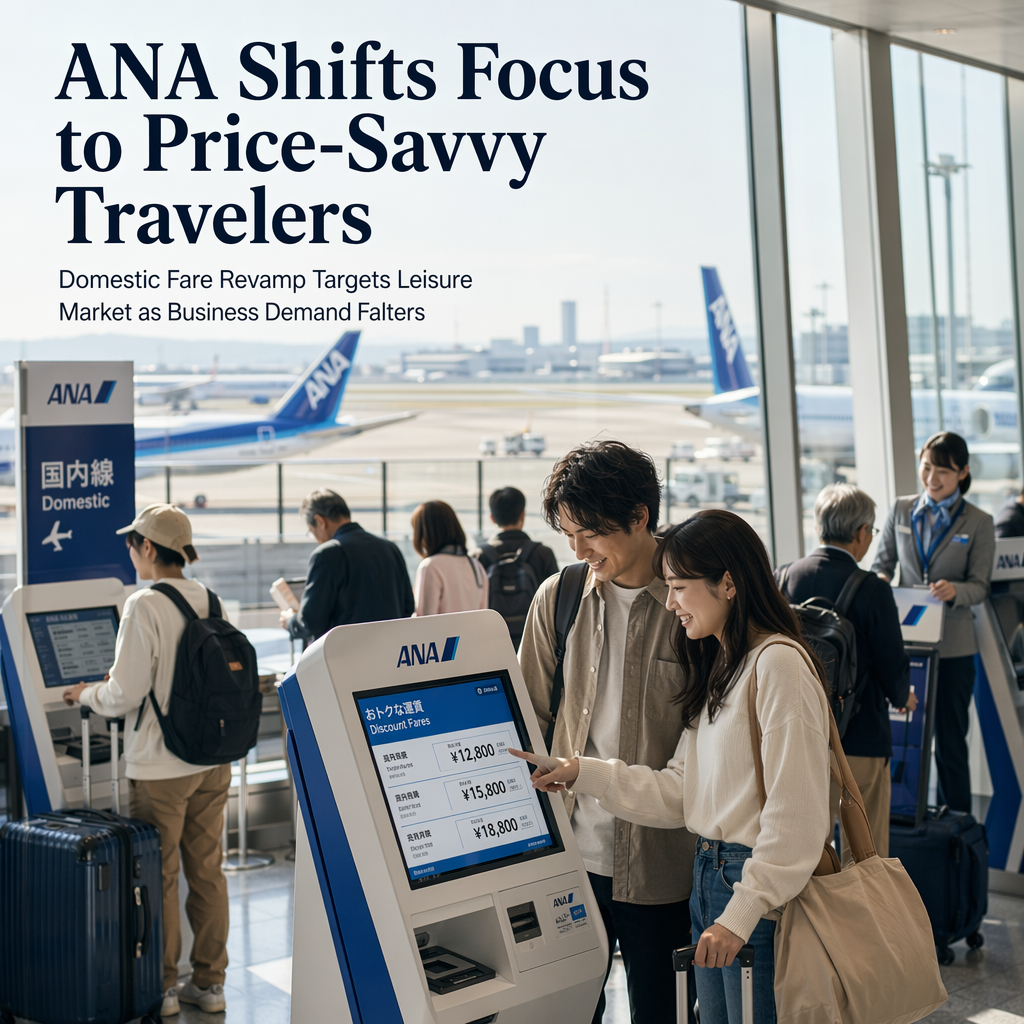
All Nippon Airways (ANA) has implemented a significant overhaul of its domestic fare system, debuting the changes in May to address ongoing challenges in its domestic operations [1]. The new system allows passengers to purchase discounted, no-frills tickets up to just before departure, provided that many seats on a flight remain unsold [1]. This approach aligns ANA's pricing and service model more closely with that of budget airlines, which typically offer lower base fares and charge for additional services [1].
The fare revamp is a strategic response to the persistent reduction in business travel demand since the COVID-19 pandemic, which has negatively impacted ANA's domestic flight performance [1]. By offering greater flexibility and lower prices, ANA aims to attract more leisure travelers and price-sensitive customers, thereby increasing seat occupancy and boosting revenue per available seat kilometer (RASK) [1].
This shift marks a departure from ANA's traditional legacy carrier model, which relied on advance bookings and higher fares, especially from business travelers [1]. With business travel yet to recover to pre-pandemic levels, ANA is prioritizing volume and seat occupancy over premium pricing to adapt to the evolving market environment [1].
No specific fare levels, price ranges, or additional financial figures were disclosed in the article [1].
CONCLUSION
ANA's domestic fare overhaul signals a strategic pivot toward a more budget-friendly model in response to weak business travel demand. By targeting leisure and price-conscious travelers, ANA aims to improve seat occupancy and revenue, reflecting a medium market impact as the airline adapts to post-pandemic realities.