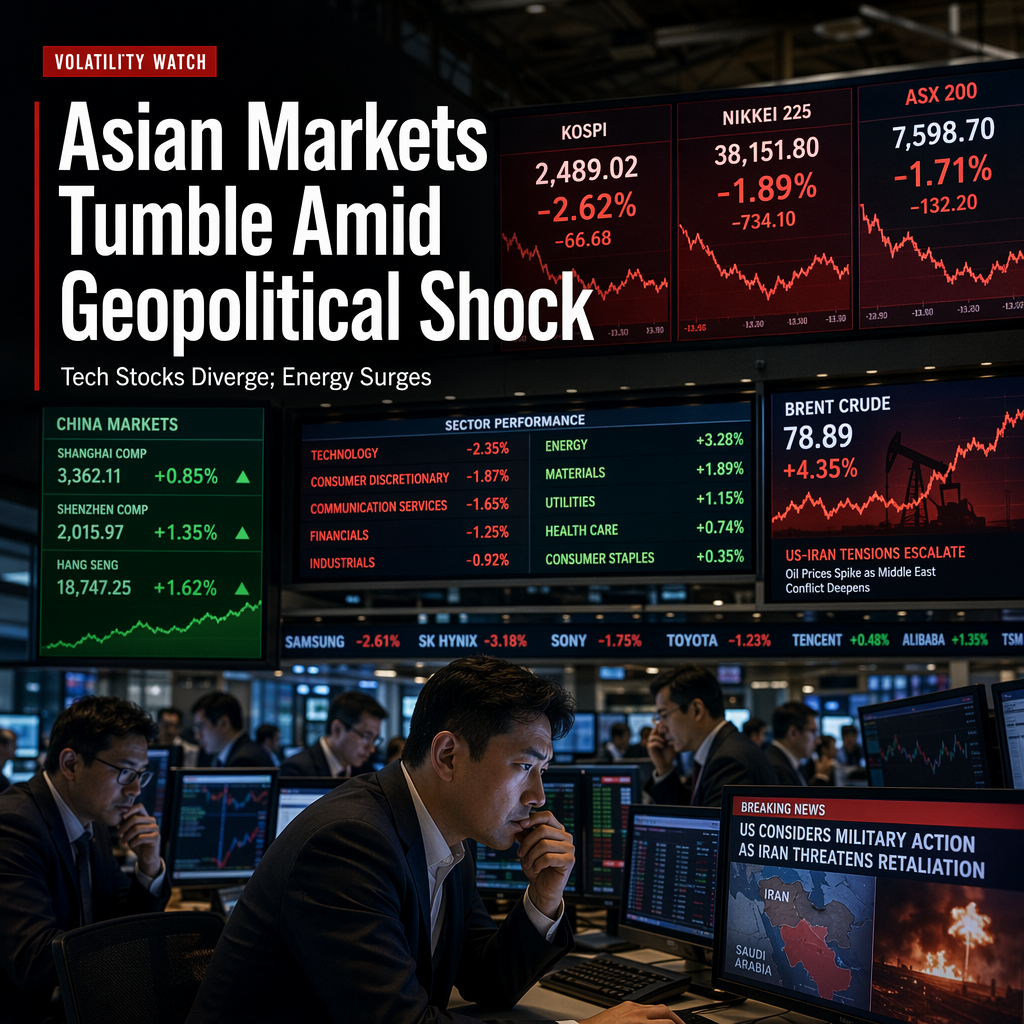
Asian equity markets experienced a mixed but generally negative reaction following a sharp escalation in US-Iran tensions and surging oil prices, according to Deutsche Bank’s Jim Reid [1]. The KOSPI index in South Korea saw significant losses, dropping -5.57% in fast-moving markets, while Japan’s Nikkei fell -0.96% and Australia’s S&P/ASX 200 declined -0.49% [1]. In contrast, mainland Chinese equities were firmer ahead of the June inflation report, with the CSI 300 rising +0.61% and the Shanghai Composite up +0.52%. The Hang Seng outperformed, gaining +2.38% as technology stocks recovered [1].
US and European equity futures, including S&P, Nasdaq, and Stoxx, were described as broadly flat despite the heightened geopolitical tensions [1]. The divergence in Asian markets was largely attributed to sectoral performance, with technology stocks driving gains in some indices while others lagged. Chipmakers faced renewed pressure, leading the Philly semiconductor index to drop -4.65%, marking its lowest level in nearly a month and leaving it -15.95% below its mid-June highs after a strong Q2 performance [1].
Despite the overall weakness, there was a notable rotation into defensive sectors in the US market. Energy stocks surged +3.02%, healthcare gained +1.55%, consumer staples rose +0.99%, and utilities advanced +0.91% [1]. A majority of S&P 500 constituents (283 companies) ended higher on the day, but the decline in chip stocks weighed on the broader index, resulting in a -0.45% drop for the S&P 500 [1].
Market sentiment across Asia remained weak but not as severe as might be expected given the geopolitical backdrop, with performance varying significantly depending on sector exposure, particularly to technology [1].
CONCLUSION
Escalating US-Iran tensions and rising oil prices triggered sharp declines in several Asian equity markets, with technology stocks driving a divergence in performance. Defensive sectors outperformed in the US, but chipmaker losses dragged down the broader market. Overall, market sentiment was cautious with high volatility and sector-driven moves.