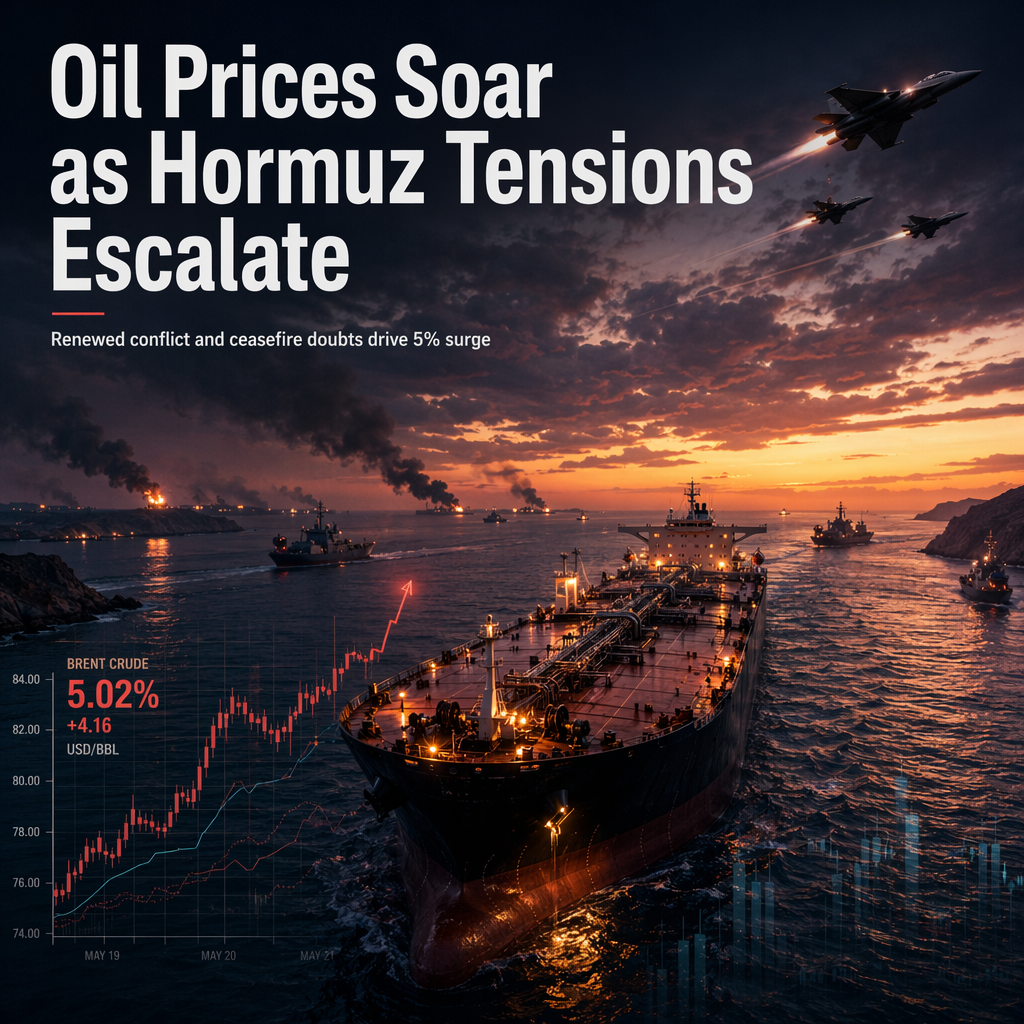
According to BNY’s Geoff Yu, global markets are experiencing increased fragility following President Trump’s declaration that the Iran ceasefire is over and the resumption of U.S. strikes in the Strait of Hormuz, which has reignited volatility in oil markets [1]. As a result, Brent, WTI, and Middle Eastern oil benchmarks have surged by approximately 5% [1]. Despite this significant price movement, inflation expectations have remained stable, and positioning data indicate that core energy and inflation hedges are still in place, which has so far limited broader market disruption [1].
Yu notes that markets are growing increasingly fragile as President Trump openly questions the durability of the ceasefire, while exchanges of fire in the Strait of Hormuz intensify [1]. The likelihood of a swift return to pre-conflict energy and goods flows through the waterway is diminishing, raising concerns for both markets and the global economy [1].
Although the immediate reaction in oil prices has been notable, it has not yet been sufficient to reverse the recent improvement in inflation expectations [1]. Positioning data, including dollar exposure and flows into inflation-protected equity sectors, suggest that core inflation hedges have remained intact throughout the period of volatility [1]. Yu emphasizes that the situation remains fluid, stating, "Oil will be the judge of whether this turns into a true escalation. Any accompanying move in yields or policy expectations will determine whether current positioning proves fragile, or resilient" [1].
Overall, the prospect of returning to the market conditions seen in March and early April now appears highly unlikely, given the escalation in hostilities and ongoing uncertainty surrounding the ceasefire [1].
CONCLUSION
The renewed conflict in the Strait of Hormuz and President Trump’s statements have driven a sharp 5% increase in oil prices, highlighting market fragility. However, inflation expectations and core hedges remain stable, limiting broader disruption for now. The situation remains dynamic, with further escalation or policy shifts likely to determine the resilience of current market positioning.