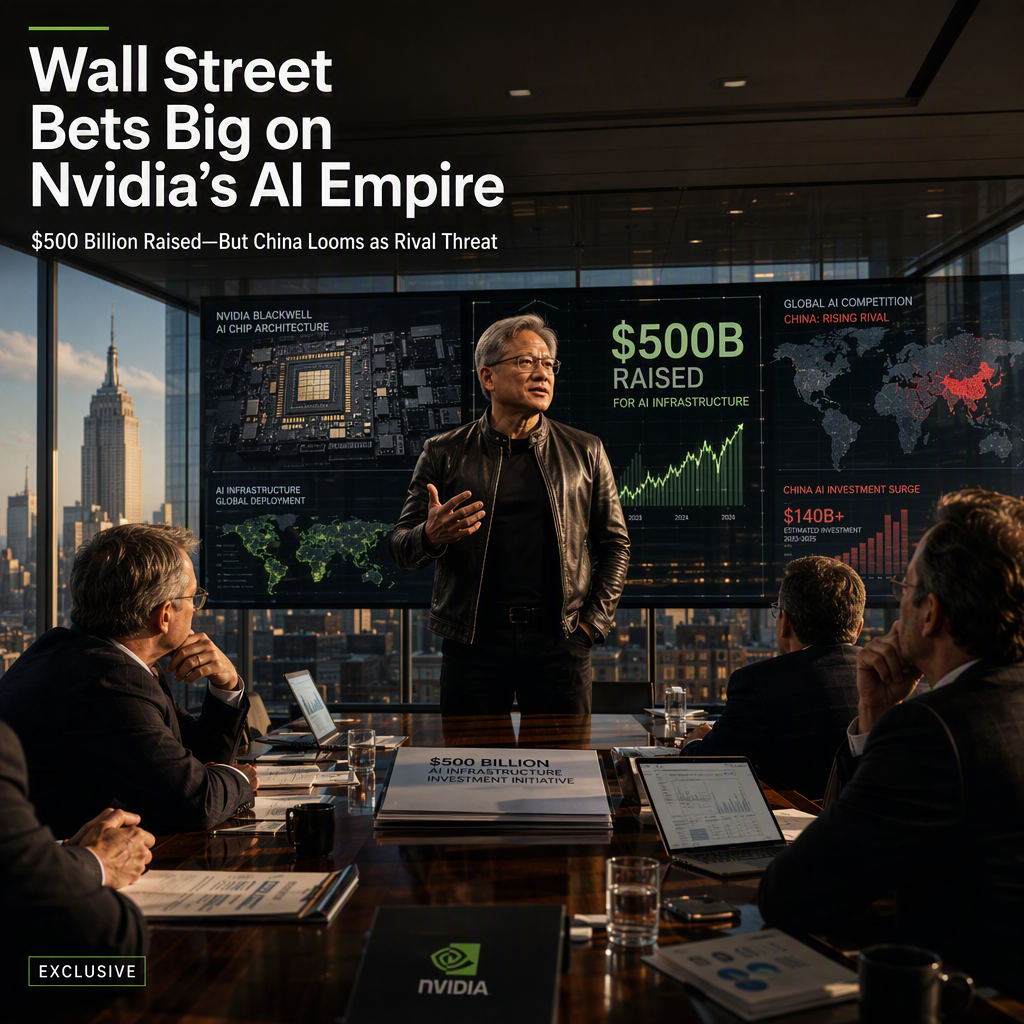
Nvidia has announced a significant partnership with six major U.S. asset managers to raise $500 billion, with the potential for even more, aimed at financing the construction and build-out of new AI factories. This move marks a fundamental shift, positioning AI infrastructure as a new asset class and signaling Wall Street's endorsement of CEO Jensen Huang's ambitious vision for the AI chip industry [1].
A key element of Nvidia's strategy is the assumption that its graphics processing units (GPUs) will retain their value over time, functioning more like traditional hard assets rather than rapidly depreciating consumer electronics. However, Ben Emons, founder of FedWatch Advisors, highlighted a major risk to this financing model: the potential for a price war triggered by Chinese chipmakers. If China increases domestic compute capacity and floods the market with low-cost silicon, hardware prices could plummet, threatening the value of collateral backing these large-scale private loans and exposing investors to significant losses [1].
In addition to the financing initiative, Nvidia launched its first open-source AI model, Nemotron 3.5 Lightning. This lightweight model can run on a single GPU on a PC and is the first open-source release since CEO Jensen Huang advocated for open models in July. Nvidia sees open-source AI as a driver for increased chip sales, as these models still require GPUs to operate and their lower cost could boost adoption compared to proprietary offerings from companies like OpenAI and Anthropic [1].
The developments underscore Nvidia's efforts to maintain growth and leadership in the AI sector, while also highlighting the competitive and financial risks posed by potential market disruptions from China [1].
CONCLUSION
Nvidia's collaboration with Wall Street to raise $500 billion for AI infrastructure marks a pivotal moment for the industry, with AI infrastructure emerging as a new asset class. While the initiative has strong backing, significant risks remain, particularly from potential Chinese competition that could undermine hardware values and investor returns.