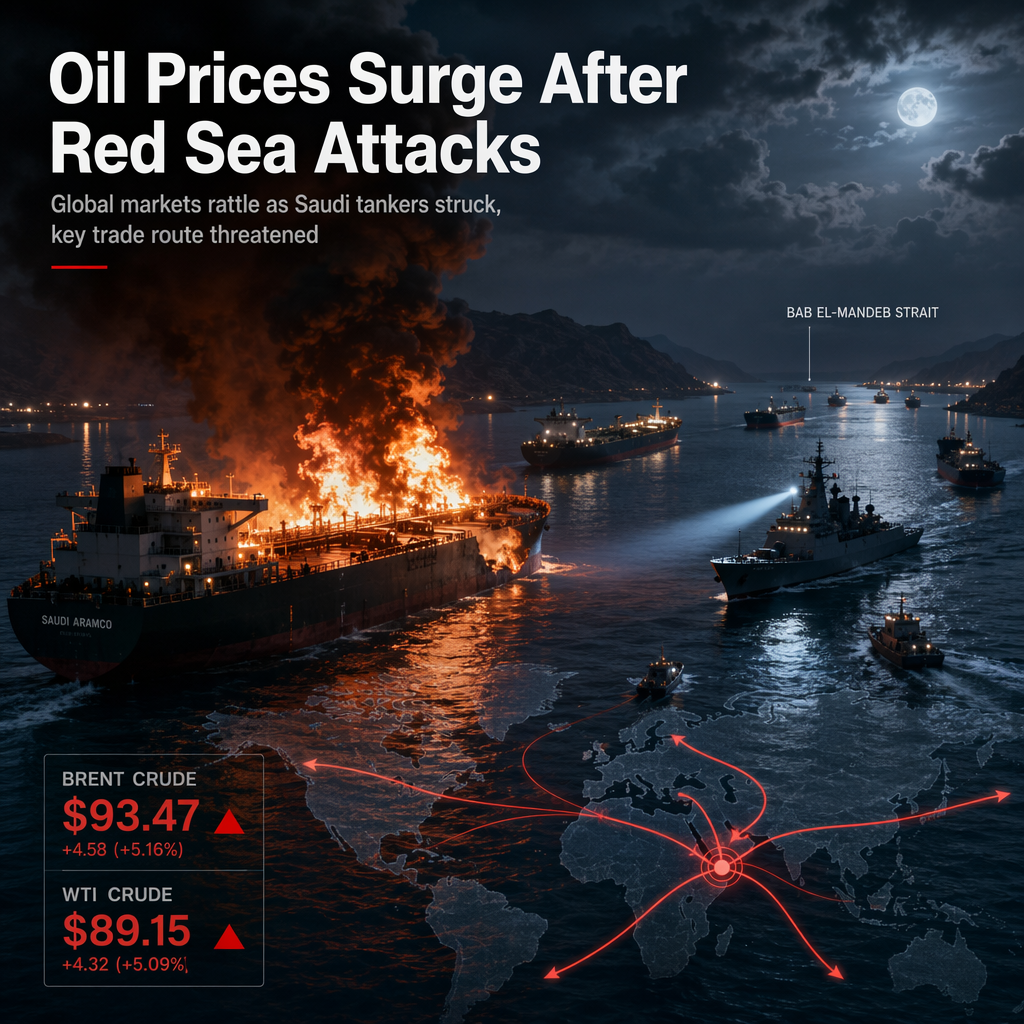
Oil prices surged sharply on Thursday, reaching their highest levels since early June, following attacks on two Saudi oil tankers in the Red Sea by Tehran-backed Houthi rebels and the announcement of a naval blockade on Saudi Arabia [1]. Brent crude oil, a key global benchmark, climbed more than 5% to nearly $99 per barrel in early trading, marking its highest point in seven weeks since June 3 [1]. U.S. crude oil also rose for the second consecutive day, gaining over 4% to almost $91 per barrel, its highest since June 11 [1].
The attacks represent the first time since the Iran war began that ship attacks have extended beyond the Strait of Hormuz, opening a new front in the conflict and raising concerns about further disruptions to global oil supplies [1]. The Bab el-Mandeb Strait, where the attacks occurred, is a critical chokepoint for global energy flows, with 12% to 15% of global maritime trade—valued at over $1 trillion annually—transiting the waterway [1]. The Strait has also served as an alternative route to the Strait of Hormuz, where ship crossings have dropped to single digits as of Tuesday due to ongoing tensions [1].
Since the beginning of the month, oil prices have increased by approximately 35%, and are now more than 60% higher since the start of the year [1]. Gasoline prices have also risen, with the national average reaching $4.09 per gallon on Thursday, up from $4.06 the previous day, according to AAA data [1]. This recent spike has reversed much of the progress toward lower prices that followed the now-collapsed U.S.-Iran memorandum of understanding signed in mid-June [1]. President Donald Trump responded to the attacks by threatening to target Iranian infrastructure for each vessel attacked by Tehran [1].
The U.K.’s Maritime Trade Office confirmed a tanker was struck by an unknown projectile north of the Bab el-Mandeb Strait, and Saudi authorities reported the Encelia was set ablaze in the Red Sea, though no mention was made of the Layla [1]. Deutsche Bank’s global head of macro research, Jim Reid, noted that inflation concerns have intensified due to the jump in Brent oil prices, and ongoing U.S.-Iran strikes show no signs of easing [1]. These inflation worries have contributed to higher bond yields this week [1].
CONCLUSION
The escalation of conflict in the Red Sea has driven oil and gas prices sharply higher, fueling inflation concerns and impacting global markets. With key shipping routes threatened and no signs of easing tensions, market volatility and upward pressure on energy prices are likely to persist.