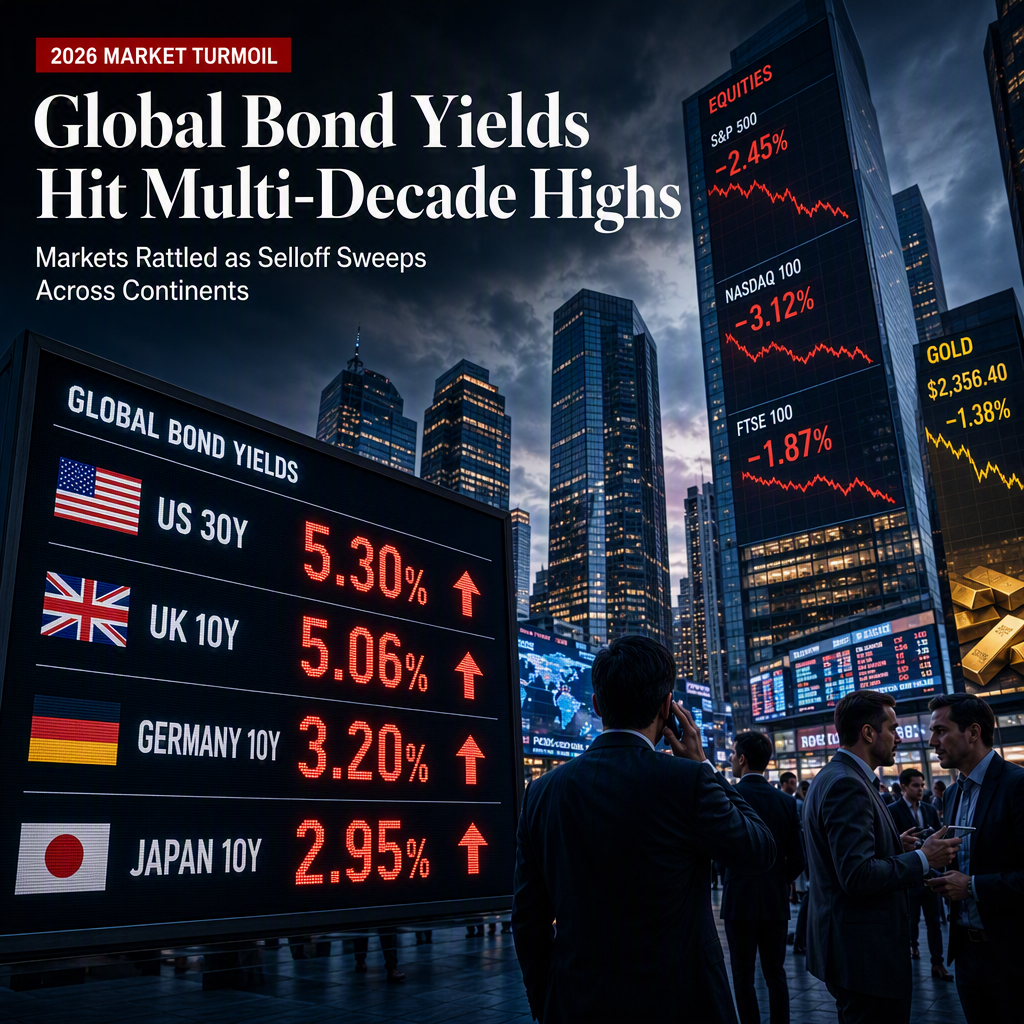
On August 18, 2026, global bond yields surged to levels not seen in decades, signaling a synchronized selloff across major markets [1]. The US 30-year Treasury yield climbed above 5.3%, marking its highest point since 2007, while the US 10-year Treasury yield reached 4.75%, a 19-month high [1]. In the UK, 10-year gilt yields crossed 5.06% and remained above 5% for the longest period in nearly twenty years [1]. German 10-year Bund yields hit their highest since 2011, and Japan's 10-year government bond yield rose to 2.95%, a level last seen in 1996 [1].
This global bond rout had immediate market repercussions. The S&P 500 index fell for a third consecutive session, and gold prices retreated from their highs, reflecting investor risk aversion and shifting capital flows [1]. The US government's 30-year bond auction on August 13 cleared at its highest yield since 2001, despite a favorable producer inflation reading that had previously driven stocks to record levels [1].
Several factors contributed to the selloff. Geopolitical tensions escalated after President Trump rejected extending a 60-day ceasefire with Iran, pushing oil prices above $85 per barrel—up roughly 50% since January 2026—and fueling inflation uncertainty [1]. Additionally, governments, particularly the US with an annual deficit around $2 trillion, are issuing large volumes of bonds, overwhelming market demand and driving up yields through a higher term premium [1]. In Japan, inflationary pressures intensified as the producer price index rose 7.2% year-over-year in July, with import prices also climbing sharply [1].
Analysts noted that the surge in yields is being driven by factors beyond central bank policy rates, with long-term inflation and fiscal sustainability concerns weighing heavily on investor sentiment [1].
CONCLUSION
Global bond yields have spiked to multi-decade highs, driven by geopolitical tensions, rising government deficits, and inflationary pressures. The selloff has triggered declines in equities and gold, highlighting heightened market uncertainty. Investors are demanding higher compensation for long-term risk, signaling persistent volatility ahead.