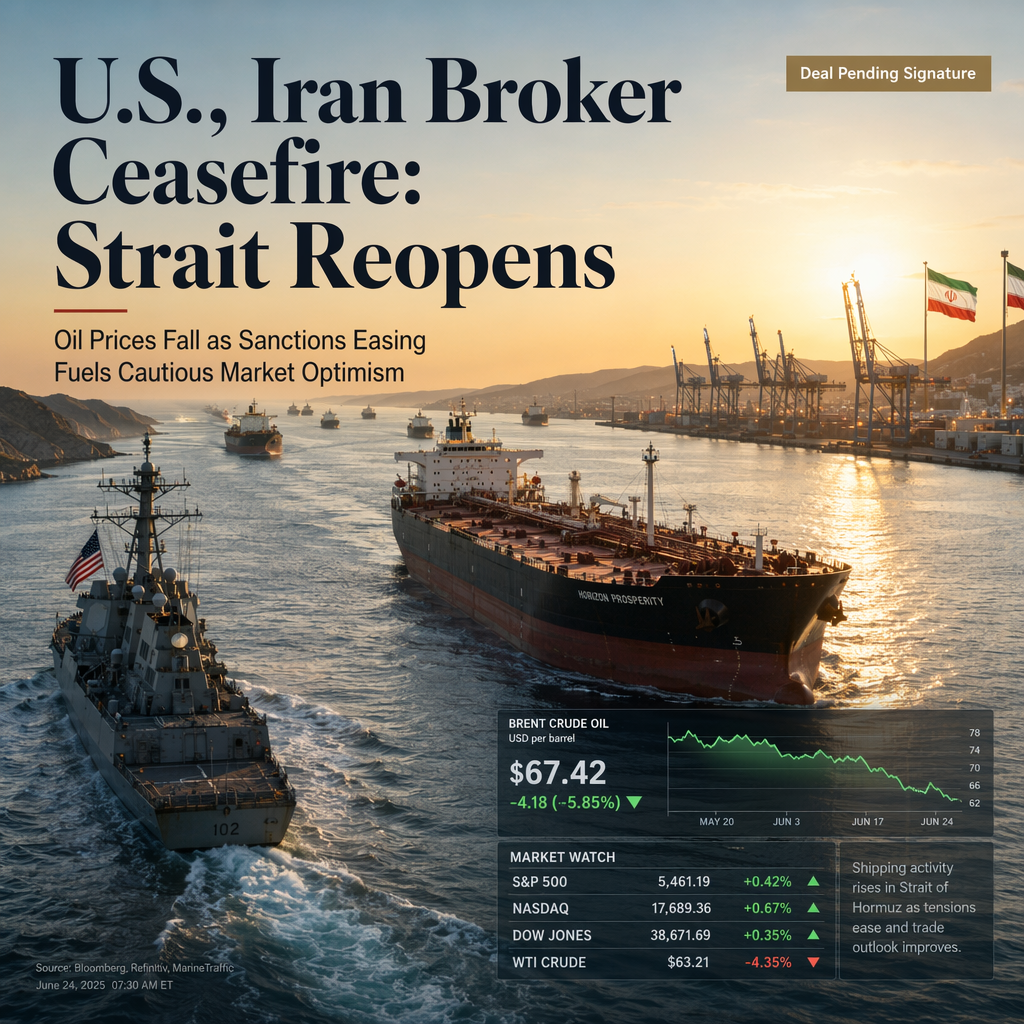
The United States and Iran have reached a preliminary agreement aimed at ending the war that began on February 28, with both sides committing to a 60-day ceasefire and the reopening of the Strait of Hormuz to commercial traffic [1][2]. President Donald Trump announced at the G7 Summit in France that the forthcoming deal has contributed to oil prices sliding near pre-war levels and rising stock prices [1]. The agreement, expected to be signed on Friday, includes a 14-point memorandum of understanding (MOU) that outlines the immediate and permanent termination of military operations, the lifting of U.S. sanctions on Iran, and the unfreezing of Iranian funds and assets [2].
Oil markets responded with restrained optimism. Brent crude, the global oil benchmark, rose over one percent, briefly crossing above $80 per barrel before settling back to $79. West Texas Intermediate Crude also increased by more than one percent to nearly $77 per barrel, later declining to around $76.60 [1]. These prices remain above the pre-war range of $65 to $75 per barrel but have decreased significantly from the wartime high of around $120 per barrel in late April [1].
The MOU stipulates that the Strait of Hormuz will reopen, with Iran allowing safe passage of commercial vessels for 60 days without charge, after which negotiations with Oman will determine the future administration of the trade route [2]. The U.S. will begin removing its naval blockade of Iranian ports, and Iran has reaffirmed it will not procure or develop nuclear weapons, with a mutually agreed mechanism to address its enriched material stockpile [2]. A senior U.S. official described Iran's commitment to destroy its enriched stockpile as a 'major, major win for the United States of America,' and clarified that sanctions relief will be tied to Iran's fulfillment of its obligations [2].
A point of contention is the draft MOU's mention of a $300 billion fund for Iran's reconstruction and economic development. President Trump stated that the U.S. will not contribute to this fund, calling reports of U.S. investment 'false,' while a senior U.S. official explained that the U.S. would only permit sanctions relief to allow third-party investment, not direct U.S. funding [1][2].
Forward-looking statements from U.S. officials indicate that the agreement is interim, with further talks planned toward a more substantive final deal within 60 days, extendable by mutual consent. Officials also emphasized that if Iran does not comply, President Trump is prepared to use other measures [2].
CONCLUSION
The preliminary U.S.-Iran deal has led to a decrease in oil prices and increased market optimism, though prices remain above pre-war levels. The agreement includes significant sanctions relief, the reopening of the Strait of Hormuz, and a commitment from Iran regarding its nuclear program, but key details and the final outcome remain subject to further negotiation. Market participants are watching closely for the deal's signing and subsequent developments.