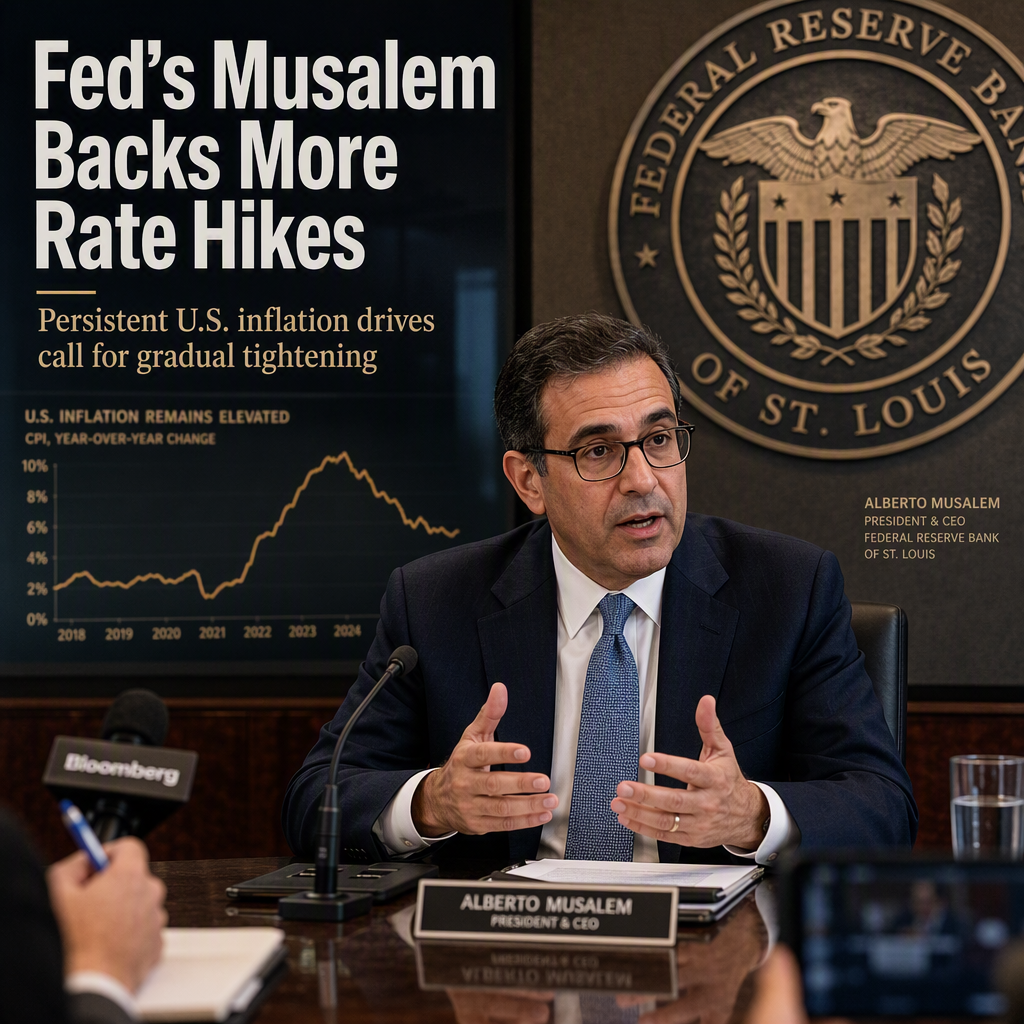
St. Louis Federal Reserve President Alberto Musalem emphasized that inflation in the United States remains too high and advocated for continued focus on reducing inflation through monetary policy measures. Musalem disclosed that he supported raising interest rates at the most recent Federal Open Market Committee (FOMC) meeting, citing a higher probability that inflation will persist above the Fed's target level. He projected that core inflation would likely remain between 2.5% and 3% in the near term, above the Federal Reserve's 2% target [1].
Musalem argued that incremental rate hikes are less costly than abrupt policy changes, suggesting a preference for gradual tightening to address inflation risks. He also noted that the labor market is not currently a driver of inflation and expressed openness to new initiatives under Fed Chair Kevin Warsh's leadership [1].
The article explains that the Federal Reserve's primary tool for achieving its dual mandate of price stability and full employment is the adjustment of interest rates. When inflation exceeds the 2% target, the Fed typically raises rates, which can strengthen the US Dollar by attracting international investment. Conversely, if inflation falls below target or unemployment rises, the Fed may lower rates to stimulate borrowing and economic activity, which can weaken the US Dollar [1].
No specific market reactions or analyst opinions were mentioned in the article. The discussion focused on the rationale behind current and potential future monetary policy actions, highlighting the Fed's commitment to addressing inflation through measured rate increases [1].
CONCLUSION
St. Louis Fed President Musalem's comments reinforce the Federal Reserve's ongoing concern about elevated inflation and the likelihood of further rate hikes. The emphasis on gradual tightening suggests a cautious approach to monetary policy, with the goal of bringing inflation closer to the Fed's 2% target. Market participants may interpret these remarks as signaling continued vigilance against inflationary pressures.