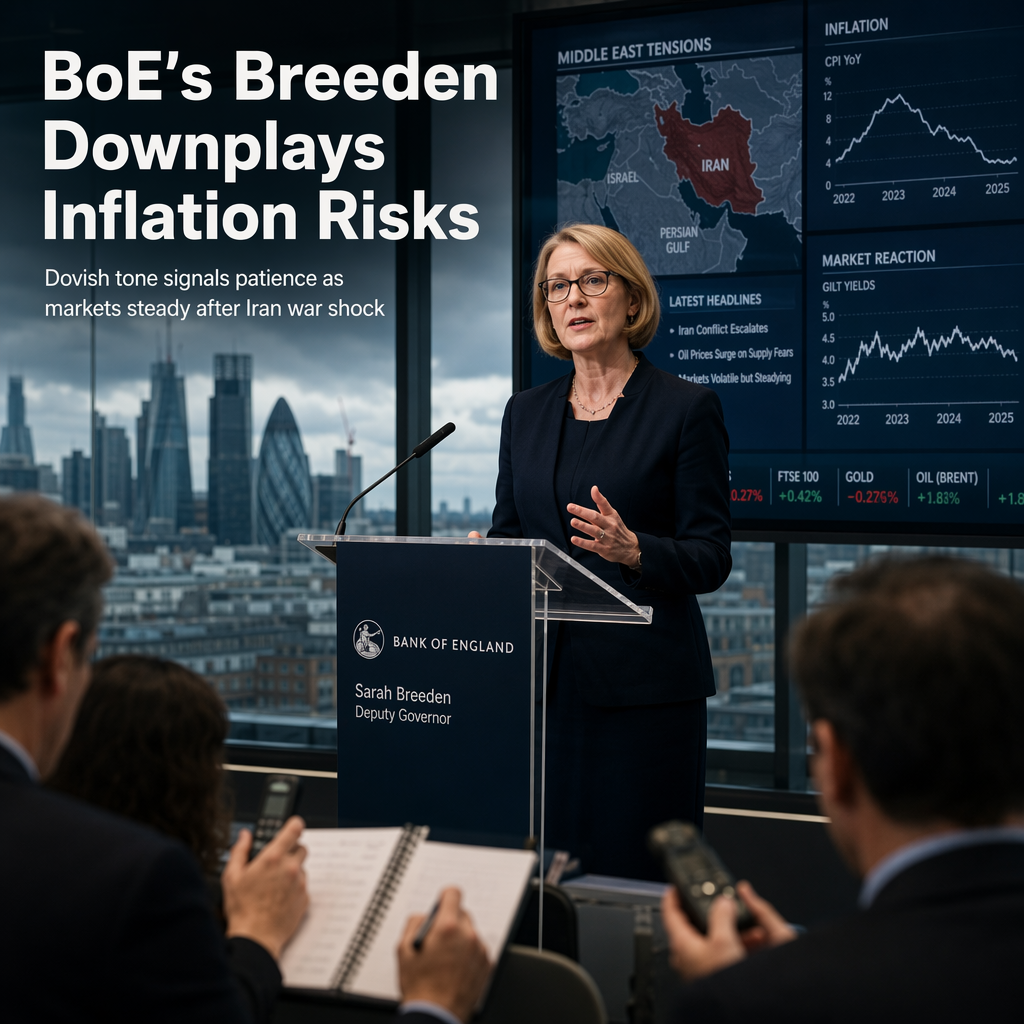
Bank of England (BoE) Deputy Governor Sarah Breeden stated during the European trading session on Thursday that UK inflation would have reached the central bank’s 2% target if not for the impact of the Middle East war, specifically referencing the Iran war shock [1]. Breeden emphasized that the Iran war shock is less likely to become embedded and lead to inflationary dynamics that would require the BoE to take action against [1]. She described the BoE as being 'in a good place' to monitor ongoing developments [1].
Market reaction to Breeden’s comments was muted, with the British Pound (GBP) showing little response. At the time of reporting, GBP/USD was trading 0.12% lower near 1.3520, attributed to a rebound in the US Dollar rather than Breeden’s remarks [1]. The FXS Speechtracker assigned a score of 3.2/10 to Breeden’s speech, below her historic average of 4.1/10, indicating a mildly dovish tone [1].
Breeden’s assertion that, absent the war, inflation would already be at target, reinforces the perception that the BoE can adopt a less aggressive stance against price pressures. This is seen as modestly negative for the Pound versus the Dollar and Euro [1]. She also acknowledged financial stability risks related to leverage supporting AI valuations but did not call for tighter policy in response [1]. Overall, her comments suggest a lower-for-longer rate bias, which may cap Pound upside while maintaining sensitivity to future inflation data [1].
CONCLUSION
BoE Deputy Governor Breeden’s remarks signal a softer stance on inflation risks, attributing current pressures largely to external shocks and downplaying the need for immediate policy tightening. The market response was limited, with the Pound showing little movement. The BoE appears poised to maintain a cautious approach, closely monitoring inflation data before making further policy decisions.