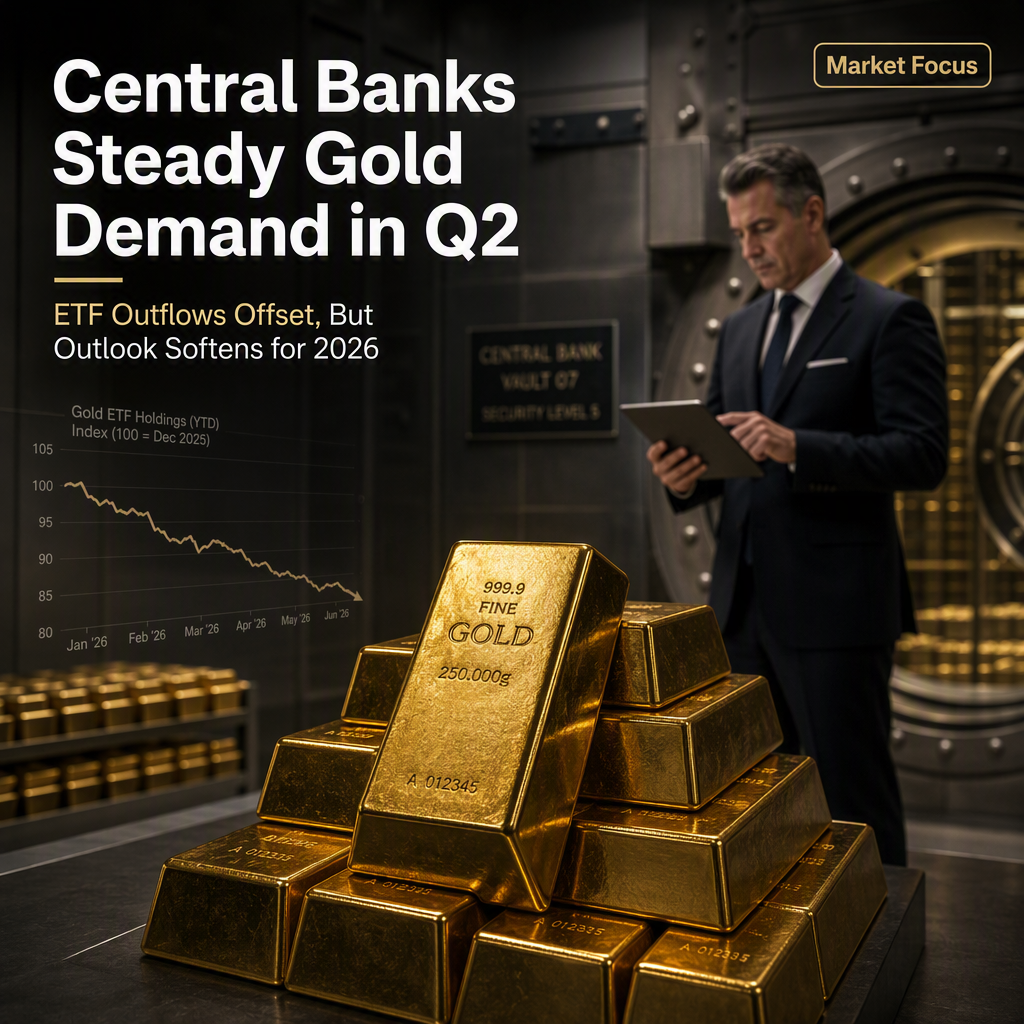
According to ING’s commodities team, global gold demand remained steady in the second quarter of 2026, with total demand unchanged year-on-year at 1,269 tonnes. This stability was attributed to robust central bank purchases, which offset weaker demand from gold exchange-traded funds (ETFs) [1]. In the first half of 2026, total gold demand reached 2,522 tonnes, representing a 2% increase compared to the same period in the previous year [1].
Gold ETFs experienced net outflows of 45 tonnes in Q2 2026, a trend ING attributes to rising inflation and interest rate expectations, as well as a stronger US dollar [1]. Despite this, central bank gold purchases surged 62% year-on-year to 289 tonnes in the second quarter, marking a strong rebound from the first quarter and aligning with recent buying trends [1].
However, revised data indicated that central banks added only 57 tonnes of gold in Q1 2026, which is 187 tonnes below the April estimate and represents the weakest first-quarter demand in over a decade [1]. As a result of this downward revision, ING now expects central bank gold purchases in 2026 to fall below 2025 levels [1].
No specific analyst opinions or forward-looking statements beyond the expectation of lower central bank gold purchases in 2026 compared to 2025 were provided in the source article [1].
CONCLUSION
Gold demand remained stable in Q2 2026 due to strong central bank buying, which offset ETF outflows. However, revised data and a weaker first quarter suggest that central bank purchases for the full year are likely to be lower than in 2025, indicating a potentially softer outlook for gold demand.