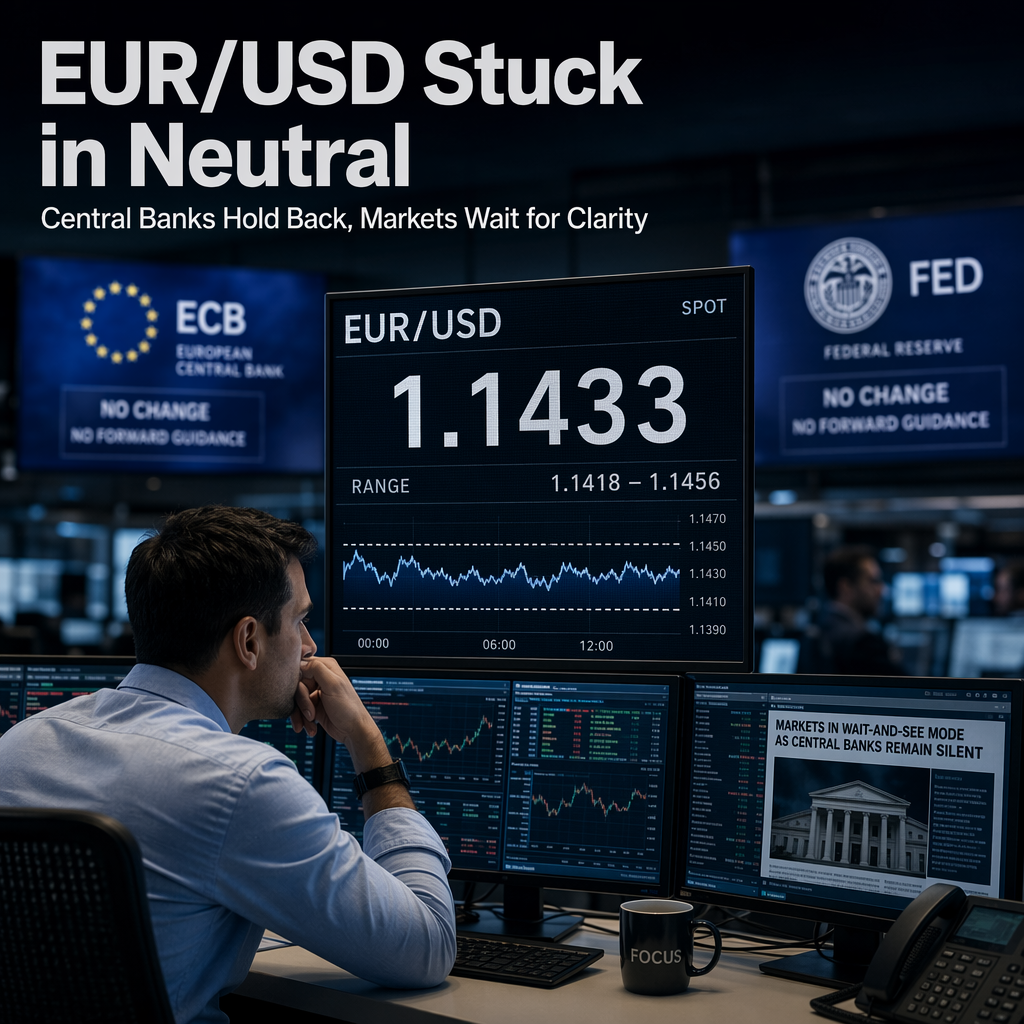
The EUR/USD currency pair has been trading within a narrow range between 1.1350 and 1.1450 since mid-June, with Commerzbank's Volkmar Baur noting that few catalysts are expected to break this pattern over the summer months [1]. On Tuesday, the pair traded marginally lower at around 1.1433 during the European session, facing slight selling pressure as the US Dollar Index (DXY) edged up to near 100.92 [2].
Both the European Central Bank (ECB) and the Federal Reserve (Fed) are refraining from providing forward guidance on monetary policy. In the June policy press conference, Fed Chairman Kevin Warsh stated that 'so-called forward guidance is not well suited to the current policy conjuncture' [2]. Similarly, ECB Governing Council member Emmanuel Moulin declined to offer any cues regarding the central bank's July decision, emphasizing, 'We are not doing forward guidance so I won’t say what we will do in July' [2].
Commerzbank expects the ECB to likely leave its key interest rate unchanged in the near term, while keeping the possibility of another rate hike open but not certain [1]. The Fed is also seen as unlikely to raise interest rates soon, with markets currently pricing in slightly more than one hike by year-end [1]. Baur suggests that as the year progresses, support for the euro may strengthen, especially as recent German industrial orders data indicate a slow cyclical recovery, and structural reforms and expansionary fiscal policy could help boost growth in Germany and Europe next year [1].
From a technical perspective, EUR/USD remains below the 20-day exponential moving average (EMA) at 1.1460, maintaining a bearish near-term tone. The Relative Strength Index (14) at 41.9 signals lingering downside pressure, with immediate resistance at the 20-day EMA and key support at the yearly low of 1.1330. A break below this support could expose the pair to the 29 May 2025 low at 1.1210, while a sustained move above the EMA could open the way to the psychological 1.1500 level [2].
CONCLUSION
EUR/USD continues to trade in a tight range as both the ECB and Fed avoid forward guidance, keeping market participants cautious. With limited catalysts and central banks signaling policy patience, the pair is likely to remain rangebound in the near term, with technical levels providing key reference points for traders.