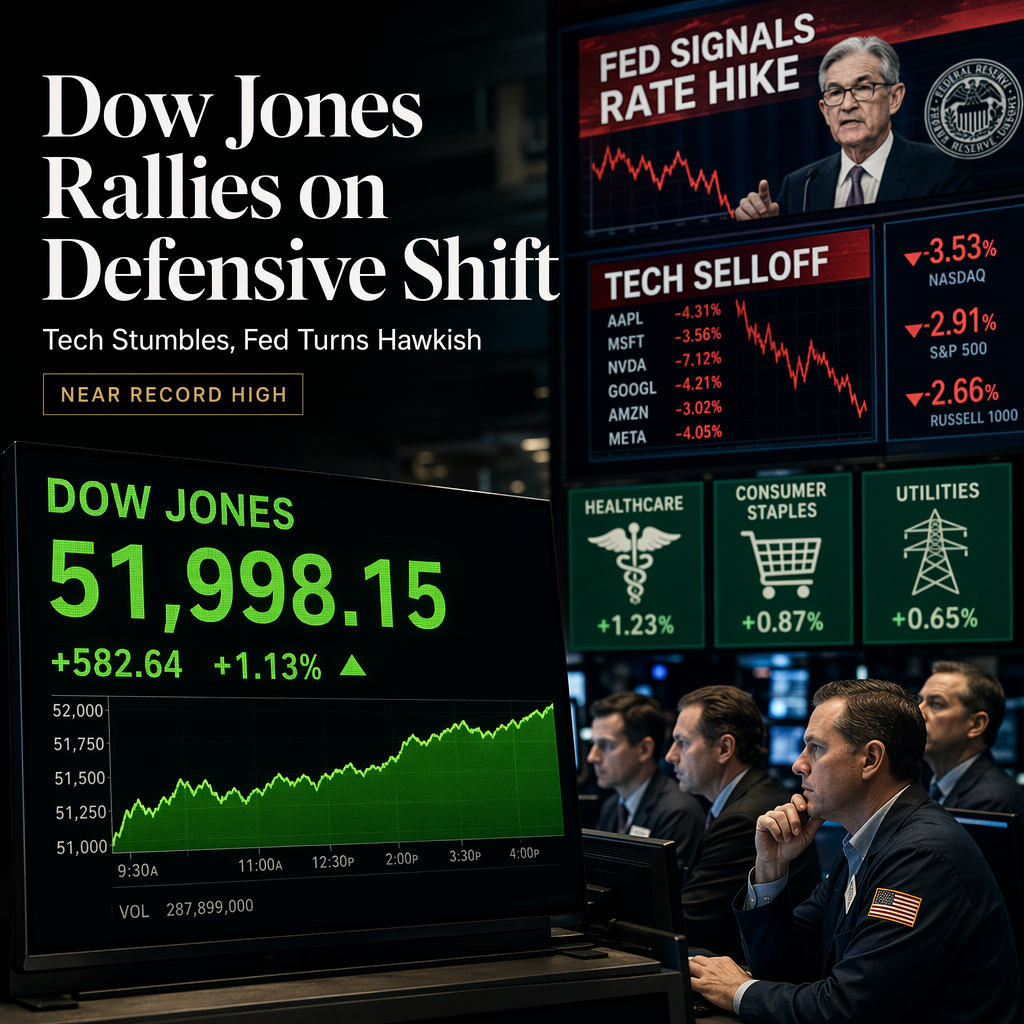
The Dow Jones Industrial Average (DJIA) closed the week as the strongest major US index, rallying more than 1% to settle just below 52,000, with its record high near 52,300 still within reach [1]. This performance was driven by a defensive rotation, as investors fled a severe technology sector selloff and sought safety in the Dow's old-economy constituents. Healthcare led the gains, with major drug makers rising between approximately 2% and 6%, while consumer staples, financials, and utilities also finished higher [1]. This sector breakdown underscores a preference for safety over growth, with the Dow's defensive weighting enabling it to outperform other indices.
Conversely, the information technology sector dropped close to 1%, following a report that OpenAI may delay its market debut until next year, which reignited concerns about the sustainability of the sector's infrastructure spending [1]. The impact was more pronounced internationally, as SoftBank—a key backer of tech buildouts—plunged over 12%, and Asian chip stocks suffered significant losses. The DJIA, with minimal exposure to megacap semiconductors and a strong defensive composition, avoided much of this turmoil [1].
The defensive rally coincided with a shift in monetary policy sentiment. A voting member of the Federal Open Market Committee (FOMC) reversed his previous call for a rate cut this year, now projecting a rate hike instead, citing inflation that extends beyond energy [1]. This hawkish turn comes shortly after the Federal Reserve unanimously held its policy rate in the 3.50% to 3.75% range, with updated projections raising the year-end median and removing the prior easing bias. Supporting the hawkish stance, the Fed's preferred inflation gauge—the Personal Consumption Expenditures Price Index (PCE)—rose again in May, and supply-side pressures from energy and geopolitical tensions in the Strait of Hormuz contributed to persistent inflation concerns [1]. Rate futures have responded by eliminating expectations for cuts and assigning a roughly 25% probability to a hike at the July meeting [1].
Despite these headwinds, the University of Michigan survey provided a modest offset, as its expectations gauge exceeded forecasts and five-year inflation expectations cooled to 3.3%, helping to temper the hawkish outlook and sustain stock market bids [1]. Additionally, geopolitical risks remain in the background, with President Trump accusing Iran of violating a ceasefire by allegedly launching attack drones at vessels in the Strait of Hormuz, though the market has largely treated this as noise [1].
CONCLUSION
The DJIA's weekly rally reflects a defensive shift amid technology sector weakness and rising hawkish signals from the Federal Reserve. Investors are prioritizing safety as inflation concerns and geopolitical risks persist, while rate hike expectations grow. Despite these challenges, positive consumer sentiment has helped support equities, keeping the Dow near record highs.