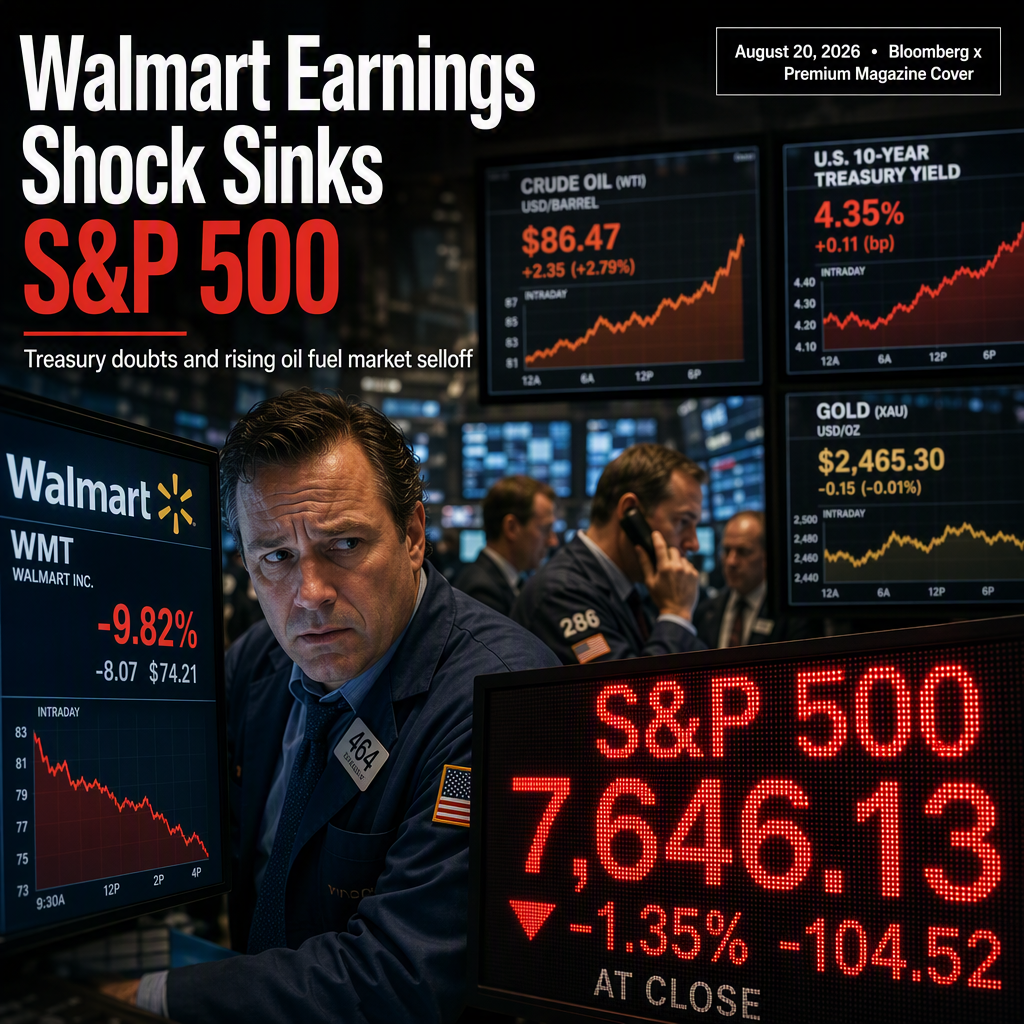
On August 20, 2026, the credibility of the U.S. Treasury's efforts to cap borrowing costs came under scrutiny as a bond rally faded, long-end yields climbed, and the S&P 500 experienced a notable decline. The S&P 500 index, which hovered near 7,720 overnight, dropped sharply after the U.S. market opened, ultimately closing near 7,646—a decline of approximately 0.87% for the day [1]. This downturn was largely attributed to Walmart, whose shares sank about 9.7% following its weakest U.S. comparable-sales growth in over six years and a subdued profit outlook, raising fresh concerns about the health of the U.S. consumer [1].
The market's risk appetite was further dampened by rising energy prices, as oil climbed back toward $88 per barrel on renewed tensions involving Iran. Meanwhile, gold prices remained steady, and bitcoin surpassed the $72,000 mark. The U.S. dollar finished mixed but was generally firmer against major currencies [1].
Key economic data released included U.S. Initial Jobless Claims at 206,000 (versus a 201,000 forecast), the Philadelphia Fed Manufacturing Index at 47.4 (well above the 25.0 forecast), and the CB U.S. Leading Index for July at 0.2% month-over-month (compared to a 0.1% forecast) [1]. Fed official Daly commented that current monetary policy is 'in a good place' and saw no urgent need for a preemptive rate move, emphasizing the Fed's focus on returning inflation to 2%. Daly also noted it was too early to assess the impact of the Treasury's changing debt-issuance strategy on Fed operations [1].
Market participants remained cautious, with some analysts, such as Bessent, downplaying the day's moves as 'noise' within a 24-hour window. However, the overall price action across equities, bonds, and commodities reflected a more cautious sentiment heading into the market close [1].
CONCLUSION
Walmart's disappointing earnings and outlook triggered a sharp selloff in its shares and weighed heavily on the S&P 500, amplifying concerns about U.S. consumer strength. Rising oil prices and uncertainty around Treasury policy further contributed to a risk-off tone in the markets. Investors are likely to remain cautious as they assess the implications of these developments for inflation and monetary policy.